. 2012;7(3):e33017.
doi: 10.1371/journal.pone.0033017. Epub 2012 Mar 22.

Subcellular localization of total and activated Src kinase in African American and Caucasian breast cancer

Affiliations

Subcellular localization of total and activated Src kinase in African American and Caucasian breast cancer

Muralidharan Anbalagan et al. PLoS One. 2012.

Abstract

Background: Src, a non-receptor tyrosine kinase is elevated in cancer with expression and activity correlated with cell proliferation, adhesion, survival, motility, metastasis and angiogenesis. There is limited data on Src expression and subcellular localization in breast cancer and no information about expression in racial/ethnic groups.

Methodology/principal findings: The present study evaluated Src expression, activity, and subcellular localization in triple negative breast cancer (TNBC) and ERα positive breast cancer (ER+BC), cancer tissue and adjacent normal epithelial ducts, and Caucasian and African American cases. 79 paraffin embedded breast carcinoma cases were obtained from Tulane University Hospital between 2007-2009. 39 cases represented TNBC (33-African Americans, 4-Caucasians, 2-unknowns) and 40 cases represented ER+BC (21-African Americans, 16-Caucasians, 3-unknowns). Immunohistochemistry was used to measure staining distribution and intensity of total Src and activated phospho-SrcY416 (p-Y416Src) in carcinoma tissue and adjacent normal mammary ducts. In TNBC and ER+BC, total Src was significantly higher in cancer compared to adjacent normal ducts (P<0.0001) in both cell membrane and cytoplasm. In membranes, p-Y416Src was elevated in cancer compared to normal ducts. Total Src in the tumor cytoplasm was significantly higher in TNBC compared to ER+BC (P = 0.0028); conversely, p-Y416Src in the tumor cell membranes was higher in TNBC compared to ER+BC (P = 0.0106). Comparison between African American (n = 21) and Caucasian ER+BC (n = 16) revealed no significant difference in expression and localization of total Src and p-Y416Src. TNBC cases positive for lymph node metastasis showed elevated membrane p-Y416Src compared to lymph node negative TNBC (P = 0.027).

Conclusion/significance: Total Src and p-Y416Src were expressed higher in cancer compared to adjacent normal ducts. Cytoplasmic total Src and membrane p-Y416Src were significantly higher in TNBC compared to ER+BC. TNBC cases with lymph node metastasis showed elevated membrane p-Y416Src. Taken together, Src was elevated in the membrane and cytoplasm of more aggressive TNBC.


Conflict of interest statement

Competing Interests: The authors have declared that no competing interests exist.

Figures

Figure 1
Figure 1. Src expression in breast cancer tissue and adjacent normal ducts of ER+BC and TNBC.
A) Comparison between total Src (t-Src) subcellular localization in cytoplasm (Cyto) and membrane (Mem) of normal ducts and cancer of ER+BC; B) Comparison between p-Y416Src (p-Src) expression in cytoplasm and membrane of normal ducts and cancer of ER+BC; C) Comparison between total Src expression in cytoplasm and membrane of normal ducts and cancer of TNBC; D) Comparison between p-Src expression in cytoplasm and membrane of normal ducts and cancer in TNBC. Statistical difference in the distribution of total and p-Y416Src kinase in normal ducts and cancer was analyzed by the Mann-Whitney U test, * P<0.05, **P<0.01, *** P<0.001. All error bars represent the SEM (standard error of mean). E) A representative photomicrograph from a TNBC case showing a weak cytoplasmic (1+) t-Src staining in normal ducts as indicated by a black arrow. F) A representative photomicrograph from a TNBC case showing a weak membrane (1+) t-Src staining in normal ducts as indicated by a red arrow (original magnification ×200). G) A representative photomicrograph from a TNBC case showing a weak cytoplasmic p-Src staining (1+) in normal ducts as indicated by a black arrow. F) A representative photomicrograph from a TNBC case showing a weak membrane (1+) p-Src staining in normal ducts as indicated by a red arrow (original magnification ×200) Scale bar, 50 µm. Insets are magnified images from selected areas (small squares) to show the membrane and cytoplasmic Src staining clearly.
Figure 2
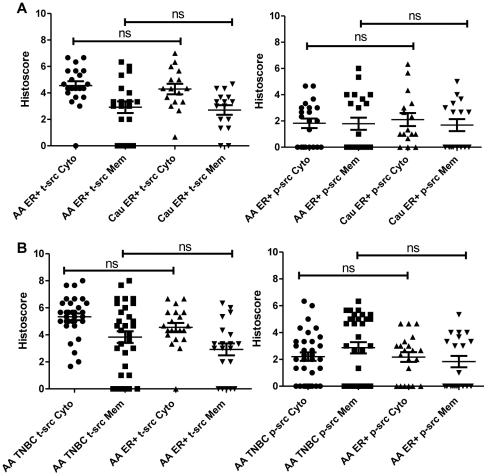
Figure 2. Src expression in African American and Caucasian breast cancer.
A) Comparison of total Src (t-src) subcellular localization in the cytoplasm (Cyto) and membrane (Mem) among African American (AA) and Caucasian (Cau) ER+BC cases. B) Comparisons of p-Y416Src (p-Src) localization (cytoplasmic/membrane) among African American (AA) and Caucasians in ER+BC. C) Comparison of total Src subcellular localization (cytoplasmic/membrane) among TNBC and ER+BC in African Americans. D) Comparisons of p-Src subcellular localization (cytoplasmic/membrane) among TNBC and ER+BC in African Americans. Statistical differences in the distribution of total and p-Src kinase were analyzed by the Mann-Whitney U test. ns - not significant. The graphs represent the mean histoscore ± SEM (standard error of mean).
Figure 3
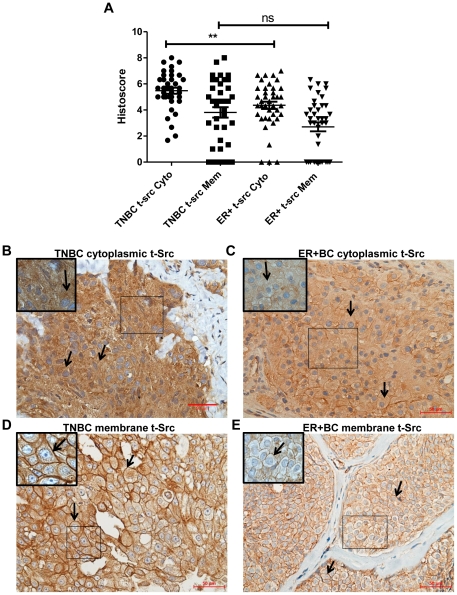
Figure 3. Evaluation of total Src expression in TNBC and ER+BC.
A) Comparison of subcellular localization in the cytoplasm (Cyto) and membrane (Mem) of total Src (t-src) in TNBC and ER+BC. B) Representative TNBC case showing strong cytoplasmic (3+) t-Src staining (shown by arrows) (original magnification ×200). C) Representative ER+BC case showing moderate cytoplasmic (2+) t-Src staining (shown by arrows) (original magnification ×200). D) Representative TNBC case showing strong membrane (3+) t-Src staining (shown by arrows) (original magnification ×200). E) Representative ER+BC case showing moderate membrane (2+) t-Src staining (shown by arrows) (original magnification ×200). Statistical differences in the distribution of t-Src in TNBC and ER+BC was analyzed by the Mann-Whitney U test, **P<0.01, ns - not significant. Scale bar, 50 µm. Insets are magnified images from selected areas (small squares) to show the membrane and cytoplasmic Src staining clearly.
Figure 4
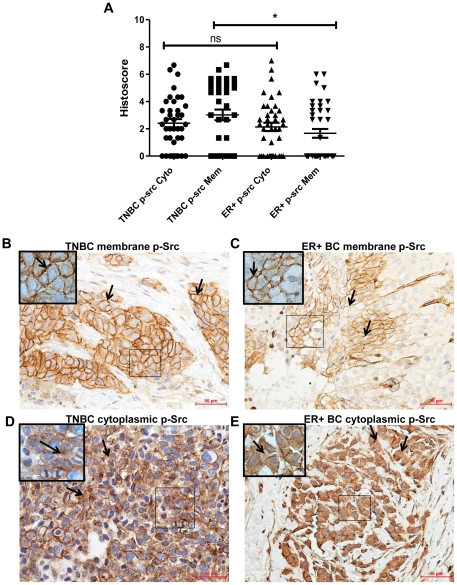
Figure 4. Evaluation of active Src expression in TNBC and ER+BC.
A) Comparison between subcellular localization in the cytoplasm (Cyto) and membrane (Mem) of p-Y416Src (p-Src) in TNBC and ER+BC. B) Representative TNBC case showing strong membrane (3+) p-Src staining (shown by arrows) (original magnification ×200). C) Representative ER+BC case showing moderate membrane (2+) p-Src staining (shown by arrows) (original magnification ×200). D) Representative TNBC case showing moderate cytoplasmic (2+) p-Src staining (shown by arrows) (original magnification ×200). E) Representative ER+BC case showing moderate cytoplasmic (2+) staining of p-Src (shown by arrows) (original magnification ×200). Statistical differences in the distribution of p-Src in TNBC and ER+BC was analyzed by the Mann-Whitney U test, * P<0.05. ns - not significant. Scale bar, 50 µm. Insets are magnified images from selected areas (small squares) to show the membrane and cytoplasmic Src staining clearly.

References

    1. Morris GJ, Naidu S, Topham AK, Guiles F, Xu Y, et al. Differences in breast carcinoma characteristics in newly diagnosed African-American and Caucasian patients: a single-institution compilation compared with the National Cancer Institute's Surveillance, Epidemiology, and End Results database. Cancer. 2007;110:876–884. - PubMed
    1. Stead LA, Lash TL, Sobieraj JE, Chi DD, Westrup JL, et al. Triple-negative breast cancers are increased in black women regardless of age or body mass index. Breast Cancer Res. 2009;11:R18. - PMC - PubMed
    1. Haffty BG, Yang Q, Reiss M, Kearney T, Higgins SA, et al. Locoregional relapse and distant metastasis in conservatively managed triple negative early-stage breast cancer. J Clin Oncol. 2006;24:5652–5657. - PubMed
    1. Dent R, Trudeau M, Pritchard KI, Hanna WM, Kahn HK, et al. Triple-negative breast cancer: clinical features and patterns of recurrence. Clin Cancer Res. 2007;13:4429–4434. - PubMed
    1. Pegram MD, Lipton A, Hayes DF, Weber BL, Baselga JM, et al. Phase II study of receptor-enhanced chemosensitivity using recombinant humanized anti-p185HER2/neu monoclonal antibody plus cisplatin in patients with HER2/neu-overexpressing metastatic breast cancer refractory to chemotherapy treatment. J Clin Oncol. 1998;16:2659–2671. - PubMed

Publication types