. 2012 Jun;53(6):1144-52.
doi: 10.1194/jlr.M024356. Epub 2012 Mar 29.

Tissue-specific knockouts of ACAT2 reveal that intestinal depletion is sufficient to prevent diet-induced cholesterol accumulation in the liver and blood

Affiliations

Tissue-specific knockouts of ACAT2 reveal that intestinal depletion is sufficient to prevent diet-induced cholesterol accumulation in the liver and blood

Jun Zhang et al. J Lipid Res. 2012 Jun.

Abstract

Acyl-CoA:cholesterol acyltransferase 2 (ACAT2) generates cholesterol esters (CE) for packaging into newly synthesized lipoproteins and thus is a major determinant of blood cholesterol levels. ACAT2 is expressed exclusively in the small intestine and liver, but the relative contributions of ACAT2 expression in these tissues to systemic cholesterol metabolism is unknown. We investigated whether CE derived from the intestine or liver would differentially affect hepatic and plasma cholesterol homeostasis. We generated liver-specific (ACAT2(L-/L-)) and intestine-specific (ACAT2(SI-/SI-)) ACAT2 knockout mice and studied dietary cholesterol-induced hepatic lipid accumulation and hypercholesterolemia. ACAT2(SI-/SI-) mice, in contrast to ACAT2(L-/L-) mice, had blunted cholesterol absorption. However, specific deletion of ACAT2 in the intestine generated essentially a phenocopy of the conditional knockout of ACAT2 in the liver, with reduced levels of plasma very low-density lipoprotein and hepatic CE, yet hepatic-free cholesterol does not build up after high cholesterol intake. ACAT2(L-/L-) and ACAT2(SI-/SI-) mice were equally protected from diet-induced hepatic CE accumulation and hypercholesterolemia. These results suggest that inhibition of intestinal or hepatic ACAT2 improves atherogenic hyperlipidemia and limits hepatic CE accumulation in mice and that depletion of intestinal ACAT2 is sufficient for most of the beneficial effects on cholesterol metabolism. Inhibitors of ACAT2 targeting either tissue likely would be beneficial for atheroprotection.


Figures
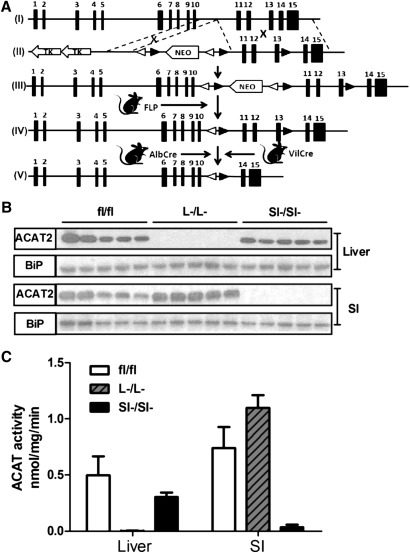
Fig.1.
Fig.1.
Conditional targeting of the ACAT2 allele allows for tissue-specific deletion. A: Targeting strategy of generating tissue-specific ACAT2 KO mice. (I) Wild-type allele, (II) targeting vector, (III) floxed allele showing hypomorphic phenotype, (IV) flippase (FLP) recombinase-mediated recombination of floxed allele, (V) knockout allele. NEO: neo cassette gene conferring neomycin selection marker; open triangle: FRT site (flippase recognition target); solid triangle: LoxP site. B: ACAT2 protein was measured by Western blot. A total of 25 μg (liver) or 15 μg (intestine) of microsomal proteins were loaded on each lane. Data represent five individual mice. Binding immunoglobulin protein (BiP) was probed as loading control. C: Microsomes from individual animals (n = 5) of each genotype shown in (B) were used to quantify the ACAT2 activity for liver or intestine.
Fig.2.
Fig.2.
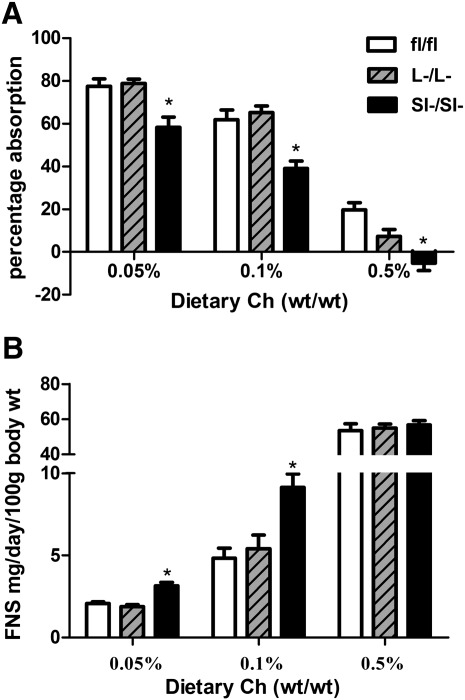
Intestine-specific, but not liver-specific, deletion of ACAT2 reduces cholesterol absorption. A: Fractional cholesterol absorption was measured by the dual fecal isotope method. B: Fecal neutral sterol loss was measured by GC. Data represent the mean ± SEM from 7 to 9 mice per group. *Significantly different from fl/fl control mice within each dietary group with P < 0.05.
Fig.3.
Fig.3.
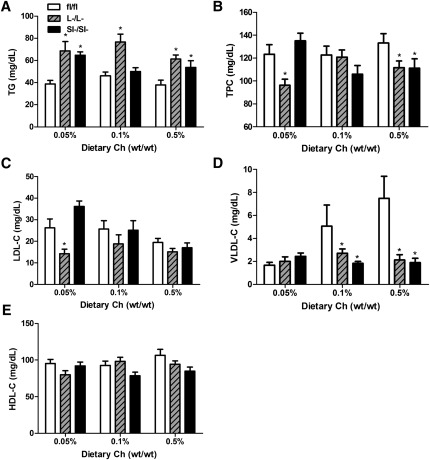
Tissue-specific deletion of ACAT2 alters plasma lipoprotein metabolism. Plasma TG (A), TPC (B), plasma LDL cholesterol (C), plasma VLDL cholesterol (D), and plasma HDL cholesterol (E). Each bar represents the average results of 7 to 8 animals. *Significantly different from fl/fl control mice within each dietary group with P < 0.05.
Fig.4.
Fig.4.
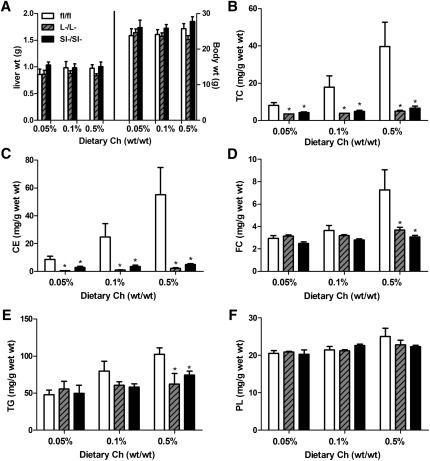
Tissue-specific deletion of ACAT2 inhibits diet-induced cholesterol ester accumulation in the liver. A: Liver weight and body weight at necropsy. B: Hepatic total cholesterol (TC). C: cholesterol ester (CE). D: Free cholesterol (FC). E: Triglycerides (TG). G: Phospholipids (PL). Data represent the mean ± SEM from five mice per group. *Significantly different from fl/fl control mice within each dietary group with P < 0.05.
Fig.5.
Fig.5.
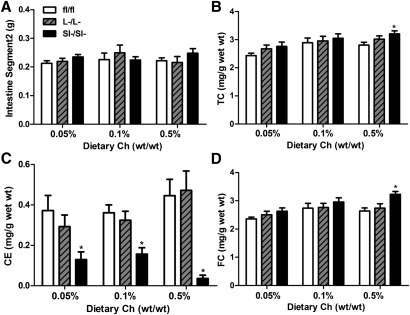
Knockout of intestinal ACAT2 reduces cholesterol ester accumulation in the enterocytes of the intestine. A: Weight of intestine segment 2. B: Intestinal TC. C: Intestinal CE. D: Intestinal FC. Data represent the mean ± SEM from five mice per group. *Significantly different from fl/fl control mice within each dietary group (P < 0.05).
Fig.6.
Fig.6.
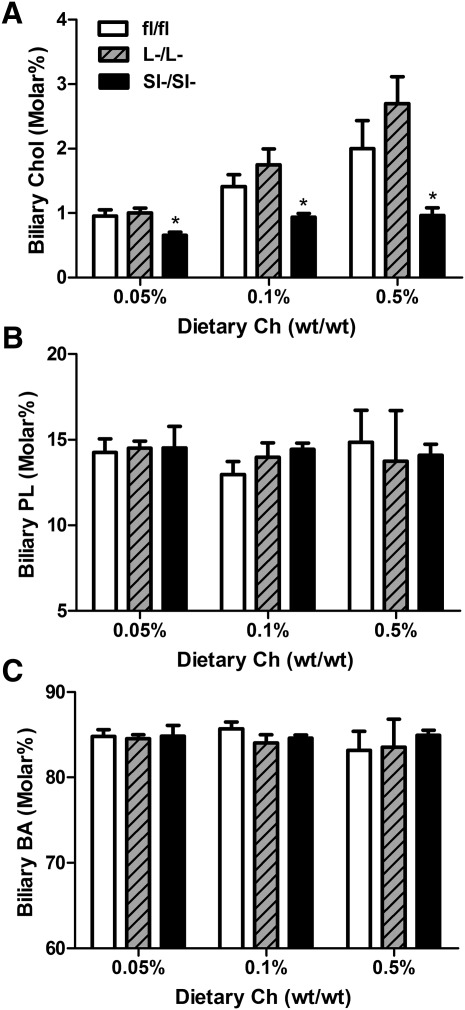
Intestine-specific, but not liver-specific, deletion of ACAT2 reduces biliary cholesterol levels. Biliary cholesterol (A), biliary phospholipids (PL) (B), and biliary bile acids (BA) (C) were quantified in gall bladder bile samples. All values are expressed as percentage molar of total lipids (cholesterol, PL, and BA). Data represent the mean ± SEM from 6 to 8 mice per group. *Significantly different from fl/fl control mice within each dietary group (P < 0.05).

References

    1. Joyce C., Skinner K., Anderson R. A., Rudel L. L. 1999. Acyl-coenzyme A:cholesteryl acyltransferase 2. Curr. Opin. Lipidol. 10: 89–95 - PubMed
    1. Degirolamo C., Shelness G. S., Rudel L. L. 2009. LDL cholesteryl oleate as a predictor for atherosclerosis: evidence from human and animal studies on dietary fat. J. Lipid Res. 50(Suppl): S434–S439 - PMC - PubMed
    1. Lee R. G., Kelley K. L., Sawyer J. K., Farese R. V., Jr, Parks J. S., Rudel L. L. 2004. Plasma cholesteryl esters provided by lecithin:cholesterol acyltransferase and acyl-coenzyme a:cholesterol acyltransferase 2 have opposite atherosclerotic potential. Circ. Res. 95: 998–1004 - PubMed
    1. Willner E. L., Tow B., Buhman K. K., Wilson M., Sanan D. A., Rudel L. L., Farese R. V., Jr 2003. Deficiency of acyl CoA:cholesterol acyltransferase 2 prevents atherosclerosis in apolipoprotein E-deficient mice. Proc. Natl. Acad. Sci. USA. 100: 1262–1267 - PMC - PubMed
    1. Bell T. A., 3rd, Brown J. M., Graham M. J., Lemonidis K. M., Crooke R. M., Rudel L. L. 2006. Liver-specific inhibition of acyl-coenzyme a:cholesterol acyltransferase 2 with antisense oligonucleotides limits atherosclerosis development in apolipoprotein B100-only low-density lipoprotein receptor−/− mice. Arterioscler. Thromb. Vasc. Biol. 26: 1814–1820 - PubMed

Publication types

MeSH terms