


Comment
doi: 10.1038/ki.2011.495.
A possible mechanism of renal cell death after ischemia/reperfusion
Affiliations
- PMID: 22460652
- PMCID: PMC3324283
- DOI: 10.1038/ki.2011.495
Item in Clipboard
Comment
A possible mechanism of renal cell death after ischemia/reperfusion
Kidney Int.
2012 Apr.
Abstract
Linkermann et al. provide the first evidence for a possible biochemical mechanism of necrotic kidney cell death associated with renal ischemia/reperfusion-induced acute kidney injury. The mechanisms of several pathways resulting in programmed necrosis were recently elucidated and rely on receptor-interacting protein kinases 1 and 3. Using an inhibitor of one of these kinases, Linkermann et al. were able to ameliorate functional and morphologic kidney damage after ischemia/reperfusion.
Figures
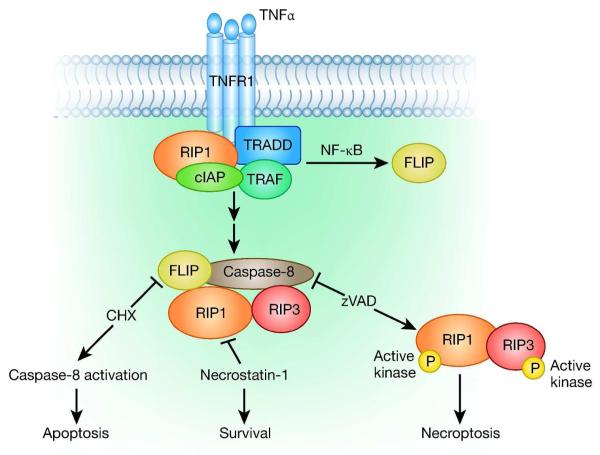
Binding of the TNFα ligand to its receptor, TNFR1, leads to recruitment of TNF receptor-associated death domain (TRADD). These proteins associate with other cytoplasmic proteins, including RIP1, TNF receptor-associated factors (TRAFs), and cellular inhibitor of apoptosis proteins (cIAPs) to form Complex 1. Complex 1 can also activate NF-κB and thereby transcription of FLICE-like inhibitory protein long (FLIP). Several steps later, the RIP1-associated complex can functionally interact with RIP3 and caspase-8, forming Complex 2. With high levels of FLIP, the complex does not result in RIP3 signaling and cell death is averted. Without FLIP, as with cycloheximide (CHX) addition, caspase-8 activation predominates and apoptosis results. When caspase-8 is inhibited, as with zVAD addition, RIP3 kinase is activated, resulting in programmed necrosis, or necroptosis. Necrostatin-1 blocks the kinase activity of RIP1, which is necessary for both apoptotic and necrotic pathways directed by Complex 2. Not shown here, in a similar death receptor mediated pathway, ligand binding to CD95/Fas induces a conformational change in the receptor, which promotes the assembly of a complex with Fas-associated death domain (FADD) and caspase-8. Similarly to the TNF pathway, FLIP can prevent caspase-8 apoptosis and cycloheximide addition can promote cell death.
Comment on
-
Rip1 (receptor-interacting protein kinase 1) mediates necroptosis and contributes to renal ischemia/reperfusion injury.Kidney Int. 2012 Apr;81(8):751-61. doi: 10.1038/ki.2011.450. Epub 2012 Jan 11. Kidney Int. 2012. PMID: 22237751
References
-
- Pabla N, Dong Z. Cisplatin nephrotoxicity: mechanisms and renoprotective strategies. Kidney Int. 2008;73:994–1007. - PubMed
-
- Green DR. Means to an end: Apoptosis and other cell death mechanisms. Cold Spring Harbor Press; Cold Spring Harbor, NY: 2010.
-
- Zong W-X, Thompson CB. Necrotic death as a cell fate. Genes & Dev. 2006;20:1–15. - PubMed
-
- Golstein P, Kroemer G. Cell death by necrosis: toward a molecular definition. Trends Biochem Sci. 2006;32:37–43. - PubMed
Publication types
MeSH terms
Substances
Grants and funding
LinkOut - more resources
Full Text Sources
