. 2012 Apr 17;109(16):6030-5.
doi: 10.1073/pnas.1203028109. Epub 2012 Mar 29.

TLS/FUS (translocated in liposarcoma/fused in sarcoma) regulates target gene transcription via single-stranded DNA response elements

Affiliations

TLS/FUS (translocated in liposarcoma/fused in sarcoma) regulates target gene transcription via single-stranded DNA response elements

Adelene Y Tan et al. Proc Natl Acad Sci U S A. .

Abstract

TLS/FUS (TLS) is a multifunctional protein implicated in a wide range of cellular processes, including transcription and mRNA processing, as well as in both cancer and neurological disease. However, little is currently known about TLS target genes and how they are recognized. Here, we used ChIP and promoter microarrays to identify genes potentially regulated by TLS. Among these genes, we detected a number that correlate with previously known functions of TLS, and confirmed TLS occupancy at several of them by ChIP. We also detected changes in mRNA levels of these target genes in cells where TLS levels were altered, indicative of both activation and repression. Next, we used data from the microarray and computational methods to determine whether specific sequences were enriched in DNA fragments bound by TLS. This analysis suggested the existence of TLS response elements, and we show that purified TLS indeed binds these sequences with specificity in vitro. Remarkably, however, TLS binds only single-strand versions of the sequences. Taken together, our results indicate that TLS regulates expression of specific target genes, likely via recognition of specific single-stranded DNA sequences located within their promoter regions.


Conflict of interest statement

The authors declare no conflict of interest.

Figures
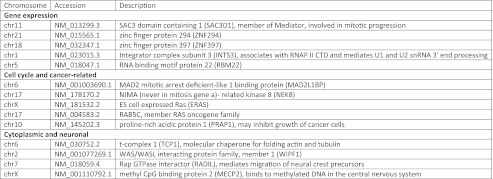
Fig. 1.
Fig. 1.
TLS microarray candidate genes. TLS was enriched (P < 0.01) at the promoter of genes involved in gene expression; cell cycle and cancer,; cytoplasmic; and neuronal proteins. Accession information and a brief description are given for each target.
Fig. 2.
Fig. 2.
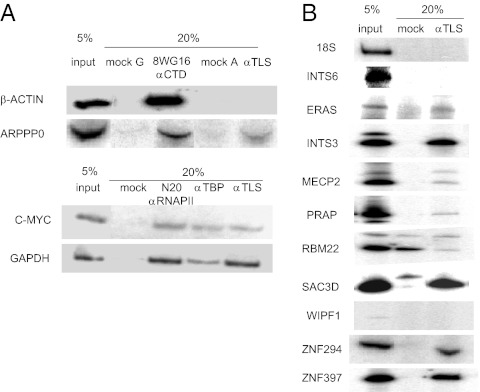
Confirmation of TLS target genes by ChIP. (A) ChIP assays were performed using antibodies to RNAP II, TBP, TLS, or mock (no antibody). DNA fragments were amplified by PCR. (B) ChIP assays were performed using antibodies against TLS or mock (no antibody). DNA fragments were then amplified using primers specific to the genes indicated on the left.
Fig. 3.
Fig. 3.
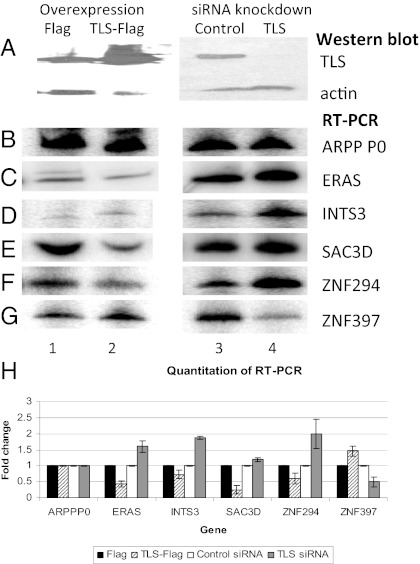
Levels of TLS protein affect target gene expression. HeLa cells were transfected with plasmids encoding Flag or TLS-Flag, or with siRNA targeting luciferase (control) or TLS. (A) TLS and actin protein levels were analyzed by Western blot. (B–G) Reverse transcription using random hexamer primers followed by PCR analysis of the genes indicated on the right. (H) Graph of quantified mRNA amounts. At least three replicates of each experiment were quantified. Error bars depict SD.
Fig. 4.
Fig. 4.
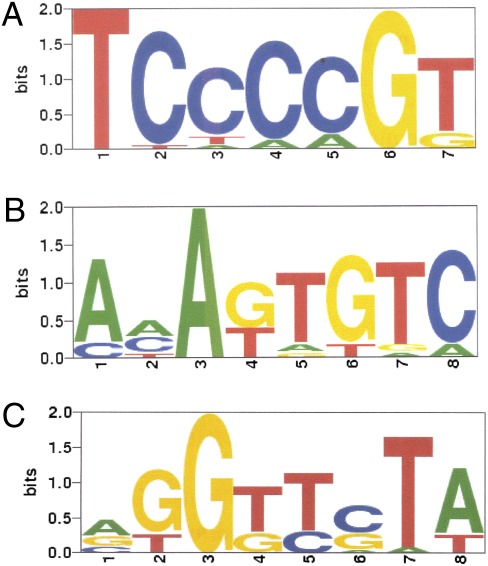
TLS-binding motifs modeled as PSAMs determined by MatrixREDUCE. (A) The first PSAM that best explains the variance in the normalized ChIP enrichment (MAT) scores using only the forward strand (R2 0.17, P value 2.54e-42). The height of each letter is proportional to its corresponding nucleotide's relative affinity at each position, and the letters are sorted in descending frequency order. The height of the entire stack at each position is then adjusted to signify the information content (in bits) of that position. (B) The second PSAM that best explains the variance in the residuals from the fit with the first PSAM, again using only the forward strand (R2 0.18, P value 2.2e-45). (C) The third PSAM that best explains the variance in the residuals from the fits with the first and second PSAMs, using both strands (R2 0.08, P value 3.4e-20).
Fig. 5.
Fig. 5.
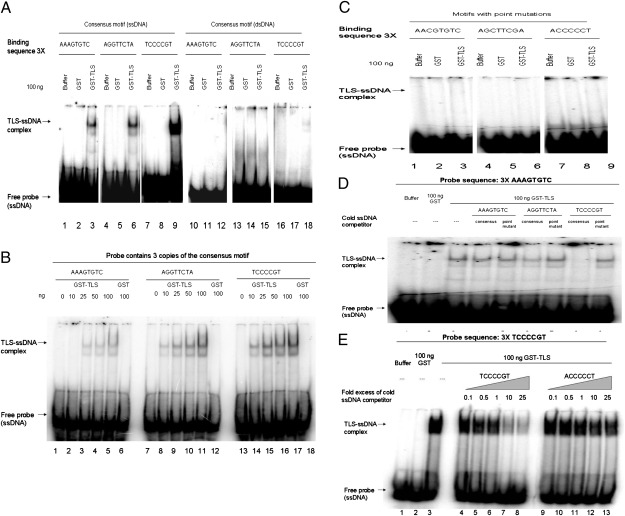
TLS binds to single-strand recognition motifs. (A) GST or GST-TLS was added to 32P-labeled ssDNA or dsDNA containing three tandem repeats of TLS motifs. (B) GST or increasing amounts (0–100 ng) of GST-TLS was added to 32P ssDNA containing three tandem repeats of TLS motifs. (C) GST or GST-TLS was added to 32P ssDNA encoding three tandem repeats of a mutated TLS motif. (D) GST and GST-TLS was added to 32P ssDNA containing three copies of AAAGTGTC. Cold competitor ssDNA containing three copies of consensus or mutated TLS-binding motifs was added as indicated. (E) GST or GST-TLS was added to 32P ssDNA containing three copies of TCCCCGT. Increasing amounts of cold competitor ssDNA was added as indicated. In all cases, complexes were resolved by native PAGE.

References

    1. Bentley DL. Rules of engagement: Co-transcriptional recruitment of pre-mRNA processing factors. Curr Opin Cell Biol. 2005;17:251–256. - PubMed
    1. Crozat A, Aman P, Mandahl N, Ron D. Fusion of CHOP to a novel RNA-binding protein in human myxoid liposarcoma. Nature. 1993;363:640–644. - PubMed
    1. Kwiatkowski TJ, Jr, et al. Mutations in the FUS/TLS gene on chromosome 16 cause familial amyotrophic lateral sclerosis. Science. 2009;323:1205–1208. - PubMed
    1. Vance C, et al. Mutations in FUS, an RNA processing protein, cause familial amyotrophic lateral sclerosis type 6. Science. 2009;323:1208–1211. - PMC - PubMed
    1. Tan AY, Manley JL. The TET family of proteins: Functions and roles in disease. J Mol Cell Biol. 2009;1:82–92. - PMC - PubMed

Publication types

MeSH terms

Substances

LinkOut - more resources