. 2012 May;61(5):1043-50.
doi: 10.2337/db11-1142. Epub 2012 Mar 28.

Hypothalamic neuropeptide Y (NPY) controls hepatic VLDL-triglyceride secretion in rats via the sympathetic nervous system

Affiliations

Hypothalamic neuropeptide Y (NPY) controls hepatic VLDL-triglyceride secretion in rats via the sympathetic nervous system

Eveline Bruinstroop et al. Diabetes. 2012 May.

Abstract

Excessive secretion of triglyceride-rich very low-density lipoproteins (VLDL-TG) contributes to diabetic dyslipidemia. Earlier studies have indicated a possible role for the hypothalamus and autonomic nervous system in the regulation of VLDL-TG. In the current study, we investigated whether the autonomic nervous system and hypothalamic neuropeptide Y (NPY) release during fasting regulates hepatic VLDL-TG secretion. We report that, in fasted rats, an intact hypothalamic arcuate nucleus and hepatic sympathetic innervation are necessary to maintain VLDL-TG secretion. Furthermore, the hepatic sympathetic innervation is necessary to mediate the stimulatory effect of intracerebroventricular administration of NPY on VLDL-TG secretion. Since the intracerebroventricular administration of NPY increases VLDL-TG secretion by the liver without affecting lipolysis, its effect on lipid metabolism appears to be selective to the liver. Together, our findings indicate that the increased release of NPY during fasting stimulates the sympathetic nervous system to maintain VLDL-TG secretion at a postprandial level.


Figures
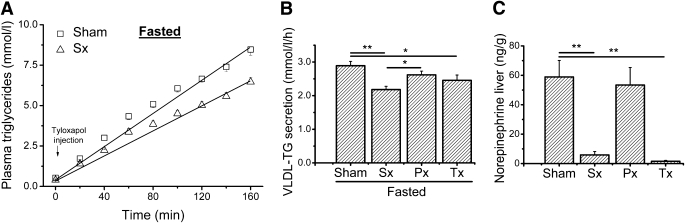
FIG. 1.
FIG. 1.
Sympathetic denervation decreases VLDL-TG secretion in the fasted state. A: Plasma triglyceride levels after intravenous tyloxapol injection in sham and Sx liver-denervated rats. B: Calculated VLDL-TG secretion in sham, Sx, Px, or Tx liver-denervated rats during fasting (one-way ANOVA P = 0.003). C: Norepinephrine values in the liver (one-way ANOVA P < 0.001). Values are means ± SEM of six to nine rats per group. *P < 0.05, **P < 0.01.
FIG. 2.
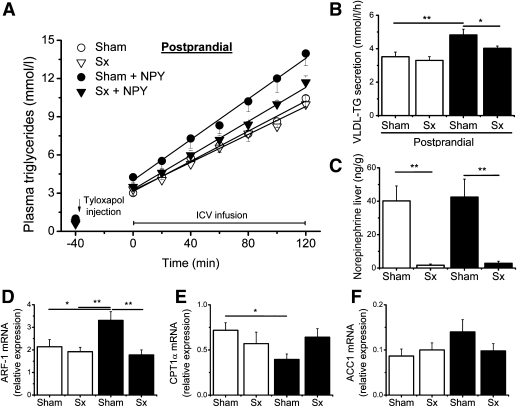
FIG. 2.
Hepatic Sx prevents the stimulatory effect of the intracerebroventricular (ICV) administration of NPY on VLDL-TG secrection compared with hepatic sham-denervated animals. A: Plasma triglyceride levels after tyloxapol injection and intracerebroventricular infusion of NPY (1 μg/μL) in sham and Sx liver-denervated rats compared with intracerebroventricular vehicle infusion in sham and Sx liver-denervated rats. B: Calculated VLDL-TG secretion rates in the sham and Sx groups after intracerebroventricular infusion of vehicle (□) or NPY (■) (two-way ANOVA NPY P = 0.001). C: Liver norepinephrine levels in the different groups (two-way ANOVA Denervation P < 0.001). D–F: Relative gene expression in the liver is shown for ARF-1 (two-way ANOVA NPY × Denervation P = 0.046), CPT1α (two-way ANOVA NPY × Denervation P = 0.046), and ACC1 (two-way ANOVA NPY × Denervation P = 0.216). Values are means ± SEM of seven to nine rats per group. *P < 0.05, **P < 0.01.
FIG. 3.
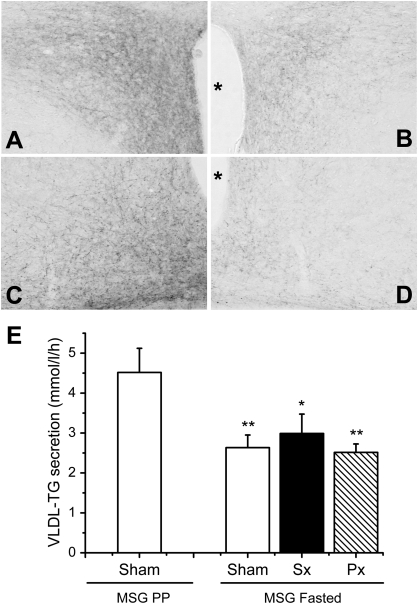
FIG. 3.
MSG rats cannot maintain VLDL-TG secretion during fasting. A–D: MSG treatment resulted in decreased NPY immunoreactivity in the PVN (B) and ARC (D) compared with saline-administered rats (A and C). The asterisk indicates the third ventricle. E: Calculated VLDL-TG secretion in PP and fasted sham, Sx, and Px liver-denervated MSG rats (one-way ANOVA P = 0.008). Values are means ± SEM of six to eight rats per group. *P < 0.05, **P < 0.01 compared with the PP sham MSG group.
FIG. 4.
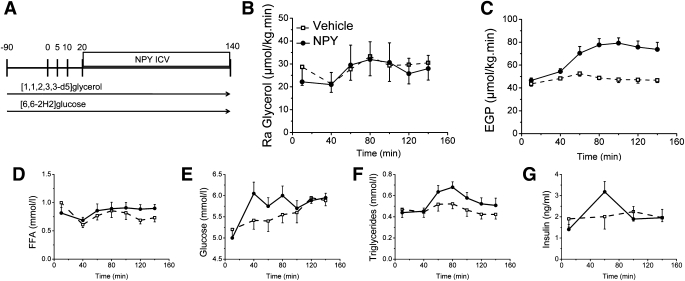
FIG. 4.
Intracerebroventricular NPY does not affect lipolysis. A: Experimental protocol of the double stable isotope study to measure lipolysis and EGP during NPY or vehicle intracerebroventricular treatment. B–G: Acute effect of intracerebroventricular NPY or vehicle on rate of appearance (Ra) of glycerol (Time × Treatment P = 0.90), EGP (Time × Treatment P < 0.01), plasma FFA (Time × Treatment P = 0.10), plasma glucose (Time × Treatment P = 0.06), plasma triglycerides (Time × Treatment P = 0.10), and plasma insulin (Time × Treatment P = 0.12) concentrations. Values are means ± SEM of six to seven rats per group.

Comment in

References

    1. Sørensen LP, Andersen IR, Søndergaard E, et al. Basal and insulin mediated VLDL-triglyceride kinetics in type 2 diabetic men. Diabetes 2011;60:88–96 - PMC - PubMed
    1. Licht CM, Vreeburg SA, van Reedt Dortland AK, et al. Increased sympathetic and decreased parasympathetic activity rather than changes in hypothalamic-pituitary-adrenal axis activity is associated with metabolic abnormalities. J Clin Endocrinol Metab 2010;95:2458–2466 - PubMed
    1. Gibbons GF. Assembly and secretion of hepatic very-low-density lipoprotein. Biochem J 1990;268:1–13 - PMC - PubMed
    1. Chirieac DV, Chirieac LR, Corsetti JP, Cianci J, Sparks CE, Sparks JD. Glucose-stimulated insulin secretion suppresses hepatic triglyceride-rich lipoprotein and apoB production. Am J Physiol Endocrinol Metab 2000;279:E1003–E1011 - PubMed
    1. Stafford JM, Yu F, Printz R, Hasty AH, Swift LL, Niswender KD. Central nervous system neuropeptide Y signaling modulates VLDL triglyceride secretion. Diabetes 2008;57:1482–1490 - PMC - PubMed

Publication types