Review
. 2013 Jan;6(1):17-26.
doi: 10.1111/j.1751-7915.2012.00342.x. Epub 2012 Mar 29.

Evolution of Bacillus thuringiensis Cry toxins insecticidal activity

Affiliations
Review

Evolution of Bacillus thuringiensis Cry toxins insecticidal activity

Alejandra Bravo et al. Microb Biotechnol. 2013 Jan.

Abstract

Insecticidal Cry proteins produced by Bacillus thuringiensis are use worldwide in transgenic crops for efficient pest control. Among the family of Cry toxins, the three domain Cry family is the better characterized regarding their natural evolution leading to a large number of Cry proteins with similar structure, mode of action but different insect specificity. Also, this group is the better characterized regarding the study of their mode of action and the molecular basis of insect specificity. In this review we discuss how Cry toxins have evolved insect specificity in nature and analyse several cases of improvement of Cry toxin action by genetic engineering, some of these examples are currently used in transgenic crops. We believe that the success in the improvement of insecticidal activity by genetic evolution of Cry toxins will depend on the knowledge of the rate-limiting steps of Cry toxicity in different insect pests, the mapping of the specificity binding regions in the Cry toxins, as well as the improvement of mutagenesis strategies and selection procedures.


Figures

Fig. 1
Fig. 1
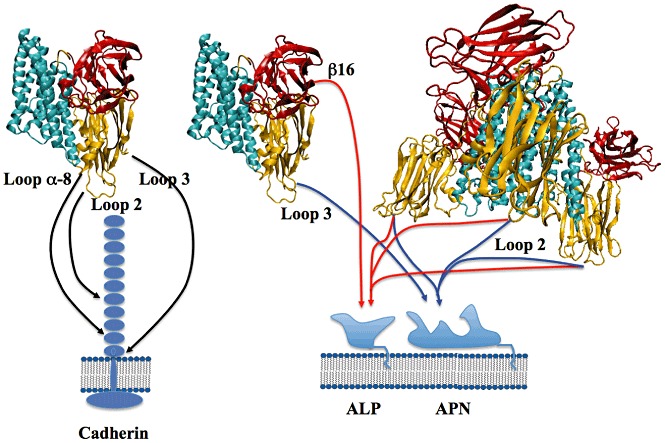
Binding regions of monomeric and oligomeric forms mapped in Cry1Ab toxin to Manduca sexta receptors, cadherin, alkaline phosphatase (ALP), and aminopeptidase-N (APN). The monomeric form depicted corresponds to the three-dimensional structure of Cry1Aa (pdb 1CIY) and the oligomeric structure corresponds to Cry4Ba trimeric structure (pdb 1W99).
Fig. 2
Fig. 2
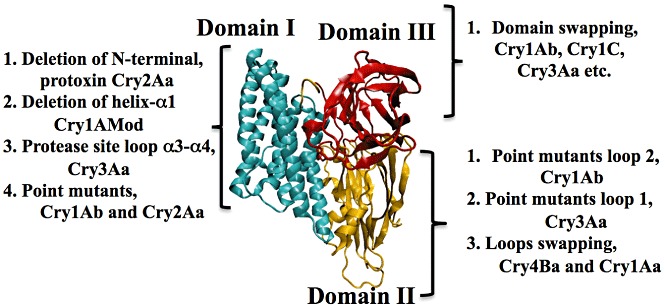
Representation of Cry toxin regions where mutations enhanced insecticidal activity in different Cry toxins. The three-dimensional structure of Cry1Aa toxin (pdb 1CIY) is depicted.
Fig. 3
Fig. 3
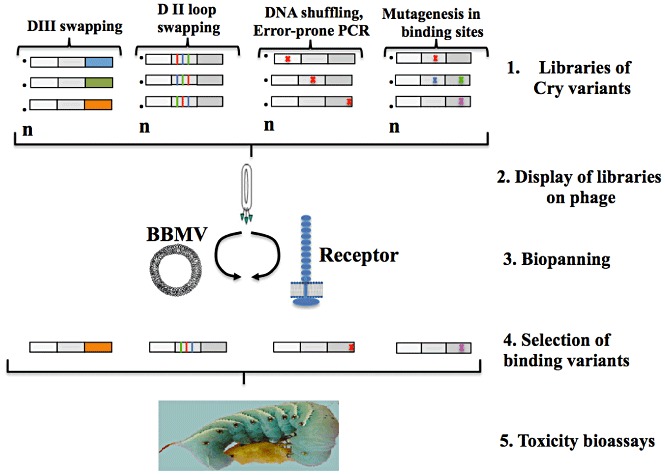
General strategy for in vitro evolution of toxicity of Cry toxins. Five steps are proposed for in vitro evolution of Cry toxins, 1. Construction of gene libraries with Cry variants obtained by different mutagenesis strategies (prone PCR, gene shuffling, domain III swapping, domain II loop 2 swapping and mutagenesis of receptor binding regions); 2. Display of gene libraries on phage; 3. Biopanning of phage display libraries using brush border membrane vesicles of insect of interest or purified receptors (cadherin is shown as example); 4. Selection of variants with improved binding characteristics; 5. Toxicity assays against the target insect to select Cry toxins with improved insecticidal activity.

References

    1. Abdullah MA, Alzate O, Mohammad M, McNall RJ, Adang MJ, Dean DH. Introduction of Culex toxicity into Bacillus thuringiensis Cry4Ba by protein engineering. Appl Environ Microbiol. 2003;69:5343–5353. - PMC - PubMed
    1. Alzate O, Osorio C, Florez AM, Dean DH. Participation of valine 171 in alpha-Helix 5 of Bacillus thuringiensis Cry1Ab delta-endotoxin in translocation of toxin into Lymantria dispar midgut membranes. Appl Environ Microbiol. 2010;76:7878–7880. - PMC - PubMed
    1. Arenas I, Bravo A, Soberon M, Gomez I. Role of alkaline phosphatase from Manduca sexta in the mechanism of action of Bacillus thuringiensis Cry1Ab toxin. J Biol Chem. 2010;285:12497–12503. - PMC - PubMed
    1. Atsumi S, Mizuno E, Hara H, Nakanishi K, Kitami M, Miura N, et al. Location of the Bombyx mori aminopeptidase N type I binding site on Bacillus thuringiensis Cry1Aa toxin. Appl Environ Microbiol. 2005;71:3966–3977. - PMC - PubMed
    1. Azzazy HME, Highsmith JWE. Phage display technology: clinical applications and recent innovations. Clin Biochem. 2002;35:425–445. - PubMed

MeSH terms

LinkOut - more resources