


Marijuana use trajectories during the post-college transition: health outcomes in young adulthood
- PMID: 22464050
- PMCID: PMC3390463
- DOI: 10.1016/j.drugalcdep.2012.02.022
Marijuana use trajectories during the post-college transition: health outcomes in young adulthood
Abstract
Background: Despite the relatively high prevalence of marijuana use among college students, little information exists regarding health outcomes associated with different use patterns or trajectories.
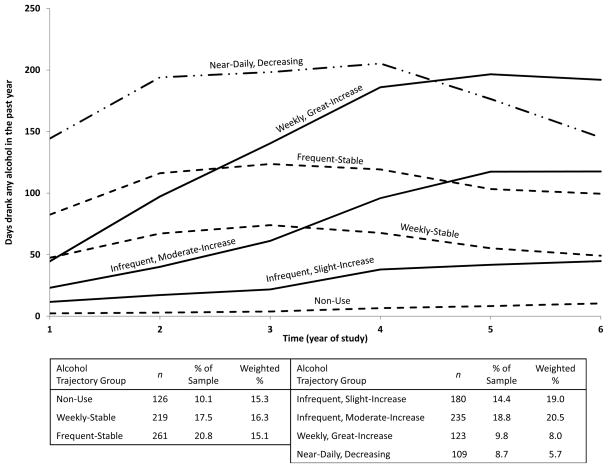
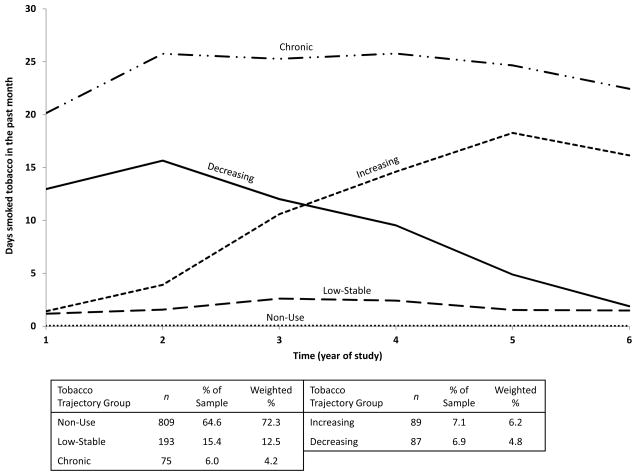
Methods: Seven annual personal interviews (years 1-7) were administered to 1253 individuals, beginning in their first year in college. Growth mixture modeling was used to identify trajectories of marijuana, alcohol, and tobacco use frequency during years 1-6. Logistic regression was used to evaluate the relationship between marijuana use trajectories and several year 7 health outcomes, holding constant year 1 health, demographics, and alcohol and tobacco use trajectories.
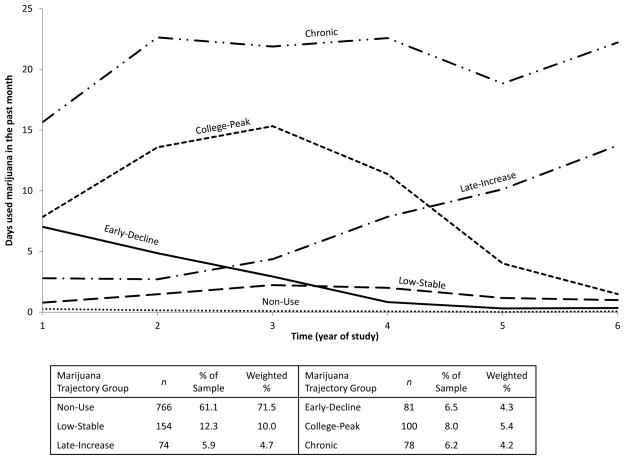
Results: Six marijuana use trajectories were identified: non-use (71.5% (wt) of students), low-stable (10.0% (wt)), late-increase (4.7% (wt)), early-decline (4.3% (wt)), college-peak (5.4% (wt)), and chronic (4.2% (wt)). The six marijuana trajectory groups were not significantly different on year 1 health-related variables, but differed on all ten year 7 health outcomes tested, including functional impairment due to injury, illness, or emotional problems; general health rating; psychiatric symptoms; health-related quality of life; and service utilization for physical and mental health problems. Non-users fared significantly better than most of the marijuana-using trajectory groups on every outcome tested. Chronic and late-increase users had the worst health outcomes.
Conclusions: Marijuana use patterns change considerably during college and the post-college period. Marijuana-using students appear to be at risk for adverse health outcomes, especially if they increase or sustain a frequent pattern of use.
Copyright © 2012 Elsevier Ireland Ltd. All rights reserved.
Figures
References
-
- American Psychiatric Association. Diagnostic and Statistical Manual of Mental Disorders: DSM-IV. American Psychiatric Press; Washington, DC: 1994.
-
- Beck AT, Rush AJ, Shaw BF, Emery G. Cognitive therapy of depression. Australian And New Zealand Journal Of Psychiatry. 1979;36:272–275. - PubMed
-
- Beck AT, Steer RA. Beck Anxiety Inventory: Manual. The Psychological Corporation, Harcourt Brace Jovanovich, Inc; San Antonio, TX: 1990.
Publication types
MeSH terms
Grants and funding
LinkOut - more resources
Full Text Sources
Medical
