


Coenzyme Q10 levels are low and associated with increased mortality in post-cardiac arrest patients
- PMID: 22465806
- PMCID: PMC3658101
- DOI: 10.1016/j.resuscitation.2012.03.023
Coenzyme Q10 levels are low and associated with increased mortality in post-cardiac arrest patients
Abstract
Aim: Survival after cardiac arrest (CA) is limited by the profound neurologic insult from ischemia-reperfusion injury. Therapeutic options are limited. Previous data suggest a benefit of coenzyme Q(10) (CoQ(10)) in post-arrest patients. We hypothesized that plasma CoQ(10) levels would be low after CA and associated with poorer outcomes.
Methods: Prospective observational study of post-arrest patients presenting to a tertiary care center. CoQ(10) levels were drawn 24h after return of spontaneous circulation (ROSC) and compared to healthy controls. Levels of inflammatory cytokines and biomarkers were analyzed. Primary endpoints were survival to discharge and neurologic status at time of discharge.
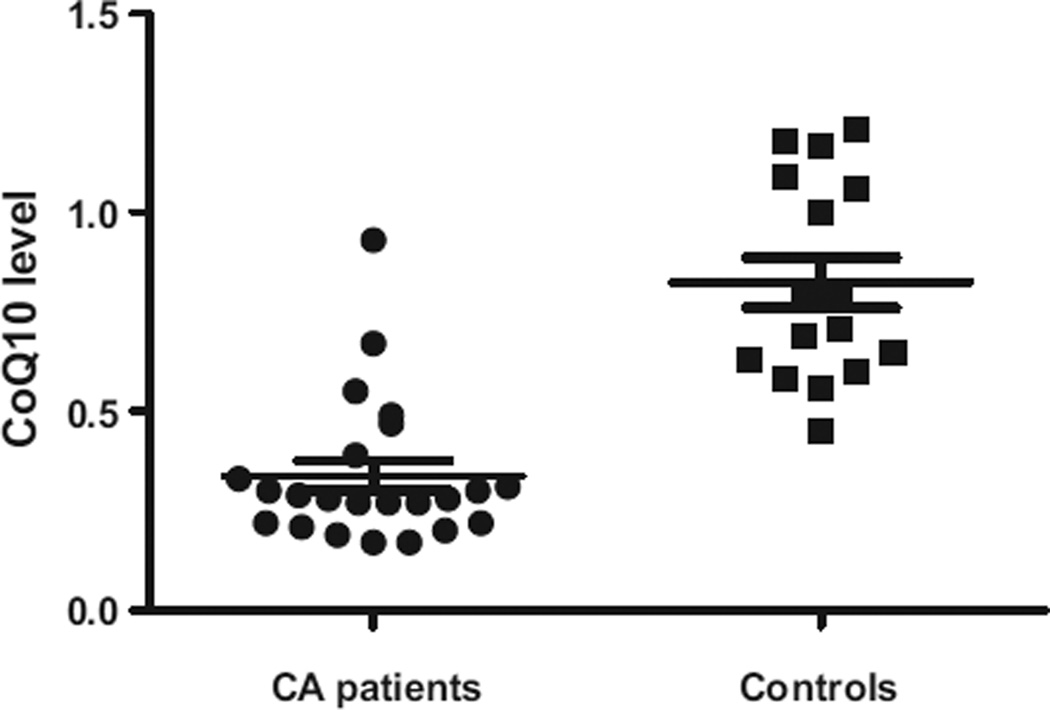
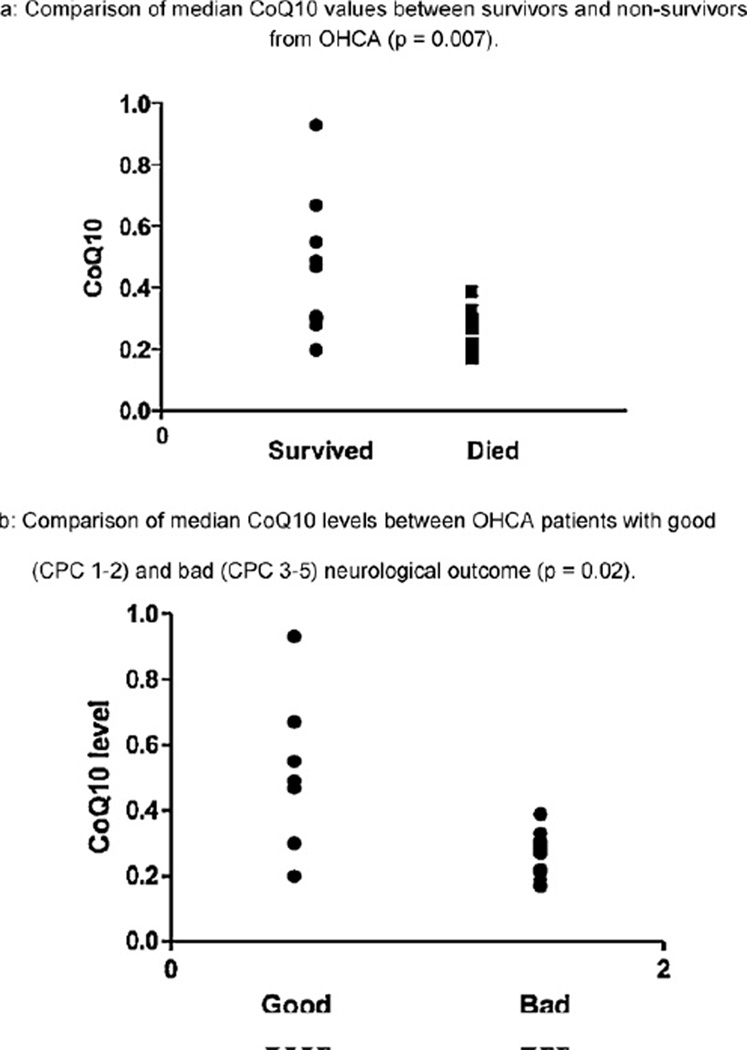
Results: 23 CA subjects and 16 healthy controls were enrolled. CoQ(10) levels in CA patients (0.28 μmol L(-1), inter-quartile range (IQR): 0.22-0.39) were significantly lower than in controls (0.75 μmol L(-1), IQR: 0.61-1.08, p<0.0001). The mean CoQ(10) level in CA patients who died was significantly lower than in those who survived (0.27 vs 0.47 μmol L(-1), p = 0.007). There was a significant difference in median CoQ(10) level between patients with a good vs poor neurological outcome (0.49 μmol L(-1), IQR: 0.30-0.67 vs 0.27 μmol L(-1), IQR: 0.21-0.30, p = 0.02). CoQ(10) was a statistically significant predictor of poor neurologic outcome (adjusted p = 0.02) and in-hospital mortality (adjusted p = 0.026).
Conclusion: CoQ(10) levels are low in human subjects with ROSC after cardiac arrest as compared to healthy controls. CoQ(10) levels were lower in those who died, as well as in those with a poor neurologic outcome.
Copyright © 2012 Elsevier Ireland Ltd. All rights reserved.
Conflict of interest statement
None of the authors declare any conflict of interests.
Figures
Comment in
-
Ubiquinone in cardiac arrest: from bathroom to bedside.Resuscitation. 2012 Aug;83(8):928-9. doi: 10.1016/j.resuscitation.2012.05.012. Epub 2012 May 26. Resuscitation. 2012. PMID: 22640977 No abstract available.
References
-
- Zheng ZJ, Croft JB, Giles WH, Mensah GA. Sudden cardiac death in the United States, 1989 to 1998. Circulation. 2001;104:2158–2163. - PubMed
-
- Young GB. Clinical practice. Neurologic prognosis after cardiac arrest. N Engl J Med. 2009;361:605–611. - PubMed
-
- Bernard SA, Gray TW, Buist MD, et al. Treatment of comatose survivors of out-of-hospital cardiac arrest with induced hypothermia. N Engl J Med. 2002;346:557–563. - PubMed
-
- Mild therapeutic hypothermia to improve the neurologic outcome after cardiac arrest. N Engl J Med. 2002;346:549–556. - PubMed
-
- Honda HM, Korge P, Weiss JN. Mitochondria and ischemia/reperfusion injury. Ann NY Acad Sci. 2005;1047:248–258. - PubMed
Publication types
MeSH terms
Substances
Grants and funding
LinkOut - more resources
Full Text Sources
Medical
