


Different effects of age, adiposity and physical activity on the risk of ankle, wrist and hip fractures in postmenopausal women
- PMID: 22465850
- PMCID: PMC3405513
- DOI: 10.1016/j.bone.2012.03.014
Different effects of age, adiposity and physical activity on the risk of ankle, wrist and hip fractures in postmenopausal women
Abstract
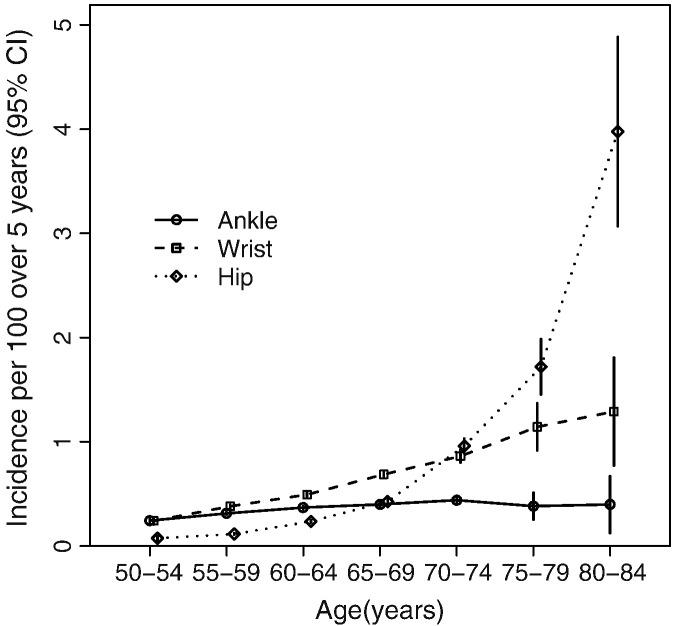
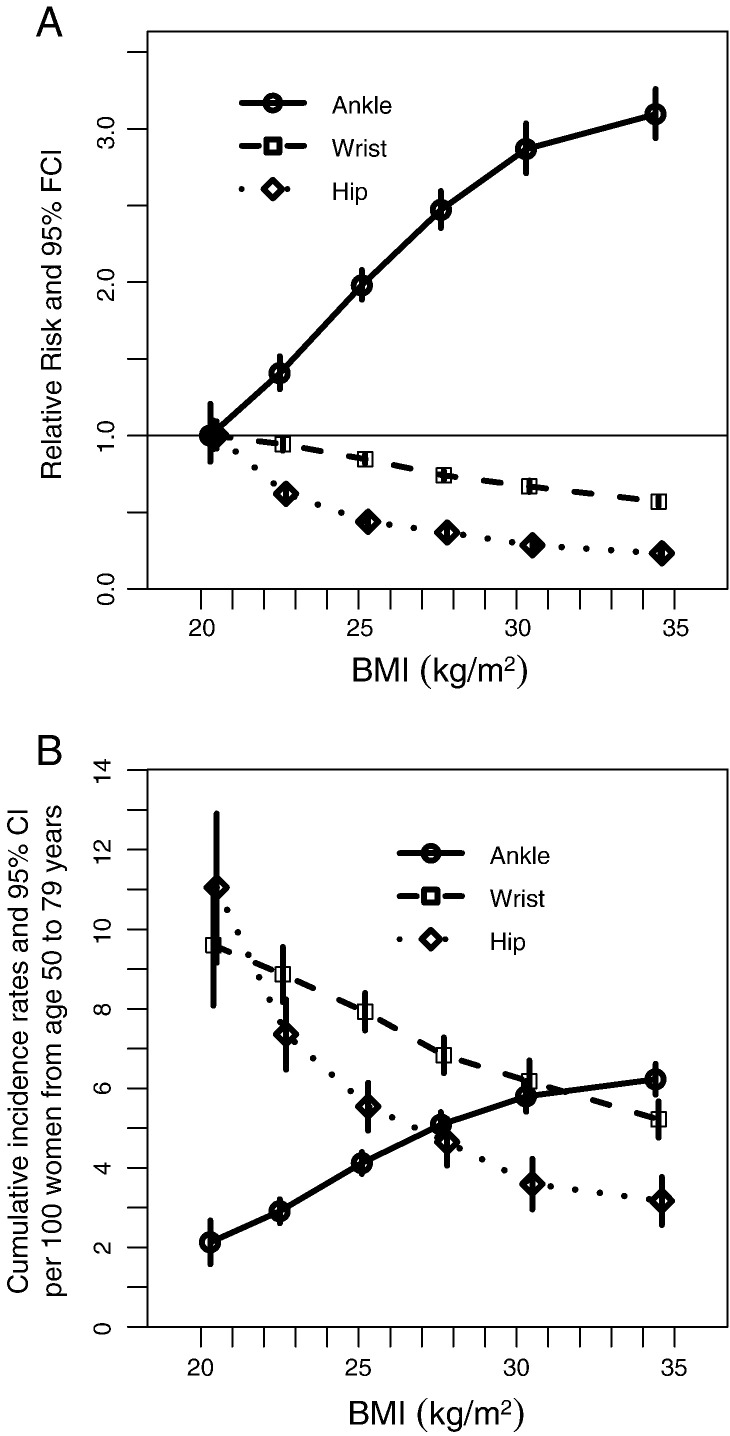
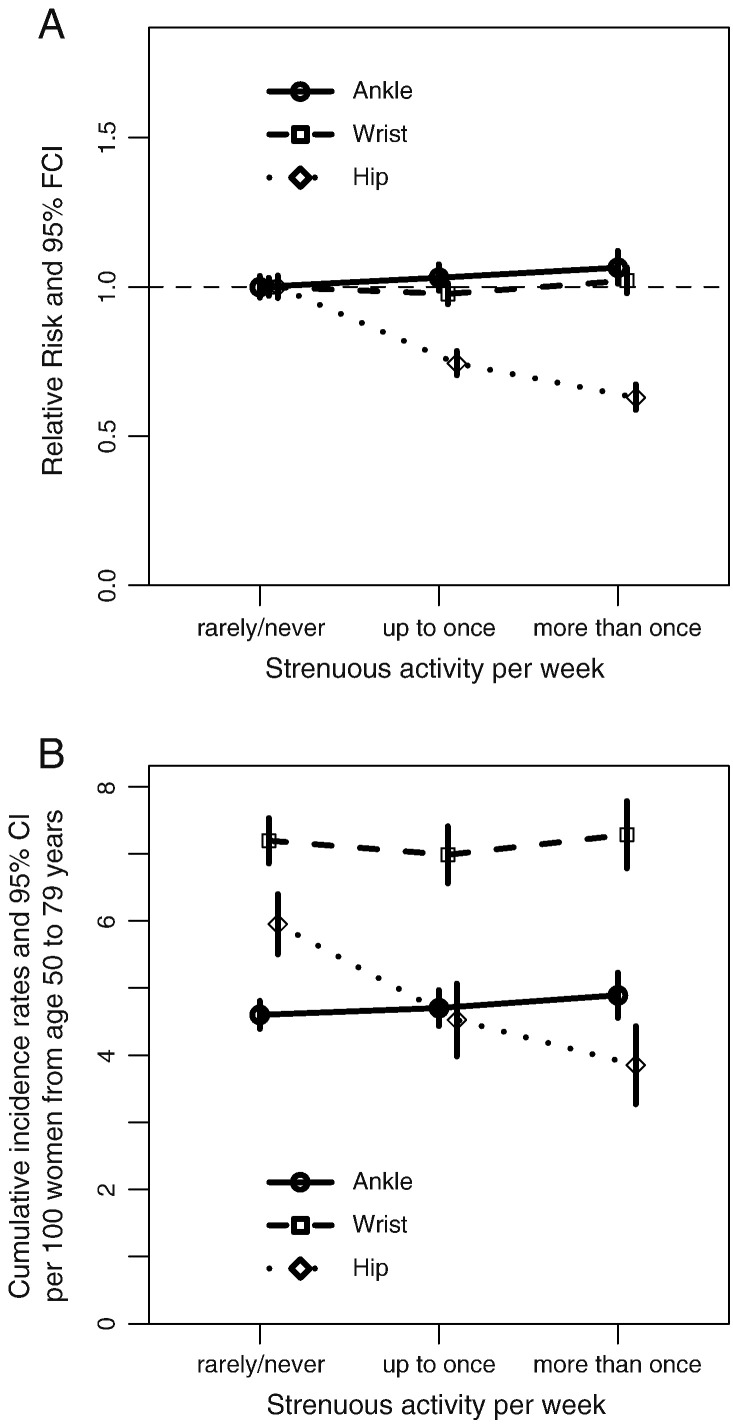
While increasing age, decreasing body mass index (BMI), and physical inactivity are known to increase hip fracture risk, whether these factors have similar effects on other common fractures is not well established. We used prospectively-collected data from a large cohort to examine the role of these factors on the risk of incident ankle, wrist and hip fractures in postmenopausal women. 1,155,304 postmenopausal participants in the Million Women Study with a mean age of 56.0 (SD 4.8) years, provided information about lifestyle, anthropometric, and reproductive factors at recruitment in 1996-2001. All participants were linked to National Health Service cause-specific hospital records for day-case or overnight admissions. During follow-up for an average of 8.3 years per woman, 6807 women had an incident ankle fracture, 9733 an incident wrist fracture, and 5267 an incident hip fracture. Adjusted absolute and relative risks (RRs) for incident ankle, wrist, and hip fractures were calculated using Cox regression models. Age-specific rates for wrist and hip fractures increased sharply with age, whereas rates for ankle fracture did not. Cumulative absolute risks from ages 50 to 84 years per 100 women were 2.5 (95%CI 2.2-2.8) for ankle fracture, 5.0 (95%CI 4.4-5.5) for wrist fracture, and 6.2 (95%CI 5.5-7.0) for hip fracture. Compared with lean women (BMI<20 kg/m(2)), obese women (BMI≥30 kg/m(2)) had a three-fold increased risk of ankle fracture (RR=3.07; 95%CI 2.53-3.74), but a substantially reduced risk of wrist fracture and especially of hip fracture (RR=0.57; 0.51-0.64 and 0.23; 0.21-0.27, respectively). Physical activity was associated with a reduced risk of hip fracture but was not associated with ankle or wrist fracture risk. Ankle, wrist and hip fractures are extremely common in postmenopausal women, but the associations with age, adiposity, and physical activity differ substantially between the three fracture sites.
Copyright © 2012 Elsevier Inc. All rights reserved.
Figures
References
-
- Armstrong M.E.G., Spencer E.A., Cairns B.J., Banks E., Pirie K., Green J. Body mass index and physical activity in relation to the incidence of hip fracture in postmenopausal women. J Bone Miner Res. 2011;26:1330–1338. - PubMed
-
- Siris E.S., Miller P.D., Barrett-Connor E., Faulkner K.G., Wehren L.E., Abbott T.A. Identification and fracture outcomes of undiagnosed low bone mineral density in postmenopausal women. JAMA. 2001;286:2815–2822. - PubMed
-
- Nelson M.E., Flatarone M.A., Morganti C.M., Trice I., Greenberg R.A., Evans W.J. Effects of high-intensity strength training on multiple risk factors for osteoporotic fractures: a randomized controlled trial. JAMA. 1994;272:1909–1914. - PubMed
-
- Hla M.M., Davis J.W., Ross P.D., Wasnich R.D., Yates A.J., Ravn P. A multicenter study of the influence of fat and lean mass on bone mineral content: evidence for differences in their relative influence at major fracture sites. Am J Clin Nutr. 1996;64:354–360. - PubMed
Publication types
MeSH terms
Grants and funding
LinkOut - more resources
Full Text Sources
Medical
