. 2012 Apr:Chapter 11:11.12.1-11.12.10.
doi: 10.1002/0471142905.hg1112s73.

High-throughput multiplex sequencing of miRNA

Affiliations

High-throughput multiplex sequencing of miRNA

Francois Vigneault et al. Curr Protoc Hum Genet. 2012 Apr.

Abstract

Next-generation sequencing offers many advantages over other methods of microRNA (miRNA) expression profiling, such as sample throughput and the capability to discover novel miRNAs. As the sequencing depth of current sequencing platforms exceeds what is necessary to quantify miRNAs, multiplexing several samples in one sequencing run offers a significant cost advantage. Although previous studies have achieved this goal by adding bar codes to miRNA libraries at the ligation step, this was recently shown to introduce significant bias into the miRNA expression data. This bias can be avoided, however, by bar coding the miRNA libraries at the PCR step instead. Here, we describe a user-friendly PCR bar-coding method of preparing multiplexed microRNA libraries for Illumina-based sequencing. The method also prevents the production of adapter dimers and can be completed in one day.


Figures

Figure 1
Figure 1
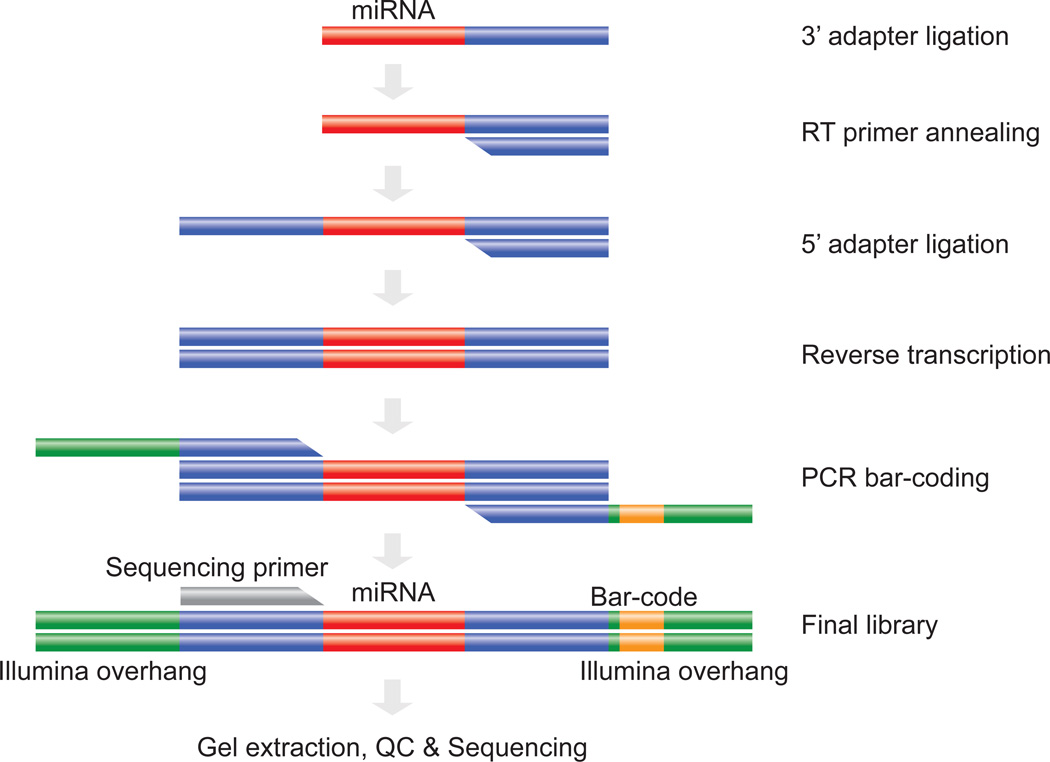
Schematic Illustration of the miRNA library preparation steps. 3’adapter is first ligated to the total RNA (steps 1–5) followed by RT primer annealing (steps 6–7) and 5’adapter ligation (steps 8–10 ). The sample is then revere transcribed (steps 11–12) and PCR enriched using bar-coded primers (steps 13–27) and is then ready for gel extraction of the miRNA library fraction and QC (steps 28–36). The library is now ready for high-throughput sequencing using either a single pass or custom indexing sequencing.
Figure 2
Figure 2
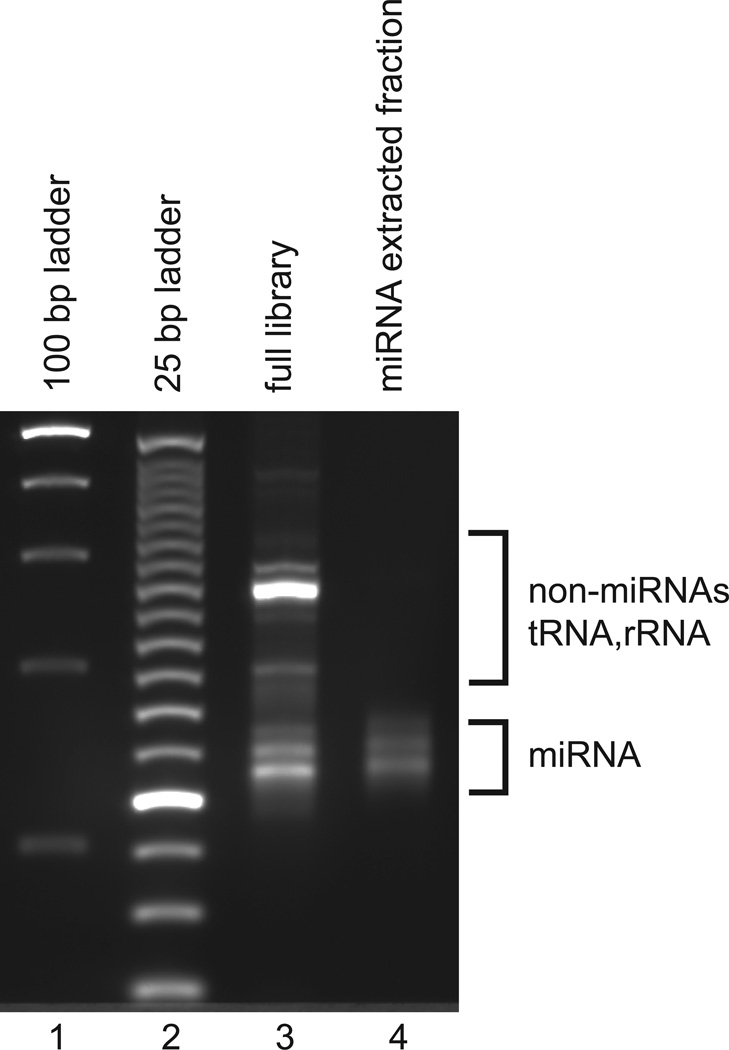
Final miRNA library analyzed on 2% agarose gel. Following the PCR and clean up steps, half of the final miRNA is loaded on one lane of a 2% E-gel alongside 100 bp (lane 1) and 25 bp ladders (lane 2). The fraction corresponding to miRNA library to be sequenced was extracted on a previous gel by cutting between 125 bp and 175 bp (lane 4) as described in the procedures and also loaded alongside the non-extracted library as a visual reference and expected recovery yield.
Figure 3
Figure 3
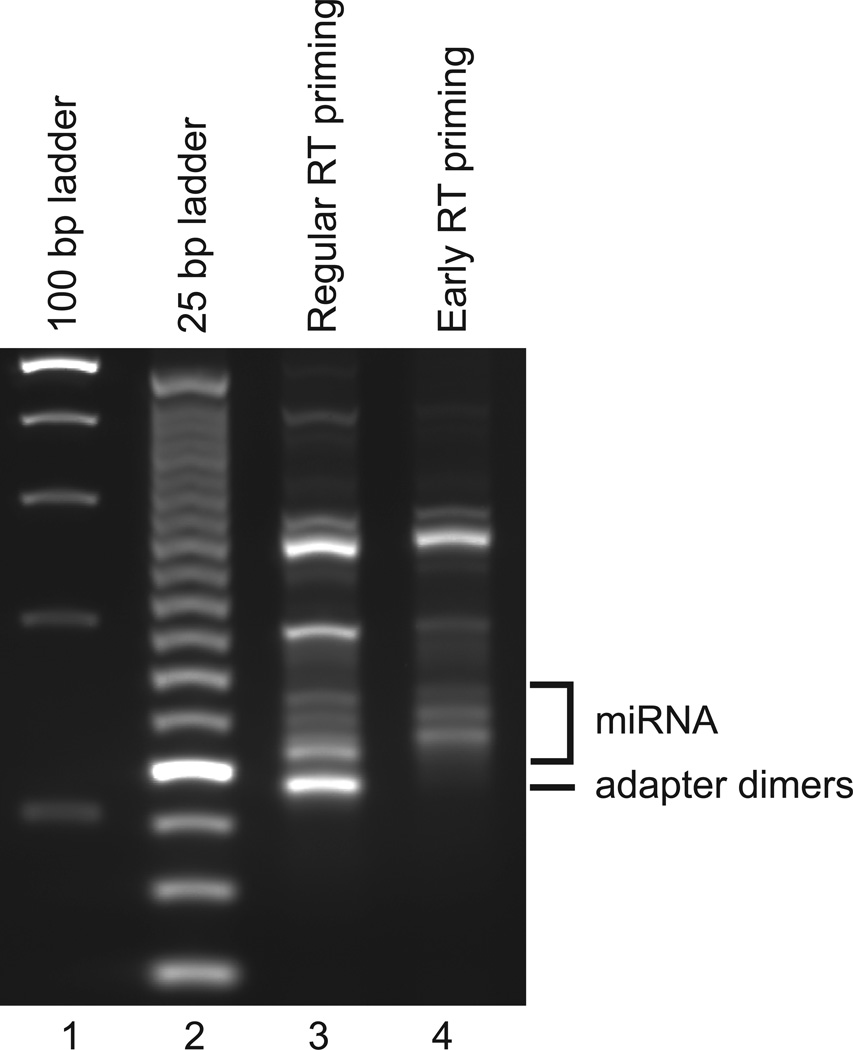
Adapter dimer consideration. Agarosegel comparing miRNA library preparation with RT primer annealing after ligation of both 3’ and 5’ adapter as described previously5 (lane 3) against miRNA library preparation with RT primer annealing after ligation of 3’ adapter only, as described here (lane 4). The adapter dimer expected to migrate at 114 bp is shown against the 100 bp (lane 1) and 25 bp ladder (lane 2). The adapter dimer is caused by ligation of 5’adapter directly to the excess of 3’adapter without miRNA captured. Our current protocol prevent the formation of this adapter dimer by annealing the RT primer to any available 3’adapter, effectively making them double stranded and therefore a poor substrate for subsequent 5’adapter ligation by T4 RNA Ligase 1.

References

    1. Alon S, Vigneault F, Eminaga S, Christodoulou DC, Seidman JG, Church GM, Eisenberg E. Barcoding bias in high-throughput multiplex sequencing of miRNA. Genome research. 2011;21(9):1506–1511. - PMC - PubMed
    1. Creighton CJ, Reid JG, Gunaratne PH. Expression profiling of microRNAs by deep sequencing. Briefings in bioinformatics. 2009;10(5):490–497. - PMC - PubMed
    1. Hafner M, Renwick N, Brown M, Mihailoviæ A, Holoch D, Lin C, Pena JTG, et al. RNA-ligase-dependent biases in miRNA representation in deep-sequenced small RNA cDNA libraries. RNA (New York NY) 2011;17(9):1697–1712. - PMC - PubMed
    1. Kawano M, Kawazu C, Lizio M, Kawaji H, Carninci P, Suzuki H, Hayashizaki Y. Reduction of non-insert sequence reads by dimer eliminator LNA oligonucleotide for small RNA deep sequencing. BioTechniques. 2010;49(4):751–755. - PubMed
    1. Kloosterman WP, Plasterk RHA. The diverse functions of microRNAs in animal development and disease. Developmental cell. 2006;11(4):441–450. - PubMed

Publication types