Controlled Clinical Trial
. 2012;7(3):e34106.
doi: 10.1371/journal.pone.0034106. Epub 2012 Mar 28.

Increased sleep fragmentation leads to impaired off-line consolidation of motor memories in humans

Affiliations
Controlled Clinical Trial

Increased sleep fragmentation leads to impaired off-line consolidation of motor memories in humans

Ina Djonlagic et al. PLoS One. 2012.

Abstract

A growing literature supports a role for sleep after training in long-term memory consolidation and enhancement. Consequently, interrupted sleep should result in cognitive deficits. Recent evidence from an animal study indeed showed that optimal memory consolidation during sleep requires a certain amount of uninterrupted sleep. Sleep continuity is disrupted in various medical disorders. We compared performance on a motor sequence learning task (MST) in relatively young subjects with obstructive sleep apnea (n = 16; apnea-hypopnea index 17.1±2.6/h [SEM]) to a carefully matched control group (n = 15, apnea-hypopnea index 3.7±0.4/h, p<0.001. Apart from AHI, oxygen nadir and arousal index, there were no significant differences between groups in total sleep time, sleep efficiency and sleep architecture as well as subjective measures of sleepiness based on standard questionnaires. In addition performance on the psychomotor vigilance task (reaction time and lapses), which is highly sensitive to sleep deprivation showed no differences as well as initial learning performance during the training phase. However there was a significant difference in the primary outcome of immediate overnight improvement on the MST between the two groups (controls = 14.7±4%, patients = 1.1±3.6%; P = 0.023) as well as plateau performance (controls = 24.0±5.3%, patients = 10.1±2.0%; P = 0.017) and this difference was predicted by the arousal index (p = 0.02) rather than oxygen saturation (nadir and time below 90% saturation. Taken together, this outcome provides evidence that there is a clear minimum requirement of sleep continuity in humans to ensure optimal sleep dependent memory processes. It also provides important new information about the cognitive impact of obstructive sleep apnea and challenges its current definitions.


Conflict of interest statement

Competing Interests: The authors have declared that no competing interests exist.

Figures

Figure 1
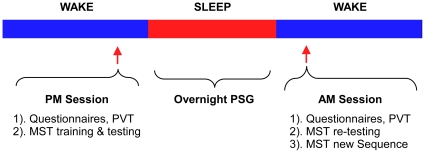
Figure 1. Schematic overview of the protocol.
All subjects were trained in the evening between 8 and 9 PM and re-tested the following morning between 6:30 and 7:30 AM on the MST. After testing, all subjects learned a new MST sequence in the morning to control for circadian effects of learning. The PVT was applied before evening and morning sessions to control for potential differences in attention and vigilance between both groups.
Figure 2
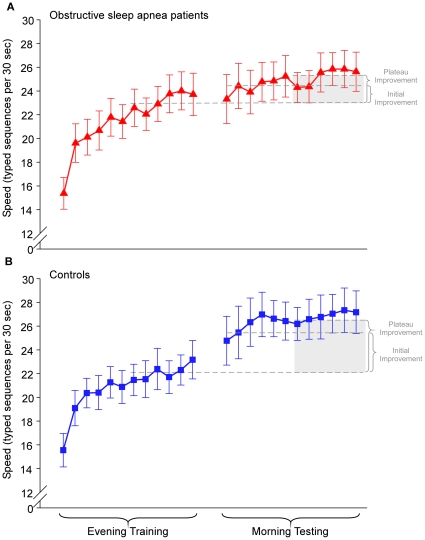
Figure 2. Trial-by-trial performance during evening training and morning testing.
Improvement in performance speed on the motor sequence task (MST) across initial training (12 trials) in the evening and at morning re-testing (12 trials) for healthy controls (n = 15, blue squares) and OSA subjects (n = 16, red triangles). The dashed line represents the average performance of the last 6 trials during the evening training as a reflection of the amount of training-dependent learning. Patients and controls did not differ in training-dependent learning in the evening. Overnight change in performance was calculated as initial improvement = percent increase of improvement from the last three training trials in the evening to the first three test trials in the morning and plateau improvement = percent improvement from the last 6 training trials in the evening to the last 6 test trials in the morning. OSA patients had a plateau improvement of 2.1±0.3 seq/30 sec compared to controls, who showed 5.0±0.9 seq/30 sec (p = 0.003). For the immediate improvement, OSA patients showed an improvement of 0.4±0.8 seq/30 sec compared to controls, who improved by 3.4±1.0 seq/30 sec (p = 0.022). Error bars represent standard errors of the mean (SEM).
Figure 3
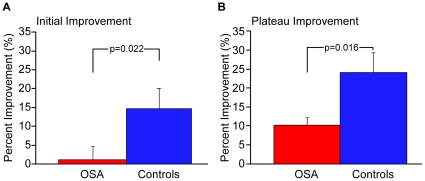
Figure 3. Measurements of overnight performance changes.
Immediate and Plateau improvement of OSA patients and healthy controls on the motor sequence learning task (MST). Performance is measured as correctly typed sequences per 30-second trial. There was a difference in off-line improvement over a night of sleep with the healthy controls showing significantly more initial improvement (P = 0.023) and plateau improvement (P = 0.017). Error bars represent standard errors of the mean (SEM).
Figure 4
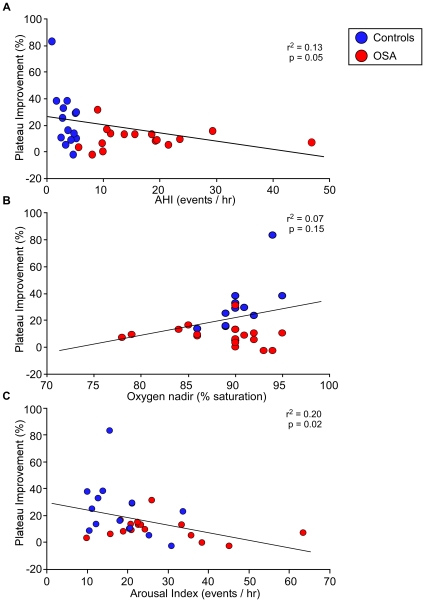
Figure 4. Correlation analysis.
Correlations between overnight improvement and AHI (events/hr), oxygen nadir (%) and arousal index for healthy controls (blue circles) and OSA subjects (red circles). Significant correlations were found between overnight improvement and arousal index (r2 = 0.20, P = 0.02), and, to a lesser extent, between overnight improvement and AHI (r2 = 0.13, P = 0.05). In contrast, no significant correlation was seen with oxygen nadir (r2 = 0.07, P = ns). One healthy control had an overnight plateau improvement of 83%. This individual had a plateau performance of 15 seq/30 sec during evening training (control average = 22 seq/30 sec), which increased to a plateau average of 28.4 seq/30 sec during morning testing (control average = 27 seq/30 sec), thus remaining within the range of normal in regards to the absolute values. Even though this person's percent overnight improvement was well above the average, the correlations remain significant when this individual is removed.
Figure 5
Figure 5. Training performance in the evening compared to morning.
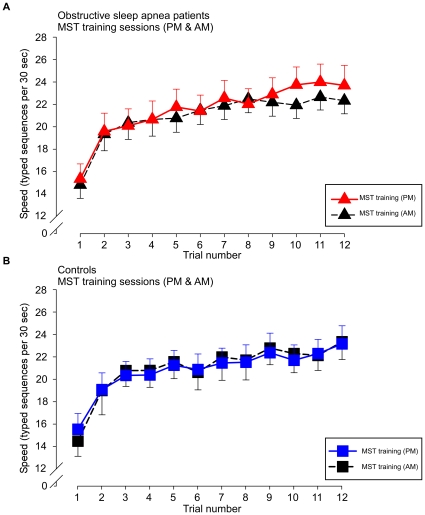
Both, OSA patients and healthy controls, showed similar performances during their initial training session in the evening compared to training of a new sequence in the morning. Subjects were randomized to one of two sequences in the evening: 4-2-3-1-4 (sequence A) or 2-4-1-3-2 (sequence B). After testing on the same sequence the following morning, all subjects were trained on the alternate sequence. There were no significant differences within groups (healthy controls or OSA patients) between performance of the new sequence learned in the morning and initial performance in the evening, ruling out circadian influences as the source of overnight changes. Error bars represent standard errors of the mean (SEM).

References

    1. Stickgold R, James L, Hobson JA. Visual discrimination learning requires sleep after training. Nat Neurosci. 2000;3:1237–1238. - PubMed
    1. Maquet P, Laureys S, Peigneux P, Fuchs S, Petiau C, et al. Experience-dependent changes in cerebral activation during human REM sleep. Nat Neurosci. 2000;3:831–836. - PubMed
    1. Diekelmann S, Born J. The memory function of sleep. Nat Rev Neurosci. 2010;11:114–126. - PubMed
    1. Stickgold R. Sleep-dependent memory consolidation. Nature. 2005;437:1272–1278. - PubMed
    1. Willingham DB. A neuropsychological theory of motor skill learning. Psychol Rev. 1998;105:558–584. - PubMed

Publication types