


Evaluation of a combined treatment paradigm consisting of environmental enrichment and the 5-HT1A receptor agonist buspirone after experimental traumatic brain injury
- PMID: 22471653
- PMCID: PMC3390981
- DOI: 10.1089/neu.2012.2385
Evaluation of a combined treatment paradigm consisting of environmental enrichment and the 5-HT1A receptor agonist buspirone after experimental traumatic brain injury
Abstract
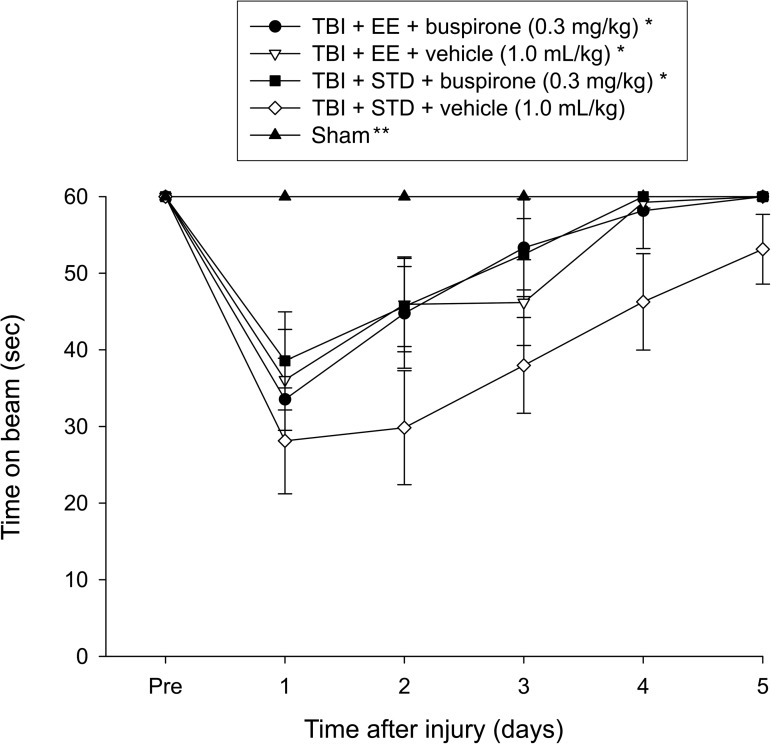
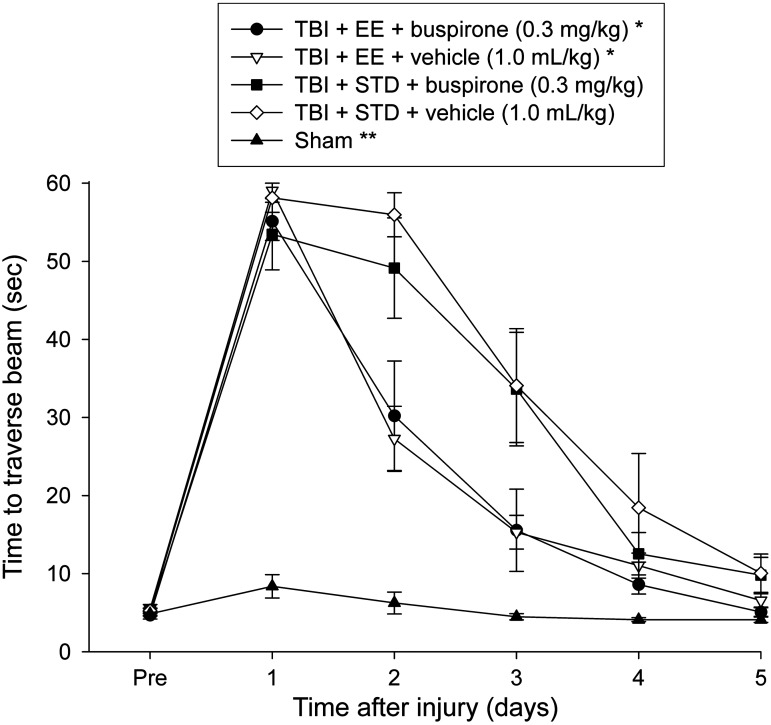
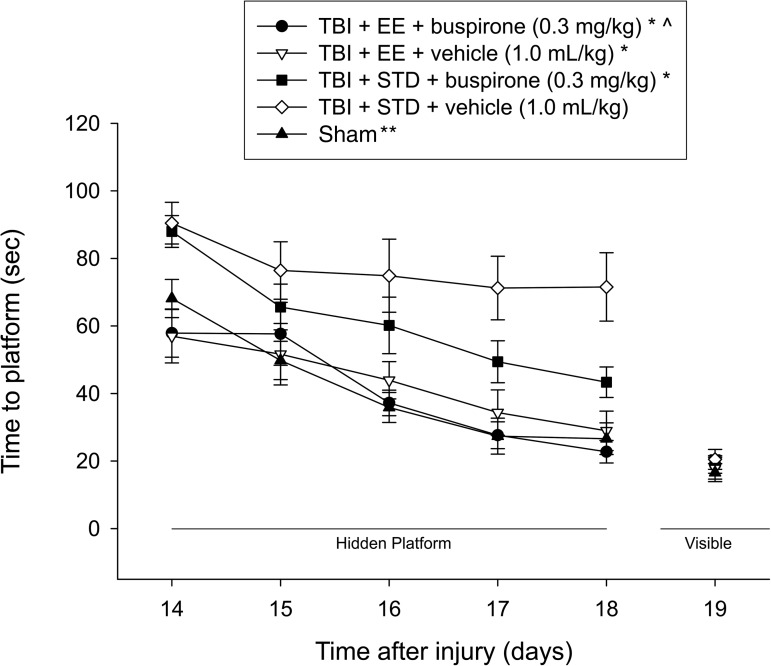
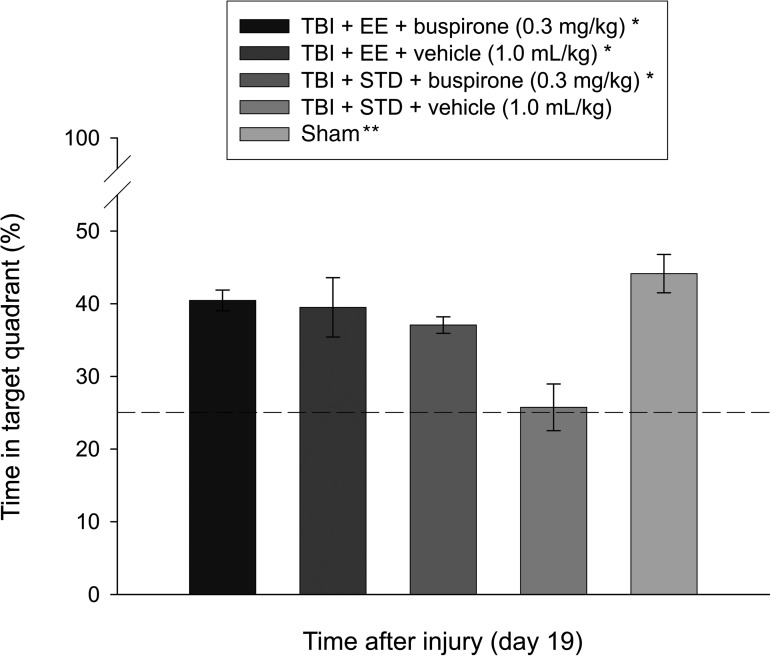
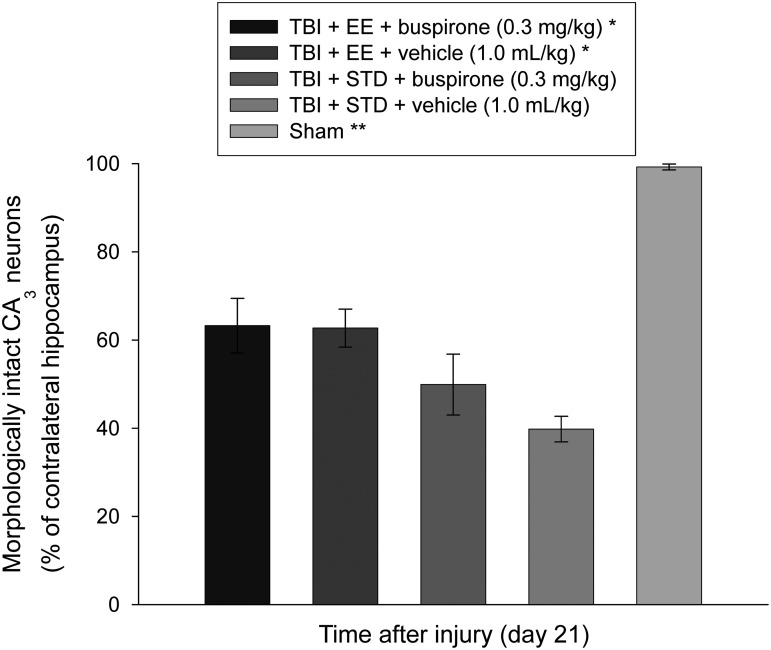
Environmental enrichment (EE) and serotonin(1A) (5-HT(1A))-receptor agonists provide significant benefit after experimental traumatic brain injury (TBI). The aim of this study was to test the hypothesis that combining these therapies would produce an effect that is more robust than either therapy alone. Anesthetized adult male rats received a cortical impact or sham injury and then were randomly assigned to EE or standard (STD) housing where they received either buspirone (0.3 mg/kg) or vehicle (1.0 mL/kg) once daily for 3 weeks. Motor and cognitive assessments were conducted on post-injury days 1-5 and 14-19, respectively. CA1/3 neurons were quantified at 3 weeks. No differences were observed among buspirone and vehicle sham groups in any task regardless of housing condition and thus the data were pooled. CA3 cell loss was reduced in the TBI+EE+buspirone and TBI+EE+vehicle groups. Motor recovery, spatial learning, and memory retention were enhanced in the TBI+EE+buspirone, TBI+EE+vehicle, and TBI+STD+buspirone groups versus the TBI+STD+vehicle group (p ≤ 0.005). Moreover, spatial learning was significantly better in the TBI+EE+buspirone group versus the TBI+STD+buspirone group (p<0.0001). No differences were revealed between the buspirone and vehicle EE groups. These data show that EE and buspirone benefit functional outcome after TBI, but their combination is not more robust than either alone, which does not support the hypothesis. The lack of an additive effect may be due to the early-and-continuous EE paradigm on its own producing marked benefits, resulting in a ceiling effect. The evaluation of buspirone in a delayed-and-abbreviated EE paradigm is ongoing in our laboratory.
Figures
Similar articles
-
A combined therapeutic regimen of buspirone and environmental enrichment is more efficacious than either alone in enhancing spatial learning in brain-injured pediatric rats.J Neurotrauma. 2014 Dec 1;31(23):1934-41. doi: 10.1089/neu.2014.3541. Epub 2014 Sep 29. J Neurotrauma. 2014. PMID: 25050595 Free PMC article.
-
Evaluation of a combined therapeutic regimen of 8-OH-DPAT and environmental enrichment after experimental traumatic brain injury.J Neurotrauma. 2010 Nov;27(11):2021-32. doi: 10.1089/neu.2010.1535. Epub 2010 Oct 28. J Neurotrauma. 2010. PMID: 21028935 Free PMC article.
-
Acute treatment with the 5-HT(1A) receptor agonist 8-OH-DPAT and chronic environmental enrichment confer neurobehavioral benefit after experimental brain trauma.Behav Brain Res. 2007 Feb 27;177(2):186-94. doi: 10.1016/j.bbr.2006.11.036. Epub 2006 Dec 12. Behav Brain Res. 2007. PMID: 17166603 Free PMC article.
-
5-HT1A and 5-HT1B receptor agonists and aggression: a pharmacological challenge of the serotonin deficiency hypothesis.Eur J Pharmacol. 2005 Dec 5;526(1-3):125-39. doi: 10.1016/j.ejphar.2005.09.065. Epub 2005 Nov 28. Eur J Pharmacol. 2005. PMID: 16310183 Review.
-
Found in translation: Understanding the biology and behavior of experimental traumatic brain injury.Neurosci Biobehav Rev. 2015 Nov;58:123-46. doi: 10.1016/j.neubiorev.2014.12.004. Epub 2014 Dec 10. Neurosci Biobehav Rev. 2015. PMID: 25496906 Free PMC article. Review.
Cited by
-
The Therapeutic Efficacy of Environmental Enrichment and Methylphenidate Alone and in Combination after Controlled Cortical Impact Injury.J Neurotrauma. 2017 Jan 15;34(2):444-450. doi: 10.1089/neu.2016.4438. Epub 2016 May 9. J Neurotrauma. 2017. PMID: 26972895 Free PMC article.
-
Environmental enrichment and the sensory brain: the role of enrichment in remediating brain injury.Front Syst Neurosci. 2014 Sep 2;8:156. doi: 10.3389/fnsys.2014.00156. eCollection 2014. Front Syst Neurosci. 2014. PMID: 25228861 Free PMC article. Review.
-
5-hydroxytryptamine1A (5-HT1A) receptor agonists: A decade of empirical evidence supports their use as an efficacious therapeutic strategy for brain trauma.Brain Res. 2016 Jun 1;1640(Pt A):5-14. doi: 10.1016/j.brainres.2015.11.026. Epub 2015 Nov 21. Brain Res. 2016. PMID: 26612522 Free PMC article. Review.
-
Spontaneous recovery of traumatic brain injury-induced functional deficits is not hindered by daily administration of lorazepam.Behav Brain Res. 2018 Feb 26;339:215-221. doi: 10.1016/j.bbr.2017.11.039. Epub 2017 Dec 2. Behav Brain Res. 2018. PMID: 29203336 Free PMC article.
-
Efficacy of a music-based intervention in a preclinical model of traumatic brain injury: An initial foray into a novel and non-pharmacological rehabilitative therapy.Exp Neurol. 2023 Nov;369:114544. doi: 10.1016/j.expneurol.2023.114544. Epub 2023 Sep 17. Exp Neurol. 2023. PMID: 37726048 Free PMC article.
References
-
- Blackerby W.F. Intensity of rehabilitation and length of stay. Brain Inj. 1990;4:167–173. - PubMed
-
- Chen X. Li Y. Kline A.E. Dixon C.E. Zafonte R.D. Wagner A.K. Gender and environmental effects on regional BDNF expression after experimental traumatic brain injury. Neuroscience. 2005;135:11–17. - PubMed
MeSH terms
Substances
LinkOut - more resources
Full Text Sources
Research Materials
Miscellaneous
