


Effect of an iPod video intervention on consent to donate organs: a randomized trial
- PMID: 22473435
- PMCID: PMC3597077
- DOI: 10.7326/0003-4819-156-7-201204030-00004
Effect of an iPod video intervention on consent to donate organs: a randomized trial
Abstract
Background: The gap between the supply of organs available for transplantation and demand is growing, especially among ethnic groups.
Objective: To evaluate the effect of a video designed to address concerns of ethnic groups about organ donation.
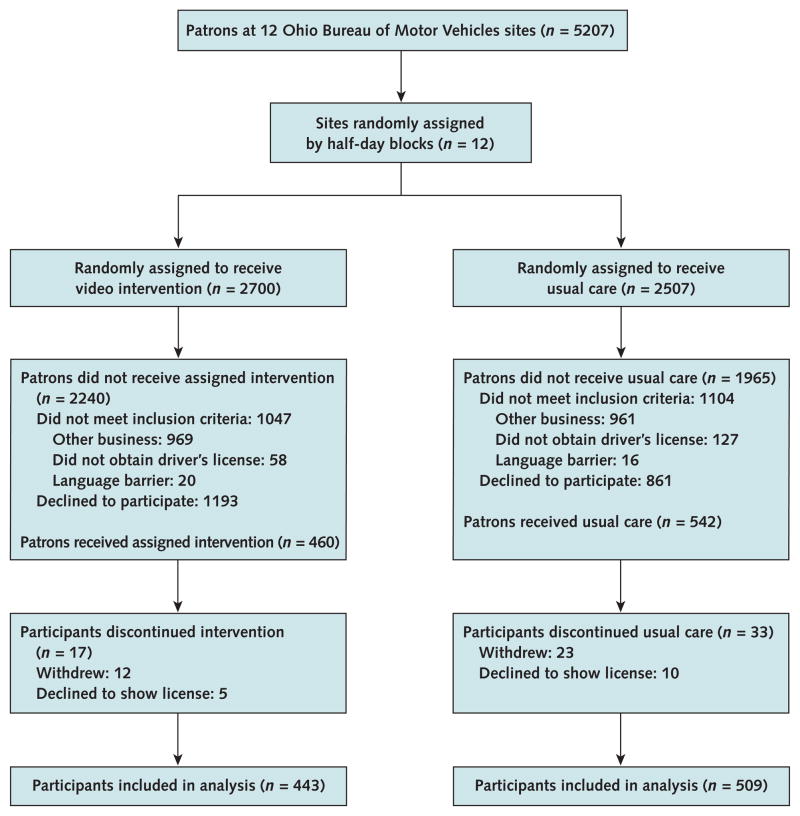
Design: Cluster randomized, controlled trial. Randomization was performed by using a random-number table with centralized allocation concealment. Participants and investigators assessing outcomes were not blinded to group assignment. (ClinicalTrials.gov registration number: NCT00870506)
Setting: Twelve branches of the Ohio Bureau of Motor Vehicles in northeastern Ohio.
Participants: 952 participants aged 15 to 66 years.
Intervention: Video (intervention; n = 443) or usual Bureau of Motor Vehicles license practices (control; n = 509).
Measurements: The primary outcome was the proportion of participants who provided consent for organ donation on a newly acquired driver's license, learner's permit, or state identification card. Secondary outcomes included willingness to make a living kidney donation to a family member in need and personal beliefs about donation.
Results: More participants who viewed the video consented to donate organs than control participants (84% vs. 72%; difference, 12 percentage points [95% CI, 6 to 17 percentage points]). The video was effective among black participants (76% vs. 54%; difference, 22 percentage points [CI, 9 to 35 percentage points]) and white participants (88% vs. 77%; difference, 11 percentage points [CI, 5 to 15 percentage points]). At the end of the trial, fewer intervention than control participants reported having insufficient information about organ donation (34% vs. 44%; difference, -10 percentage points [CI, -16 to -4 percentage points]), wanting to be buried with all of their organs (14% vs. 25%; difference, -11 percentage points [CI, -16 to -6 percentage points]), and having conflicts with organ donation (7% vs. 11%; difference, -4 percentage points [CI, -8 to -2 percentage points]).
Limitation: How the observed increases in consent to donate organs might translate into a greater organ supply in the region is unclear.
Conclusion: Exposure to a brief video addressing concerns that ethnic groups have about organ donation just before obtaining a license, permit, or identification card increased consent to donate organs among white and black participants.
Primary funding source: National Institutes of Health and the Robert Wood Johnson Foundation.
Conflict of interest statement
References
-
- Health Resources and Services Administration. Organ Procurement and Transplantation Network. Washington, DC: U.S. Department of Health & Human Services; 2011. [14 February 2012]. Accessed at http://optn.transplant.hrsa.gov/latestData/step2.asp? on.
-
- U.S. Census Bureau. American FactFinder. Washington, DC: U.S. Census Bureau; 2011. [24 December 2011]. Accessed at http://factfinder.census.gov on.
-
- Thornton JD, Wong KA, Cardenas V, Curtis JR, Spigner C, Allen MD. Ethnic and gender differences in willingness among high school students to donate organs. J Adolesc Health. 2006;39:266–74. - PubMed
-
- Horton RL, Horton PJ. Knowledge regarding organ donation: identifying and overcoming barriers to organ donation. Soc Sci Med. 1990;31:791–800. - PubMed
Publication types
MeSH terms
Associated data
Grants and funding
LinkOut - more resources
Full Text Sources
Medical
Miscellaneous
