


Improvements in skeletal muscle strength and cardiac function induced by resveratrol during exercise training contribute to enhanced exercise performance in rats
- PMID: 22473781
- PMCID: PMC3424731
- DOI: 10.1113/jphysiol.2012.230490
Improvements in skeletal muscle strength and cardiac function induced by resveratrol during exercise training contribute to enhanced exercise performance in rats
Abstract
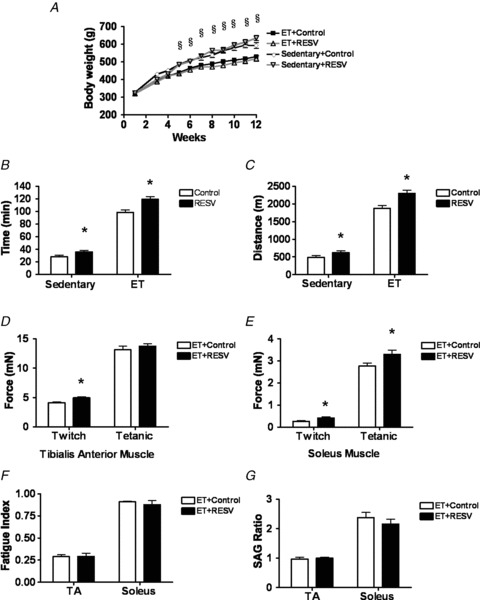
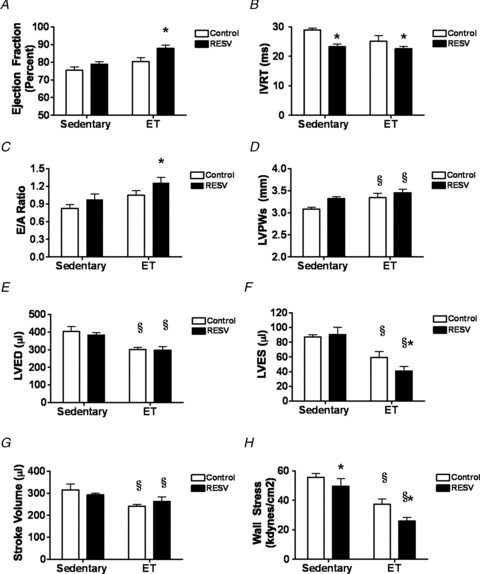
Exercise training (ET) improves endurance capacity by increasing both skeletal muscle mitochondrial number and function, as well as contributing to favourable cardiac remodelling.Interestingly, some of the benefits of regular exercise can also be mimicked by the naturally occurring polyphenol, resveratrol (RESV). However, it is not known whether RESV enhances physiological adaptations to ET. To investigate this, male Wistar rats were randomly assigned to a control chow diet or a chow diet that contained RESV (4 g kg⁻¹ of diet) and subsequently subjected to a programme of progressive treadmill running for 12 weeks. ET-induced improvements in exercise performance were enhanced by 21% (P <0.001) by the addition of RESV to the diet. In soleus muscle, ET+RESV increased both the twitch (1.8-fold; P <0.05) and tetanic(1.2-fold; P <0.05) forces generated during isometric contraction, compared to ET alone. In vivo echocardiography demonstrated that ET+RESV also increased the resting left ventricular ejection fraction by 10% (P <0.05), and reduced left ventricular wall stress compared to ET alone.These functional changes were accompanied by increased cardiac fatty acid oxidation (1.2-fold;P <0.05) and favourable changes in cardiac gene expression and signal transduction pathways that optimized the utilization of fatty acids in ET+RESV compared to ET alone. Overall, our findings provide evidence that the capacity for fatty acid oxidation is augmented by the addition of RESV to the diet during ET, and that this may contribute to the improved physical performance of rats following ET.
Figures

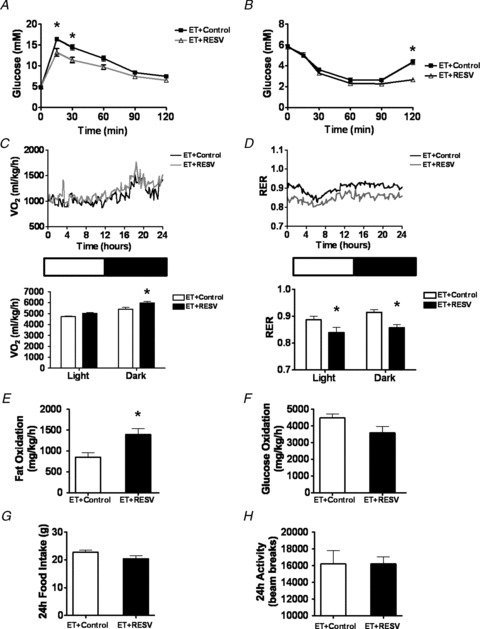
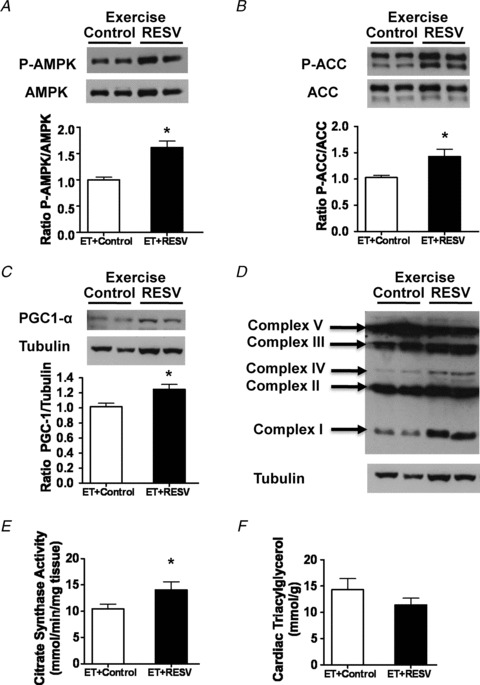
 ) (C) and respiratory exchange ratio (RER) (D) were measured by indirect calorimetry. E and F, the amount of whole-body fat (E) and glucose oxidation (F) was calculated from the calorimetry data. G, food consumption was measured over a 24 h period. H, physical activity was monitored by dual axis detection using infra-red photocell technology over a 24 h period. Data are presented as the mean ± SEM of n = 6 rats. Significant difference: *P < 0.05 ET + Control vs. ET + RESV using a Student's t test.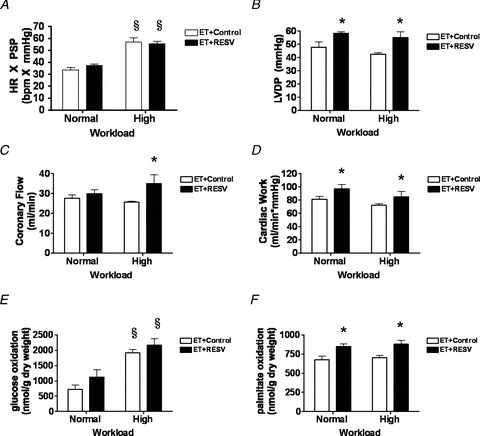
Comment in
-
Potentiating exercise training with resveratrol.J Physiol. 2012 Jul 15;590(14):3215-6. doi: 10.1113/jphysiol.2012.237743. J Physiol. 2012. PMID: 22826301 Free PMC article. No abstract available.
References
-
- Adhihetty PJ, Irrcher I, Joseph AM, Ljubicic V, Hood DA. Plasticity of skeletal muscle mitochondria in response to contractile activity. Exp Physiol. 2003;88:99–107. - PubMed
-
- Barger JL, Kayo T, Pugh TD, Prolla TA, Weindruch R. Short-term consumption of a resveratrol-containing nutraceutical mixture mimics gene expression of long-term caloric restriction in mouse heart. Exp Gerontol. 2008;43:859–866. - PubMed
-
- Baur JA, Pearson KJ, Price NL, Jamieson HA, Lerin C, Kalra A, Prabhu VV, Allard JS, Lopez-Lluch G, Lewis K, Pistell PJ, Poosala S, Becker KG, Boss O, Gwinn D, Wang M, Ramaswamy S, Fishbein KW, Spencer RG, Lakatta EG, Le Couteur D, Shaw RJ, Navas P, Puigserver P, Ingram DK, de Cabo R, Sinclair DA. Resveratrol improves health and survival of mice on a high-calorie diet. Nature. 2006;444:337–342. - PMC - PubMed
Publication types
MeSH terms
Substances
Grants and funding
LinkOut - more resources
Full Text Sources
Other Literature Sources
Medical
