. 2012 Apr 17;109(16):6018-23.
doi: 10.1073/pnas.1200074109. Epub 2012 Apr 2.

ATP drives direct photosynthetic production of 1-butanol in cyanobacteria

Affiliations

ATP drives direct photosynthetic production of 1-butanol in cyanobacteria

Ethan I Lan et al. Proc Natl Acad Sci U S A. .

Abstract

While conservation of ATP is often a desirable trait for microbial production of chemicals, we demonstrate that additional consumption of ATP may be beneficial to drive product formation in a nonnatural pathway. Although production of 1-butanol by the fermentative coenzyme A (CoA)-dependent pathway using the reversal of β-oxidation exists in nature and has been demonstrated in various organisms, the first step of the pathway, condensation of two molecules of acetyl-CoA to acetoacetyl-CoA, is thermodynamically unfavorable. Here, we show that artificially engineered ATP consumption through a pathway modification can drive this reaction forward and enables for the first time the direct photosynthetic production of 1-butanol from cyanobacteria Synechococcus elongatus PCC 7942. We further demonstrated that substitution of bifunctional aldehyde/alcohol dehydrogenase (AdhE2) with separate butyraldehyde dehydrogenase (Bldh) and NADPH-dependent alcohol dehydrogenase (YqhD) increased 1-butanol production by 4-fold. These results demonstrated the importance of ATP and cofactor driving forces as a design principle to alter metabolic flux.


Conflict of interest statement

The authors declare no conflict of interest.

Figures
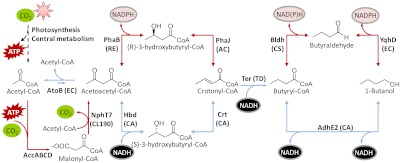
Fig. 1.
Fig. 1.
Variations in the CoA-dependent 1-butanol pathway. The fermentative CoA 1-butanol pathway is in blue. Alternative routes are in red. EC, E. coli; RE, R. eutropha; CA, C. acetobutylicum; AC, A. caviae; TD, T. denticola; CS, C. saccharoperbutylacetonicum N1-4; CL190, Streptomyces sp. strain CL190.
Fig. 2.
Fig. 2.
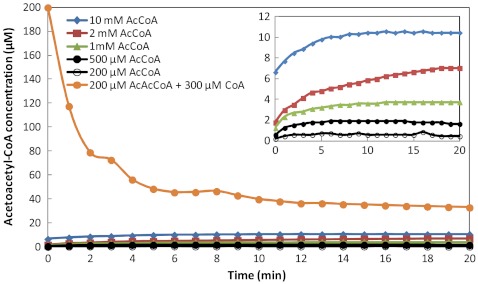
Determination of equilibrium concentrations for the thiolase (AtoB) mediated reaction. The equilibrium constant (Keq) was determined from the equilibrium concentrations. E. coli AtoB was cloned, purified, and used in an in vitro assay. AcCoA, acetyl-CoA; AcAcCoA, acetoacetyl-CoA; CoA, coenzyme A. Detailed conditions and methods are listed in SI Text.
Fig. 3.
Fig. 3.
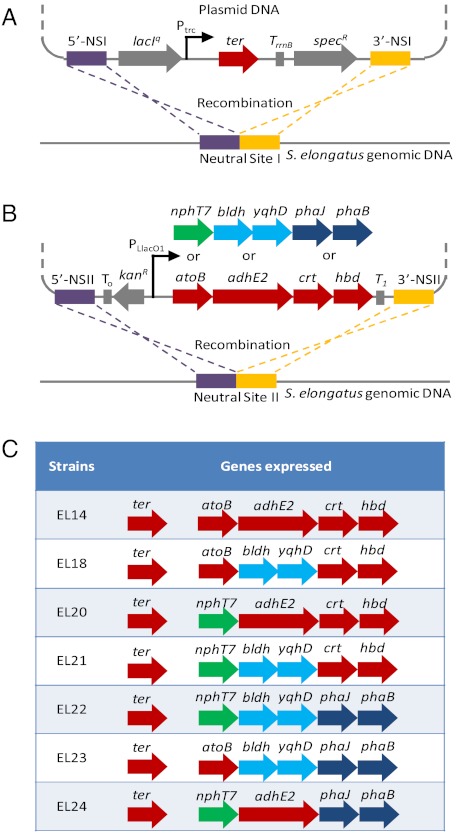
Schematic representation of recombination to integrate (A) ter at NSI, (B) atoB, adhE2, crt, and hbd at NSII in the genome of S. elongatus. Different combinations of alternative genes nphT7, bldh, yqhD, phaJ, and phaB can replace their counterpart enzymes to recombine into NSII. (C) List of strains with different combinations of overexpressed genes used in this study.
Fig. 4.
Fig. 4.
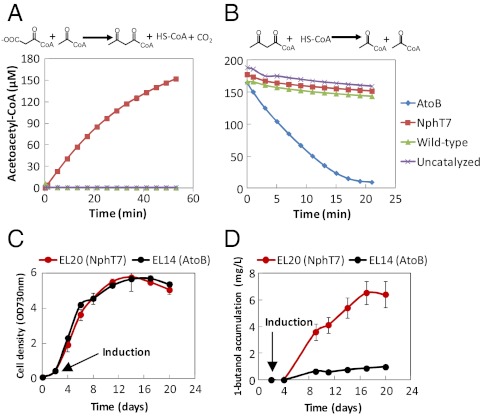
(A) In vitro assay for the synthesis of acetoacetyl-CoA using crude extracts of wild-type S. elongatus PCC 7942, strain EL14 and EL20. (B) In vitro assay for the thiolysis of acetoacetyl-CoA using crude extracts of wild-type S. elongatus PCC 7942, strain EL14 and EL20. (C) Cell density and (D) 1-butanol accumulation as a function of time of strain EL14 and EL20. 1-Butanol production by strain EL14 was near detection limit of about 1 mg/L.
Fig. 5.
Fig. 5.
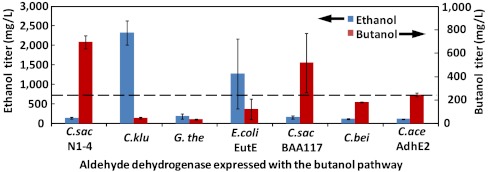
Production of 1-butanol and ethanol by recombinant E. coli strains JCL299 expressing CoA-dependent 1-butanol pathway with YqhD from E. coli and Bldh from different organisms. Dashed line represents the baseline production by using AdhE2. Detailed production procedure is listed in SI Text.
Fig. 6.
Fig. 6.
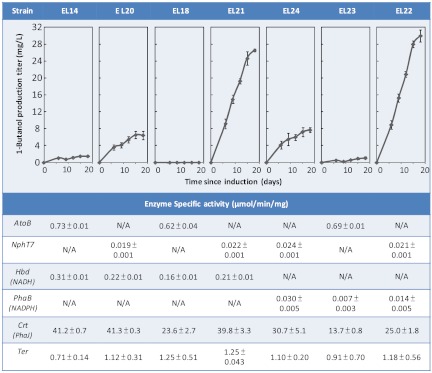
1-Butanol production and enzyme activity of strains expressing different enzymes. Strain genotype is listed in Fig. 3C. Expression of nphT7 enables direct photosynthetic production of 1-butanol under oxygenic condition. Strains EL21 and EL22 expressing bldh and yqhD achieved the highest production.

References

    1. Papoutsakis ET. Engineering solventogenic clostridia. Curr Opin Biotechnol. 2008;19:420–429. - PubMed
    1. Ezeji TC, Qureshi N, Blaschek HP. Bioproduction of butanol from biomass: From genes to bioreactors. Curr Opin Biotechnol. 2007;18:220–227. - PubMed
    1. Atsumi S, Hanai T, Liao JC. Non-fermentative pathways for synthesis of branched-chain higher alcohols as biofuels. Nature. 2008;451:86–89. - PubMed
    1. Atsumi S, Liao JC. Directed evolution of Methanococcus jannaschii citramalate synthase for biosynthesis of 1-propanol and 1-butanol by Escherichia coli. Appl Environ Microbiol. 2008;74:7802–7808. - PMC - PubMed
    1. Shen CR, Liao JC. Metabolic engineering of Escherichia coli for 1-butanol and 1-propanol production via the keto-acid pathways. Metab Eng. 2008;10:312–320. - PubMed

Publication types

MeSH terms