


Pharmacological manipulation of the dopaminergic system affects wheel-running activity in differentially active mice
- PMID: 22475103
- PMCID: PMC4190615
Pharmacological manipulation of the dopaminergic system affects wheel-running activity in differentially active mice
Abstract
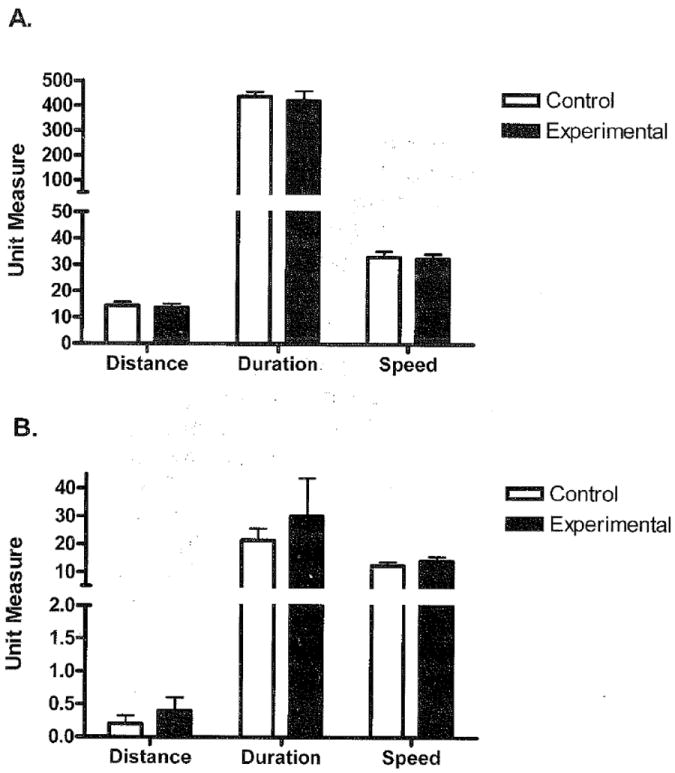
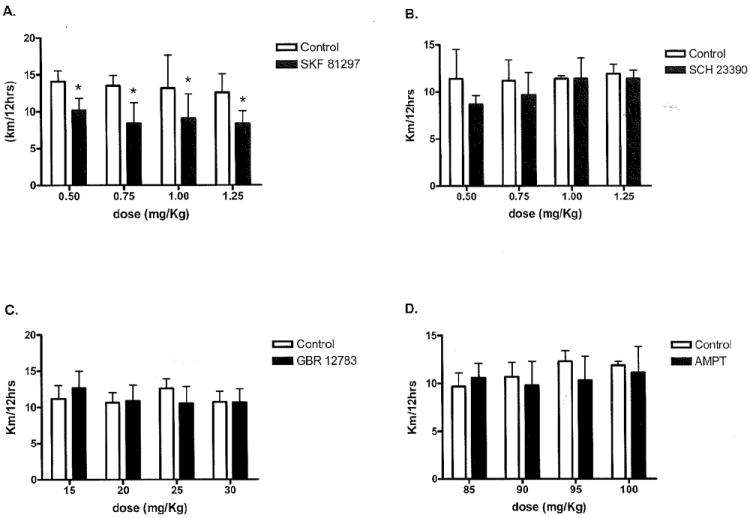
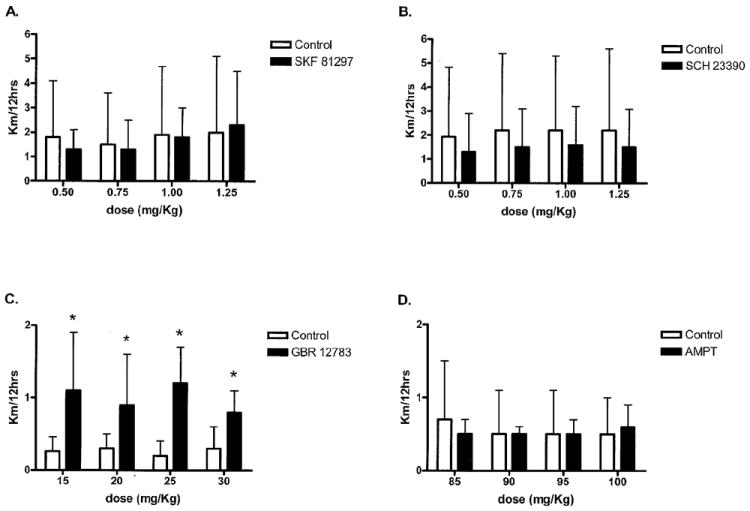
The genetic factors involved in the regulation of physical activity are not well understood. The dopamine system has been implicated in the control of voluntary locomotion and wheel running (WR) in mice and is thus a likely candidate as a genetic/biological system important to the regulation of physical activity. This study evaluated the effects of four different dopaminergic acting drugs on WR in differentially active inbred strains of mice. High active C57L/J (n=7, 3 controls, 4 experimental) and low active C3H/HeJ (n=8, 3 controls, 5 experimental) were analyzed for baseline wheel-running indices of distance (km/day), duration (mins/day), and speed (m/min) for 21 days. Experimental mice received increasing doses over four days of each of the following drugs: SKF 81297 (D1 agonist), SCH 23390 (D1 antagonist), GBR 12783 (DAT inhibitor), and AMPT (tyrosine hydroxylase inhibitor). Each drug dose response treatment was separated by three days of recovery (no drug injections). WR indices were monitored during drug treatments and during drug wash-out phases. SKF 81297 significantly reduced (p=0.0004) WR in the C57L/J mice, but did not affect WR in the C3H/HeJ mice. GBR 12783 significantly increased (p=0.0005) WR in C3H/HeJ mice, but did not affect WR in C57L/J mice. Only duration (not overall WR) was significantly reduced in C57L/J mice in response to SCH 23390 (p=0.003) and AMPT (p=0.043). SCH 23390 (p=0.44) and AMPT (p=0.98) did not significantly affect WR in C3H/HeJ mice. These results suggest that genetic differences in dopamine signaling may play a role in the WR response to dopaminergic-acting drugs in inbred strains of mice. The high activity in the C57L/J strain appears most responsive to D1-like receptor acting drugs, while in the C3H/HeJ strain, dopamine re-uptake appears to have an influence on activity level.
Conflict of interest statement
DISCLOSURE: ALL AUTHORS REPORT NO CONFLICTS OF INTEREST RELEVANT TO THIS ARTICLE.
Figures
References
-
- Heitmann BL, Hills AP, Frederiksen P, Ward LC. Obesity, leanness, and mortality: effect modification by physical activity in men and women. Obesity (Silver Spring) 2009;17(1):136–42. - PubMed
-
- Oldridge NB. Economic burden of physical inactivity: healthcare costs associated with cardiovascular disease. Eur J Cardiovasc Prev Rehabil. 2008;15(2):130–9. - PubMed
-
- Festing MF. Wheel activity in 26 strains of mouse. Lab Anim. 1977;11(4):257–8. - PubMed
-
- Lauderdale DS, Fabsitz R, Meyer JM, Sholinsky P, Ramakrishnan V, Goldberg J. Familial determinants of moderate and intense physical activity: a twin study. Med Sci Sports Exerc. 1997;29(8):1062–8. - PubMed
-
- Lerman I, Harrison BC, Freeman K, et al. Genetic variability in forced and voluntary endurance exercise performance in seven inbred mouse strains. J Applied Physiol. 2002;92(6):2245–55. - PubMed
Publication types
MeSH terms
Substances
Grants and funding
LinkOut - more resources
Full Text Sources
Miscellaneous