


Infant flow biphasic nasal continuous positive airway pressure (BP- NCPAP) vs. infant flow NCPAP for the facilitation of extubation in infants' ≤ 1,250 grams: a randomized controlled trial
- PMID: 22475409
- PMCID: PMC3402979
- DOI: 10.1186/1471-2431-12-43
Infant flow biphasic nasal continuous positive airway pressure (BP- NCPAP) vs. infant flow NCPAP for the facilitation of extubation in infants' ≤ 1,250 grams: a randomized controlled trial
Abstract
Background: The use of mechanical ventilation is associated with lung injury in preterm infants and therefore the goal is to avoid or minimize its use. To date there is very little consensus on what is considered the "best non-invasive ventilation mode" to be used post-extubation. The objective of this study was to compare the effectiveness of biphasic nasal continuous positive airway pressure (BP-NCPAP) vs. NCPAP in facilitating sustained extubation in infants ≤ 1,250 grams.
Methods: We performed a randomized controlled trial of BP-NCPAP vs. NCPAP in infants ≤ 1,250 grams extubated for the first time following mechanical ventilation since birth. Infants were extubated using preset criteria or at the discretion of the attending neonatologist. The primary outcome was the incidence of sustained extubation for 7 days. Secondary outcomes included incidence of adverse events and short-term neonatal outcomes.
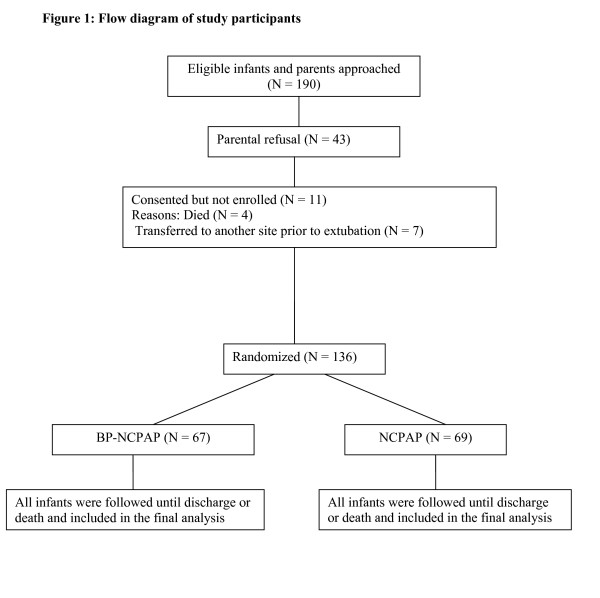
Results: Sixty-seven infants received BP-NCPAP and 69 NCPAP. Baseline characteristics were similar between groups. The trial was stopped early due to increased use of non-invasive ventilation from birth, falling short of our calculated sample size of 141 infants per group. The incidence of sustained extubation was not statistically different between the BP-NCPAP vs. NCPAP group (67% vs. 58%, P = 0.27). The incidence of adverse events and short-term neonatal outcomes were similar between the two groups (P > 0.05) except for retinopathy of prematurity which was noted to be higher (P = 0.02) in the BP-NCPAP group.
Conclusions: Biphasic NCPAP may be used to assist in weaning from mechanical ventilation. The effectiveness and safety of BP-NCPAP compared to NCPAP needs to be confirmed in a large multi-center trial as our study conclusions are limited by inadequate sample size. CLINICAL TRIALS REGISTRATION #: NCT00308789 SOURCE OF SUPPORT: Grant # 06-06, Physicians Services Incorporated Foundation, Toronto, Canada. Summit technologies Inc. provided additional NCPAP systems and an unrestricted educational grant.Abstract presented at The Society for Pediatric Research Meeting, Baltimore, USA, May 2nd-5th, 2009 and Canadian Paediatric Society Meeting, June 23rd-29th, Ottawa, 2009.
Figures
References
-
- Lemons JA, Bauer CR, Oh W, Korones SB, Papile LA, Stoll BJ, Verter J, Temprosa M, Wright LL, Ehrenkranz RA, Fanaroff AA, Stark A, Carlo W, Tyson JE, Donovan EF, Shankaran S, Stevenson DK. Very low birth weight outcomes of the National Institute of Child health and human development neonatal research network, January 1995 through December 1996. Pediatrics. 2001;107:E1. doi: 10.1542/peds.107.1.e1. - DOI - PubMed
-
- European Perinatal Health Report. 2008. http://www.europeristat.com
-
- SUPPORT Study Group of the Eunice Kennedy Shriver NICHD Neonatal Research Network; Finer NN, Carlo WA, Walsh MC, Rich W, Gantz MG, Laptook AR, Yoder BA, Faix RG, Das A, Poole WK, Donovan EF, Newman NS, Ambalavanan N, Frantz ID, Buchter S, Sánchez PJ, Kennedy KA, Laroia N, Poindexter BB, Cotten CM, Van Meurs KP, Duara S, Narendran V, Sood BG, O'Shea TM, Bell EF, Bhandari V, Watterberg KL, Higgins RD. Early CPAP versus surfactant in extremely preterm infants. N Engl J Med. 2010;362:1970–1979. - PMC - PubMed
Publication types
MeSH terms
Associated data
LinkOut - more resources
Full Text Sources
Medical
Research Materials
