


The Polls-Review: Inaccurate Age and Sex Data in the Census Pums Files: Evidence and Implications
- PMID: 22476405
- PMCID: PMC3175601
- DOI: 10.1093/poq/nfq033
The Polls-Review: Inaccurate Age and Sex Data in the Census Pums Files: Evidence and Implications
Abstract
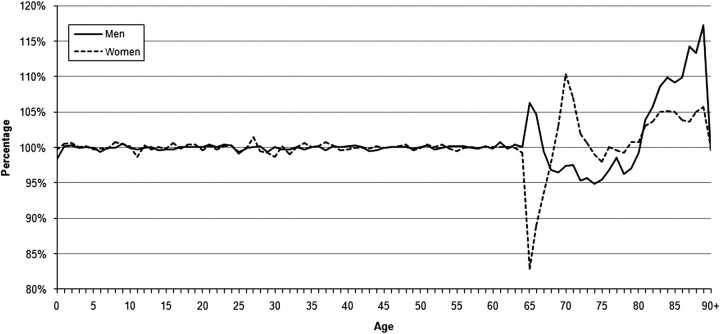
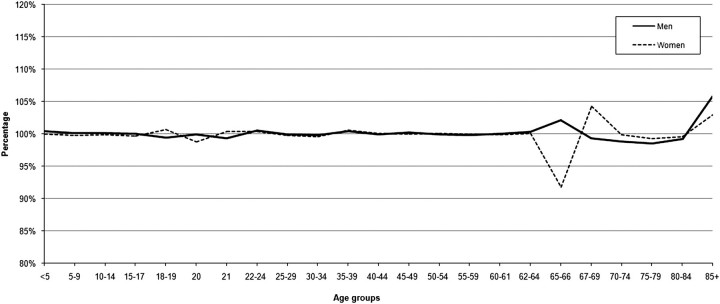
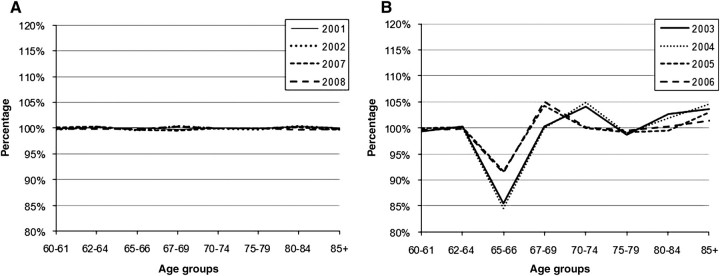
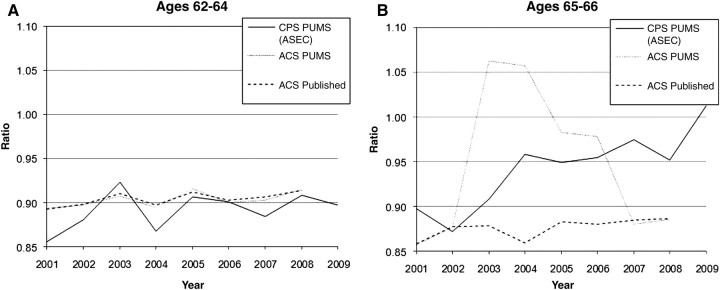
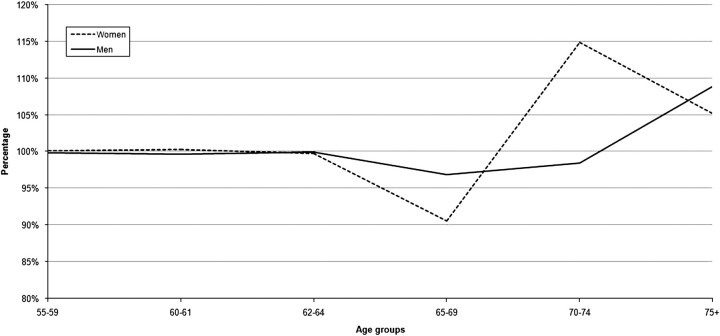
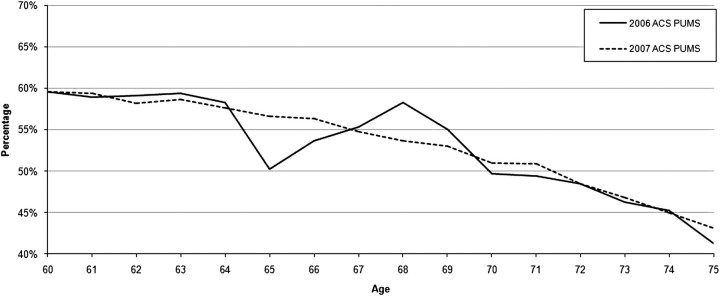
We discover and document errors in public-use microdata samples ("PUMS files") of the 2000 Census, the 2003-2006 American Community Survey, and the 2004-2009 Current Population Survey. For women and men age 65 and older, age- and sex-specific population estimates generated from the PUMS files differ by as much as 15 percent from counts in published data tables. Moreover, an analysis of labor-force participation and marriage rates suggests the PUMS samples are not representative of the population at individual ages for those age 65 and over. PUMS files substantially underestimate labor-force participation of those near retirement age and overestimate labor-force participation rates of those at older ages. These problems were an unintentional byproduct of the misapplication of a newer generation of disclosure-avoidance procedures carried out on the data. The resulting errors in the public-use data could significantly impact studies of people age 65 and older, particularly analyses of variables that are expected to change by age.
Figures
References
-
- Blewett Lynn A., Davern Michael. Distributing State Children’s Health Insurance Funds: A Critical Review of the Design and Implementation of the Funding Formula. Journal of Health Politics, Policy, and Law. 2007;32(3):415–55. - PubMed
-
- Census 2000 Advisory Committee The Public Use Microdata Samples of the U.S. Census: Research Applications and Privacy Issues. Prepared for Census 2000 Users’ Conference on PUMS Data. 2000 Available at http://usa.ipums.org/usa/2000PUMSReport_full.pdf.
-
- King Miriam, Ruggles Steven, Alexander Trent, Leicach Donna, Sobek Matthew. Integrated Public Use Microdata Series, Current Population Survey: Version 2.0. [Machine-readable database] Minneapolis: Minnesota Population Center [producer and distributor]; 2009. Available at http://cps.ipums.org/cps/
-
- Office of Management and Budget Statistical Policy Working Paper 31: Measuring and Reporting Sources of Error in Surveys. Statistical Policy Office, Office of Information and Regulatory Affairs. 2001 Jul; Available at http://www.fcsm.gov/01papers/SPWP31_final.pdf.
Grants and funding
LinkOut - more resources
Full Text Sources
