


A comparative study of restenosis rates in bare metal and drug-eluting stents
- PMID: 22477592
- PMCID: PMC3005409
- DOI: 10.1055/s-0031-1278368
A comparative study of restenosis rates in bare metal and drug-eluting stents
Abstract
Background: Various studies have been performed throughout the world on the rate of restenosis using bare metal stents (BMS) and drug-eluting stents (DES). The prohibitive costs associated with DES generally dictate the type of stent used, especially in developing countries. Therefore, there was a need for a study to assess the effect of various risk factors on restenosis in BMS and DES in the Indian context. A study was performed in the premier institution of the Indian Armed Forces, the Army Hospital (Research and Referral), New Delhi, India, under the aegis of the Indian Council of Medical Research (New Delhi). The profile of patients in the armed forces is inherently diverse in terms of demography, ethnicity, genetics, etc, which reflects the diverse and varied nature of the population in India.
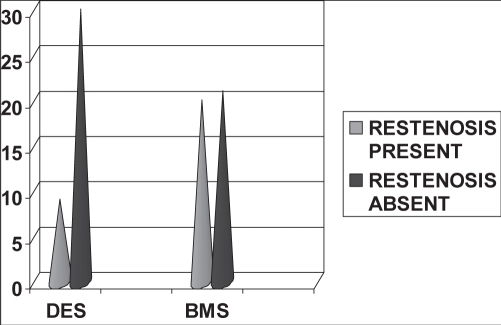
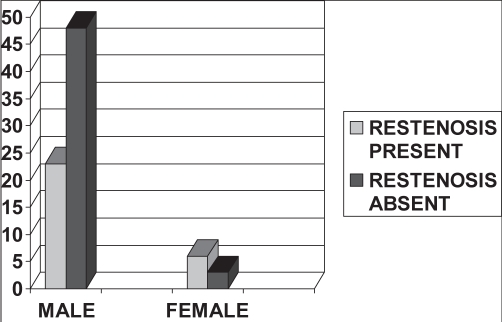
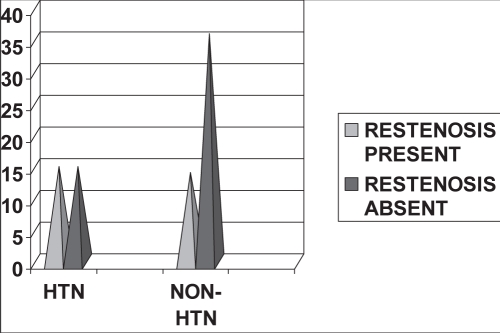
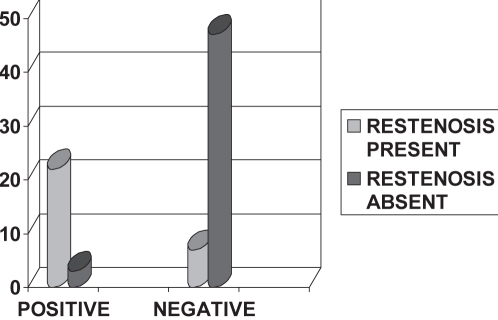
Methods and results: A total of 130 patients were included in the present study. Follow-up after stent implantation was scheduled for six to nine months following the procedure to assess symptoms, drug compliance, and treadmill test and coronary angiography results, and to ascertain the incidence of restenosis. However, only 80 patients returned for follow-up and, therefore, the final analysis was based on these patients. They were segregated into BMS (n=41) and DES (n=39) groups. Restenosis occurred in 29 patients (36.3%). Nine of 39 patients with DES (23.1%) and 20 of 41 patients with BMS (48.8%) developed restenosis. There was a statistically significant relationship between restenosis and female sex, clinical presentation before intervention and at the time of follow-up evaluation (unstable angina), hypertension, positive stress test and compliance with medical therapy (P<0.05). No statistically significant relationship was observed between restenosis and age, diabetes, smoking, obesity and diet (P>0.05).
Conclusions: DES appear to reduce the restenosis rate and clinical end points, and appear to be more cost effective than BMS. Patient-related factors (eg, sex, hypertension and unstable angina) are important variables that affect the restenosis rate. Noninvasive stress testing had high positive and negative predictive values. Therefore, based on the present study, noninvasive stress testing is suggested before routine angiography at follow-up, which will reduce the need for repeat coronary angiography.
Figures
References
-
- Rupprecht HJ, Brennecke R, Bernhard G, Erbel R, Pop T, Meyer J. Analysis of risk factors for restenosis after PTCA. Cathet Cardiovasc Diagn. 1990;19:151–9. - PubMed
-
- Macdonald RG, Henderson MA, Hirshfeld JW, Jr, et al. Patient-related variables and restenosis after percutaneous transluminal coronary angioplasty – a report from the M-HEART group. Am J Cardiol. 1990;66:926–31. - PubMed
-
- Watanabe CT, Maynard C, Ritchie JL. Comparison of short-term outcomes following coronary artery stenting in men versus women. Am J Cardiol. 2001;88:848. - PubMed
-
- Jacobs AK, Johnston JM, Haviland A, et al. Improved outcomes for women undergoing contemporary percutaneous coronary intervention: A report from the national heart, lung, and blood institute dynamic registry. J Am Coll Cardiol. 2002;39:1608. - PubMed
-
- Holmes DR, Jr, Vlietstra RE, Smith HC, et al. Restenosis after percutaneous transluminal coronary angioplasty (PTCA): A report from the PTCA registry of the national heart, lung, and blood institute. Am J Cardiol. 1984;53:77C–81C. - PubMed
LinkOut - more resources
Full Text Sources
Other Literature Sources
