doi: 10.1371/journal.pntd.0001450.
Epub 2012 Mar 27.
Assessing the potential of a candidate dengue vaccine with mathematical modeling
- PMID: 22479655
- PMCID: PMC3313921
- DOI: 10.1371/journal.pntd.0001450
Item in Clipboard
Assessing the potential of a candidate dengue vaccine with mathematical modeling
PLoS Negl Trop Dis.
2012.
No abstract available
Conflict of interest statement
Laurent Coudeville, Jean Lang, and Remy Teyssou are employees of Sanofi-Pasteur (France). Adrienne Guignard, Gerhart Knerer, and Baudoin Standaert are employees of GSK Biologicals (Belgium). Joachim Hombach and Pem Namgyal are staff members of the World Health Organization. This report contains the collective views of an international group of experts, and does not necessarily represent the decisions or the stated policy of the World Health Organization. All other authors have declared that no competing interests exist.
Figures
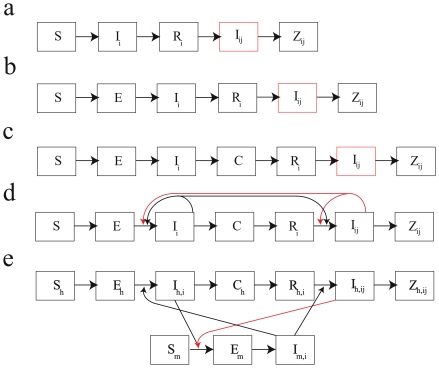
The disease state space of five alternative dengue model structures incorporating immune enhancement and short-term cross protection are shown. The disease states are: S susceptible, E exposed but not yet infectious, I
i infectious with serotype i, I
ij infectious with serotype j having had serotype i, R
i recovered from and immune to serotype i, Z
ij recovered from and immune to serotypes i and j and hence immune to all serotypes, C temporarily cross-protected from all serotypes due to recent exposure. Model (a): individuals immune to one serotype are more likely to experience a severe infection (denoted by red box). Model (b): similar to model a with the addition of a pre-infectious exposed class E. Model (c): includes a short-term cross-protection class C in which recently recovered individuals are protected from infection for a certain amount of time. Model (d): model with short-term cross-protection and increased infectiousness of class I
ij indicated by red arrows showing an increase in the rates of acquisition of primary and secondary infection due to this effect. Model (e): increased transmissibility among secondary infections I
ij to a mosquito species. Note that in this formulation, mosquitoes that have obtained infection from a secondary human infection are not more likely to transmit to humans. Subscripts h and m denote human and mosquito, respectively.
References
-
- Halstead SB. Dengue. Lancet. 2007;370:1644–1652. - PubMed
-
- Halstead SB. Pathogenesis of dengue: challenges to molecular biology. Science. 1988;239:476. - PubMed
-
- Whitehorn J, Farrar J. Dengue. Brit Med Bul. 2010;95:161–173. - PubMed
-
- Gubler DJ. Epidemic dengue/dengue hemorrhagic fever as a public health, social and economic problem in the 21st century. Trends Microbiol. 2002;10:100–103. - PubMed
Publication types
MeSH terms
Substances
Grants and funding
LinkOut - more resources
Full Text Sources
Medical