. 2012:2012:204946.
doi: 10.1155/2012/204946. Epub 2012 Feb 16.

Tumor lymphangiogenesis as a potential therapeutic target

Affiliations

Tumor lymphangiogenesis as a potential therapeutic target

Tam Duong et al. J Oncol. 2012.

Abstract

Metastasis the spread of cancer cells to distant organs, is the main cause of death for cancer patients. Metastasis is often mediated by lymphatic vessels that invade the primary tumor, and an early sign of metastasis is the presence of cancer cells in the regional lymph node (the first lymph node colonized by metastasizing cancer cells from a primary tumor). Understanding the interplay between tumorigenesis and lymphangiogenesis (the formation of lymphatic vessels associated with tumor growth) will provide us with new insights into mechanisms that modulate metastatic spread. In the long term, these insights will help to define new molecular targets that could be used to block lymphatic vessel-mediated metastasis and increase patient survival. Here, we review the molecular mechanisms of embryonic lymphangiogenesis and those that are recapitulated in tumor lymphangiogenesis, with a view to identifying potential targets for therapies designed to suppress tumor lymphangiogenesis and hence metastasis.


Figures
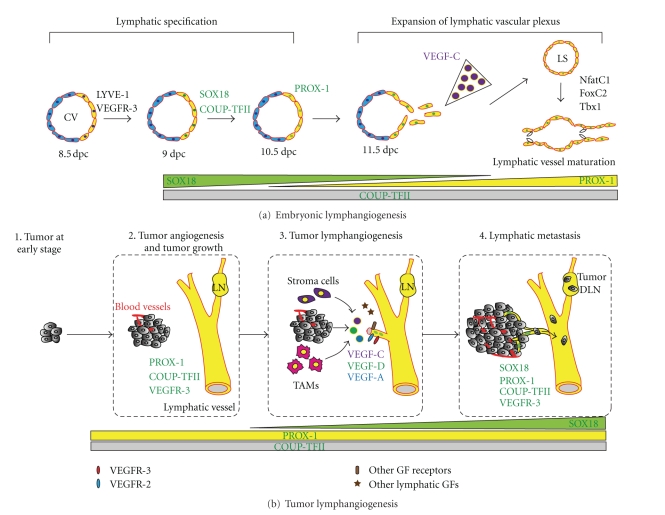
Figure 1
Figure 1
Embryonic lymphangiogenesis versus tumor lymphangiogenesis. (a) During early lymphatic vessel development, lymphatic endothelial precursor cells (SOX18+/COUP-TFII+/PROX-1+) from the CV migrate outwards and form lymph sacs (LS), from which lymphatic vessels start to extend throughout the body. (b) In a tumor microenvironment, various lymphatic growth factors are secreted from tumor cells, inflammatory cells (e.g., TAMs), and stroma cells. These factors stimulate the formation of tumor neolymphatics, either in the peritumoral or intratumoral area, which facilitate the intravasation of cancer cells into lymphatic vessels. Interestingly, several key early factors in embryonic lymphangiogenesis also play critical roles during tumor lymphangiogenesis. In particular, SOX18 is not required for maintenance of adult lymphatics but appears to be reactivated and regulate the formation of tumor neolymphatics. CV, cardinal vein; LS, lymph sac; dpc, days coitum; GF, growth factor; LN, lymph node; DLN, draining lymph node; TAMs, tumor-associated macrophages.
Figure 2
Figure 2
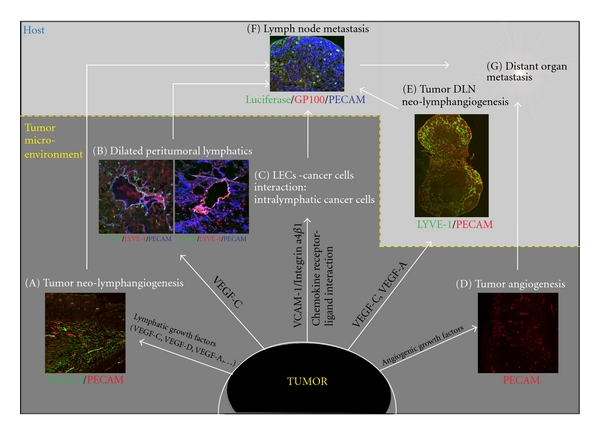
Biology of tumor lymphangiogenesis and metastasis. (A), (B) Stimulation of tumor neo-lymphangiogenesis and enlargement of tumor lymphatics can facilitate intravasation of cancer cells into the lymphatics. (C) The interaction between tumor cells and LECs via tumor cell receptors (e.g., Integrin α4β1) and endothelial cell adhesion molecules (e.g., VCAM-1) or via chemokine receptor ligand interaction (e.g., CCR7/CCL21) can facilitate the invasion of cancer cells into lymphatic vessels (intralymphatic cancer cells). (E) Notably, lymphangiogenesis also occurs at the tumor draining lymph node (DLN) before metastasis of cancer cells to this site, probably to generate a favourable environment for in-coming metastatic cancer cells at this site. (F) Intralymphatic cancer cells then metastasize to the tumor DLN. (D), (sG) Additionally, tumor angiogenesis also contributes to distant organ metastasis. The tumor microenvironment has a critical impact on tumor progression and metastasis. LECs, lymphatic endothelial cells; DLN, draining lymph node.
Figure 3
Figure 3
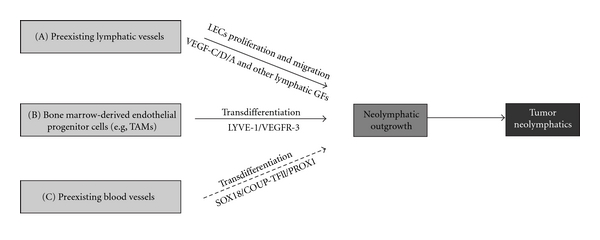
Potential cellular origins of tumor lymphatic endothelial cells. (A) Neolymphatics mainly arise from preexisting vasculature by proliferation and migration of LECs. (B) Bone marrow-derived endothelial progenitor cells (e.g., tumor-associated macrophages—TAMs) can also transdifferentiate into LECs, which further incorporate into the pre-existing lymphatic vasculature. (C) BECs can transdifferentiate into LECs under stimulation of reexpressed lymphatic transcription factors and lymphatic growth factor receptors. This mechanism has not been shown in in vivo (dashed line arrow).
Figure 4
Figure 4
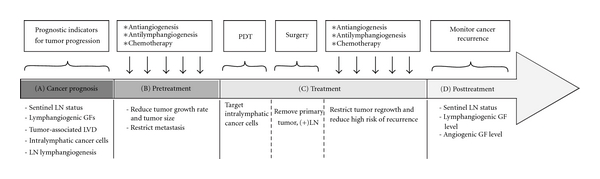
Schematic for potential clinical strategies in treatment of metastatic disease. (A) Tumor progression can be evaluated based on several prognostic indicators including tumor lymphangiogenesis and sentinal LNs status. These steps will guide the therapeutic decision to adopt anti-lymphangiogenic strategies if the tumor appears to be lymphangiogenesis-dependent and/or to have lymph node metastasis. (B) Antiangiogenesis, anti-lymphangiogenesis, and chemotherapy can be applied to reduce tumor growth and restrict metastasis before surgery. For advanced disease or nonresectable tumors, there will be no surgery [171]. (C) Photodynamic therapy (PDT) also can be performed before removal of the primary tumor, to eradicate in-transit tumor cells and prevent tumor relapse. Anti-lymphangiogenic, antiangiogenic, and chemotherapy can also be applied later, to prevent tumor regrowth and metastasis. (D) Cancer recurrence can be monitored by checking sentinel LN status, lymphangiogenic and angiogenic growth factor levels. PDT, photodynamic therapy; LN, lymph node; LVD, lymphatic vessel density; GF, growth factor (adapted from [171]).

References

    1. Paget S. The distribution of secondary growths in cancer of the breast. The Lancet. 1889;133(3421):571–573. - PubMed
    1. Ewing J. Neoplastic Diseases. 6th edition. Vol. 16. Philadelphia, Pa, USA: W. B. Saunders; 1928.
    1. Alitalo K, Tammela T, Petrova TV. Lymphangiogenesis in development and human disease. Nature. 2005;438(7070):946–953. - PubMed
    1. Shayan R, Achen MG, Stacker SA. Lymphatic vessels in cancer metastasis: bridging the gaps. Carcinogenesis. 2006;27(9):1729–1738. - PubMed
    1. Cao Y. Opinion: emerging mechanisms of tumour lymphangiogenesis and lymphatic metastasis. Nature Reviews Cancer. 2005;5(9):735–743. - PubMed

LinkOut - more resources