. 2012:2012:182834.
doi: 10.1155/2012/182834. Epub 2012 Feb 28.

Reticulophagy and ribophagy: regulated degradation of protein production factories

Affiliations

Reticulophagy and ribophagy: regulated degradation of protein production factories

Eduardo Cebollero et al. Int J Cell Biol. 2012.

Abstract

During autophagy, cytosol, protein aggregates, and organelles are sequestered into double-membrane vesicles called autophagosomes and delivered to the lysosome/vacuole for breakdown and recycling of their basic components. In all eukaryotes this pathway is important for adaptation to stress conditions such as nutrient deprivation, as well as to regulate intracellular homeostasis by adjusting organelle number and clearing damaged structures. For a long time, starvation-induced autophagy has been viewed as a nonselective transport pathway; however, recent studies have revealed that autophagy is able to selectively engulf specific structures, ranging from proteins to entire organelles. In this paper, we discuss recent findings on the mechanisms and physiological implications of two selective types of autophagy: ribophagy, the specific degradation of ribosomes, and reticulophagy, the selective elimination of portions of the ER.


Figures
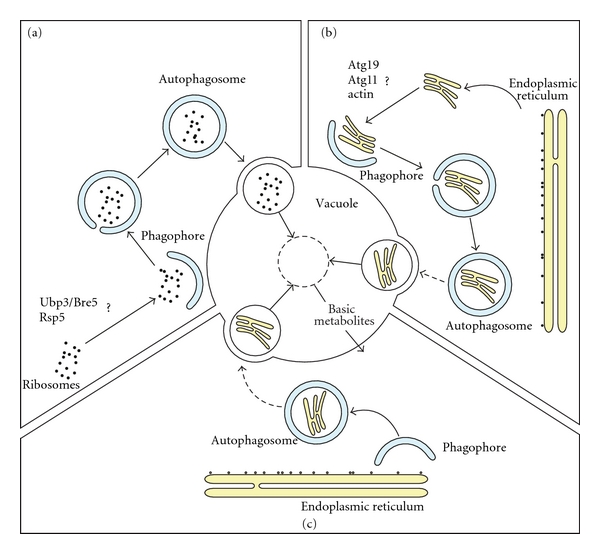
Figure 1
Figure 1
Mechanisms of ribophagy and reticulophagy in yeast. (a) A model for ribophagy. Under ribophagy inducing conditions, ribosomes are selectively engulfed into autophagosomes and subsequently degraded in the vacuole. The generated basic metabolites (amino acids, sugars, fatty acids etc.) are then recycled back to the cytoplasm for reuse or as a source of energy. ((b) and (c)) Models for reticulophagy. Under stress conditions, due to an accumulation of unfolded proteins and/or protein aggregates, a partial scission of the ER occurs and the formed fragments are specifically transported to the sites where autophagosome biogenesis takes place (b). ER stress triggers the recruitment of the Atg proteins onto or close to this organelle. There, possibly by utilizing the ER membranes, the Atg proteins mediate the formation of autophagosomes, which expand around the ER sections that have to be removed (c). The dashed arrows indicate that under specific ER stress conditions, autophagosomes do not fuse with the vacuole. Question marks highlight proteins that have been implicated in the transport and selection of the cargo in which the mechanism of action remains to be elucidated.
Figure 2
Figure 2
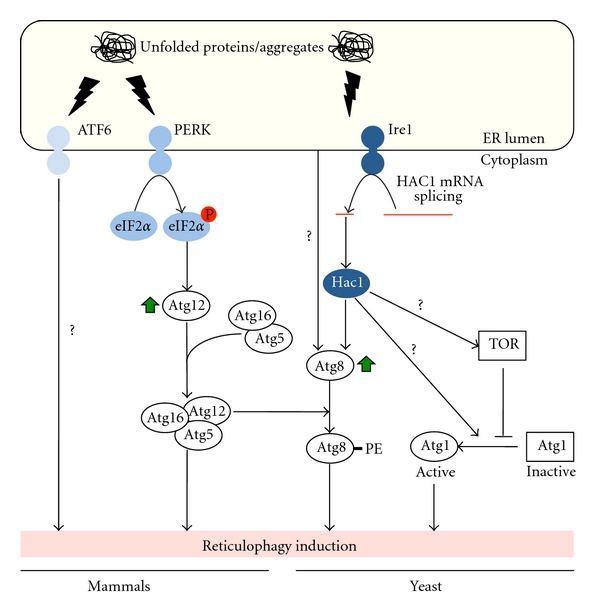
Signalling cascades inducing reticulophagy upon ER stress. The transmembrane protein Ire1 (yeast and mammals), ATF6, and PERK (mammals) sense the accumulation of unfolded proteins and/or aggregates, and trigger a general transcriptional response that affect the levels of proteins involved in autophagy. These include Atg8 (signal mediated through Ire1/Hac1 and unidentified alternative pathways in yeast) and Atg12 (mediated by the PERK/eIF2α signalling cascade in mammals). The Atg12-Atg5 (Atg16) complex facilitates the lipidation of Atg8 and autophagy induction. Unknown signalling events in yeast, dependent or independent of the inhibition of the Tor kinase, promote Atg1 activation. Green arrows indicate an increase in protein levels. Question marks indicate signalling cascades that may exist but have not yet been characterized.

References

    1. Levine B, Mizushima N, Virgin HW. Autophagy in immunity and inflammation. Nature. 2011;469(7330):323–335. - PMC - PubMed
    1. Mizushima N, Levine B. Autophagy in mammalian development and differentiation. Nature Cell Biology. 2010;12(9):823–830. - PMC - PubMed
    1. Levine B, Kroemer G. Autophagy in the pathogenesis of disease. Cell. 2008;132(1):27–42. - PMC - PubMed
    1. Mizushima N, Levine B, Cuervo AM, Klionsky DJ. Autophagy fights disease through cellular self-digestion. Nature. 2008;451(7182):1069–1075. - PMC - PubMed
    1. Nakatogawa H, Suzuki K, Kamada Y, Ohsumi Y. Dynamics and diversity in autophagy mechanisms: lessons from yeast. Nature Reviews Molecular Cell Biology. 2009;10(7):458–467. - PubMed

LinkOut - more resources