Meta-Analysis
. 2012 Apr 6;90(4):636-47.
doi: 10.1016/j.ajhg.2012.02.020.

Combined analysis of genome-wide association studies for Crohn disease and psoriasis identifies seven shared susceptibility loci

Affiliations
Meta-Analysis

Combined analysis of genome-wide association studies for Crohn disease and psoriasis identifies seven shared susceptibility loci

David Ellinghaus et al. Am J Hum Genet. .

Abstract

Psoriasis (PS) and Crohn disease (CD) have been shown to be epidemiologically, pathologically, and therapeutically connected, but little is known about their shared genetic causes. We performed meta-analyses of five published genome-wide association studies on PS (2,529 cases and 4,955 controls) and CD (2,142 cases and 5,505 controls), followed up 20 loci that showed strongest evidence for shared disease association and, furthermore, tested cross-disease associations for previously reported PS and CD risk alleles in additional 6,115 PS cases, 4,073 CD cases, and 10,100 controls. We identified seven susceptibility loci outside the human leukocyte antigen region (9p24 near JAK2, 10q22 at ZMIZ1, 11q13 near PRDX5, 16p13 near SOCS1, 17q21 at STAT3, 19p13 near FUT2, and 22q11 at YDJC) shared between PS and CD with genome-wide significance (p < 5 × 10(-8)) and confirmed four already established PS and CD risk loci (IL23R, IL12B, REL, and TYK2). Three of the shared loci are also genome-wide significantly associated with PS alone (10q22 at ZMIZ1, p(rs1250544) = 3.53 × 10(-8), 11q13 near PRDX5, p(rs694739) = 3.71 × 10(-09), 22q11 at YDJC, p(rs181359) = 8.02 × 10(-10)). In addition, we identified one susceptibility locus for CD (16p13 near SOCS1, p(rs4780355) = 4.99 × 10(-8)). Refinement of association signals identified shared genome-wide significant associations for exonic SNPs at 10q22 (ZMIZ1) and in silico expression quantitative trait locus analyses revealed that the associations at ZMIZ1 and near SOCS1 have a potential functional effect on gene expression. Our results show the usefulness of joint analyses of clinically distinct immune-mediated diseases and enlarge the map of shared genetic risk loci.


Figures

Figure 1
Figure 1
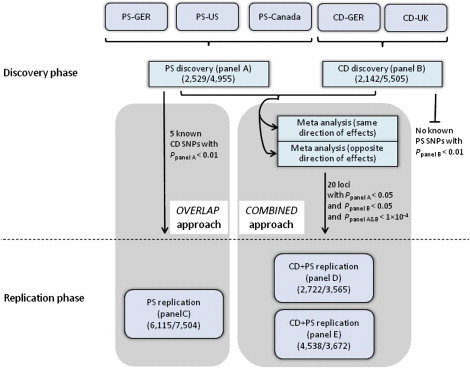
Study Design for the Combined Analysis of CD and PS For discovery, we conducted a PS and a CD GWAS meta-analysis (panel A and B in Table S1), respectively, and employed two strategies (OVERLAP and COMBINED) to systematically search for shared risk loci. In a first approach (OVERLAP), we tested established non-HLA PS risk SNPs for potential association (p < 0.01) with CD and vice versa. In a second approach (COMBINED), we selected SNPs from 20 loci for being nominally associated in each of the single-disease meta-analyses (ppanel A < 0.05, ppanel B < 0.05) and for being significantly associated in the combined-phenotype association analysis at the 10−4 level (ppanel A&B < 10−4). For replication, follow-up SNP genotyping was performed for CD and PS in independent replication panels (panels C–E in Table S1). The following abbreviations are used: PS-GER, German PS GWAS; PS-US, United States PS GWAS; PS-Canada, Canadian PS GWAS; CD-GER, German CD GWAS; and CD-UK, United Kingdom CD GWAS. For each panel, numbers of cases/controls are displayed in parentheses.
Figure 2
Figure 2
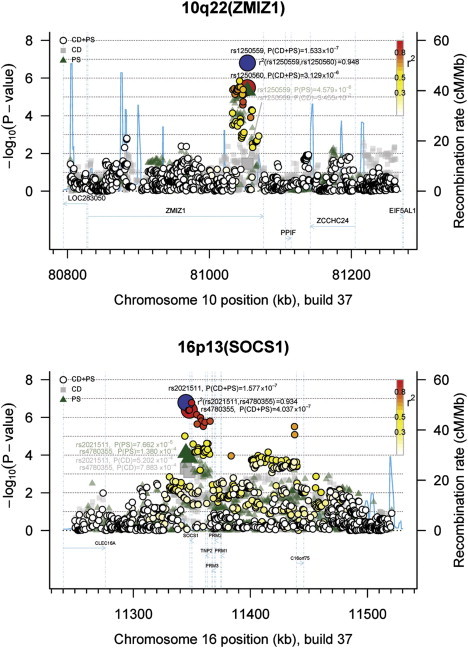
Regional Association Plots of In Silico Fine-Mapping for Newly Detected Shared Risk Loci from COMBINED Approach Shared risk loci for CD and PS at (A) 10q22 (ZMIZ1) and (B) 16p13 (near SOCS1). eQTL analyses revealed a potential effect of the associations at ZMIZ1 and near SOCS1 on gene expression. p values (−log10p) are depicted with regard to the physical location of markers and are based on imputed genotypes. SNP genotypes were imputed with the EUR reference from 1000 Genomes Project (see Subjects and Methods). The following abbreviations are used: blue-filled circle, lead SNP of the combined-phenotype data (panels A and B); other filled circles, analyzed SNPs of the combined-phenotype data (panels A and B) where the fill color corresponds to the strength of linkage disequilibrium (r2) with the lead SNP (for color coding see legend in the upper right corner of each plot); green triangles, analyzed SNPs of the meta-analysis on PS (panel A); gray squares, analyzed SNPs of the meta-analysis on CD (panel B); and blue line, recombination intensity (cM/Mb). Positions and gene annotations are according to NCBI's build 37 (hg19).
Figure 3
Figure 3
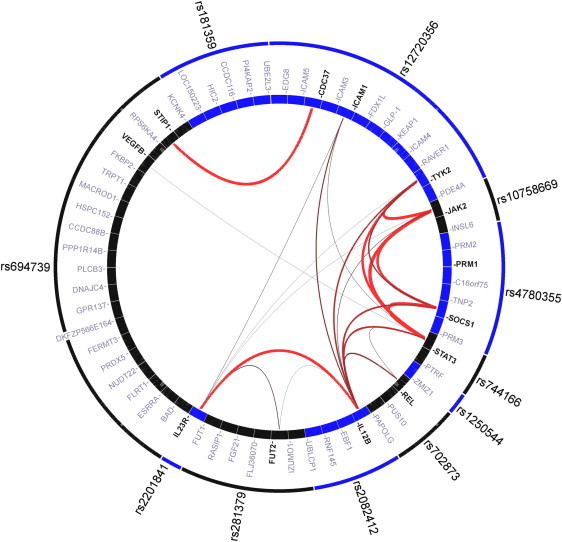
Gene Relationships across the 11 Shared Risk Loci of CD and PS Identified by GRAIL Analysis GRAIL is a statistical text-mining approach to quantify the degree of relatedness among genes in genomic disease regions. It estimates the statistical significance of the number of observed relationships with a null model in which relationships between the genes occur by random chance. A significance score ptext, which is adjusted for multiple hypothesis testing, represents the output GRAIL score. ptext values approximately estimate type-I error rates. Outer circle: lead SNPs from shared risk loci of both diseases; each box represents a SNP. Inner circle: genes of the genomic regions around lead SNPs that were identified based on LD properties; each box represents a gene; genes that were scored at ptext < 0.05 are significantly linked to genes in the other disease regions and are indicated in bold type. Lines: the lines between genes represent significant connections, with the thickness and redness of the lines being inversely proportional to the probability that a text-based connection would be seen by chance.

References

    1. Bhalerao J., Bowcock A.M. The genetics of psoriasis: A complex disorder of the skin and immune system. Hum. Mol. Genet. 1998;7:1537–1545. - PubMed
    1. Elder J.T., Nair R.P., Guo S.W., Henseler T., Christophers E., Voorhees J.J. The genetics of psoriasis. Arch. Dermatol. 1994;130:216–224. - PubMed
    1. Russell R.K., Satsangi J. IBD: A family affair. Best Pract. Res. Clin. Gastroenterol. 2004;18:525–539. - PubMed
    1. Griffiths C.E., Barker J.N. Pathogenesis and clinical features of psoriasis. Lancet. 2007;370:263–271. - PubMed
    1. Logan I., Bowlus C.L. The geoepidemiology of autoimmune intestinal diseases. Autoimmun. Rev. 2010;9:A372–A378. - PubMed

Publication types