


Spatial modeling of cell signaling networks
- PMID: 22482950
- PMCID: PMC3519356
- DOI: 10.1016/B978-0-12-388403-9.00008-4
Spatial modeling of cell signaling networks
Abstract
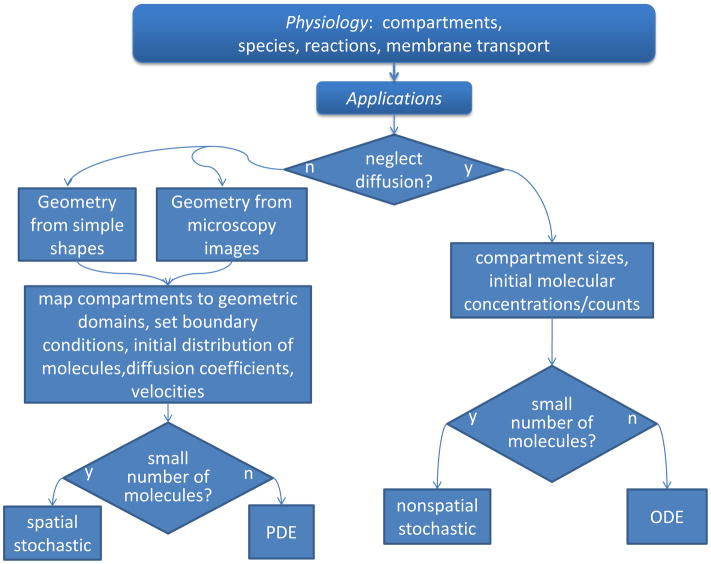
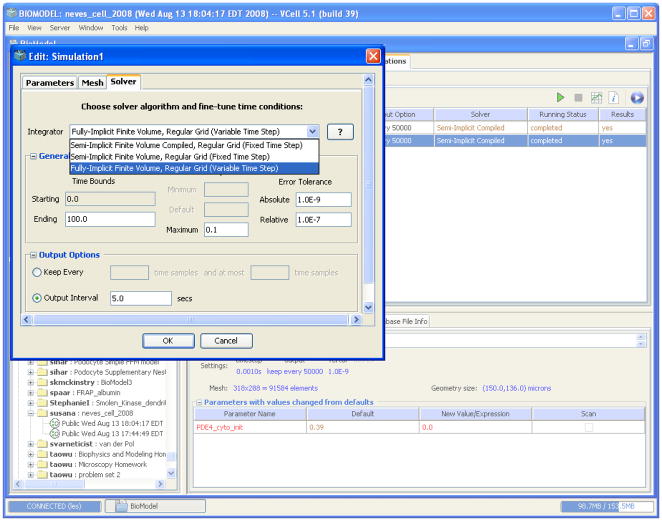
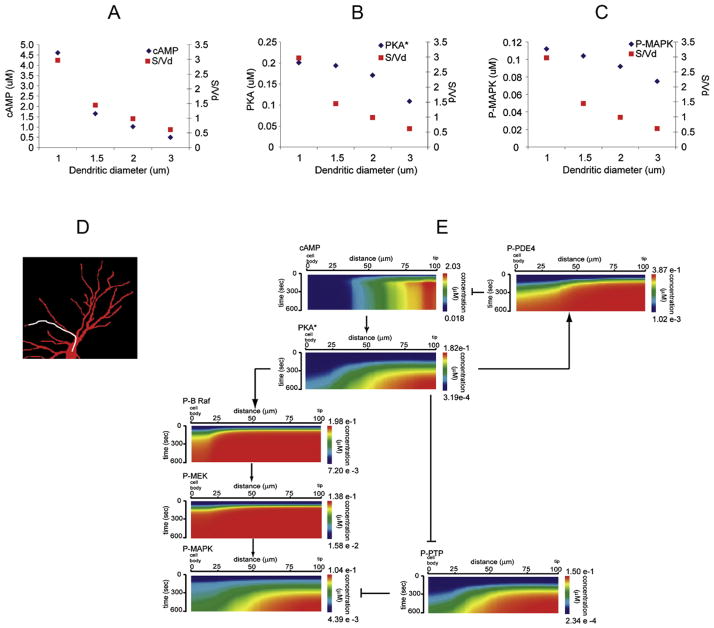
The shape of a cell, the sizes of subcellular compartments, and the spatial distribution of molecules within the cytoplasm can all control how molecules interact to produce a cellular behavior. This chapter describes how these spatial features can be included in mechanistic mathematical models of cell signaling. The Virtual Cell computational modeling and simulation software is used to illustrate the considerations required to build a spatial model. An explanation of how to appropriately choose between physical formulations that implicitly or explicitly account for cell geometry and between deterministic versus stochastic formulations for molecular dynamics is provided, along with a discussion of their respective strengths and weaknesses. As a first step toward constructing a spatial model, the geometry needs to be specified and associated with the molecules, reactions, and membrane flux processes of the network. Initial conditions, diffusion coefficients, velocities, and boundary conditions complete the specifications required to define the mathematics of the model. The numerical methods used to solve reaction-diffusion problems both deterministically and stochastically are then described and some guidance is provided in how to set up and run simulations. A study of cAMP signaling in neurons ends the chapter, providing an example of the insights that can be gained in interpreting experimental results through the application of spatial modeling.
Copyright © 2012 Elsevier Inc. All rights reserved.
Figures

References
VI. Further Reading
-
- Alves R, Antunes F, Salvador A. Tools for kinetic modeling of biochemical networks. Nat Biotech. 2006;24:667–672. - PubMed
-
- Czech J, Dittrich M, Stiles JR. Rapid creation, Monte Carlo simulation, and visualization of realistic 3D cell models. Methods Mol Biol. 2009;500:237–287. - PubMed
-
- Hattne J, Fange D, Elf J. Stochastic reaction-diffusion simulation with MesoRD. Bioinformatics. 2005;21:2923–2924. - PubMed
Publication types
MeSH terms
Substances
Grants and funding
LinkOut - more resources
Full Text Sources
Other Literature Sources
Molecular Biology Databases
Research Materials
