Review
. 2012 Jul;20(7):1227-44.
doi: 10.1007/s00167-012-1985-7. Epub 2012 Apr 8.

The controversy of patellar resurfacing in total knee arthroplasty: Ibisne in medio tutissimus?

Affiliations
Review

The controversy of patellar resurfacing in total knee arthroplasty: Ibisne in medio tutissimus?

Oliver S Schindler. Knee Surg Sports Traumatol Arthrosc. 2012 Jul.

Abstract

Early arthroplasty designs were associated with a high level of anterior knee pain as they failed to cater for the patello-femoral joint. Patellar resurfacing was heralded as the saviour safeguarding patient satisfaction and success but opinion on its necessity has since deeply divided the scientific community and has become synonymous to topics of religion or politics. Opponents of resurfacing contend that the native patella provides better patellar tracking, improved clinical function, and avoids implant-related complications, whilst proponents argue that patients have less pain, are overall more satisfied, and avert the need for secondary resurfacing. The question remains whether complications associated with patellar resurfacing including those arising from future component revision outweigh the somewhat increased incidence of anterior knee pain recorded in unresurfaced patients. The current scientific literature, which is often affected by methodological limitations and observer bias, remains confusing as it provides evidence in support of both sides of the argument, whilst blinded satisfaction studies comparing resurfaced and non-resurfaced knees generally reveal equivalent results. Even national arthroplasty register data show wide variations in the proportion of patellar resurfacing between countries that cannot be explained by cultural differences alone. Advocates who always resurface or never resurface indiscriminately expose the patella to a random choice. Selective resurfacing offers a compromise by providing a decision algorithm based on a propensity for improved clinical success, whilst avoiding potential complications associated with unnecessary resurfacing. Evidence regarding the validity of selection criteria, however, is missing, and the decision when to resurface is often based on intuitive reasoning. Our lack of understanding why, irrespective of pre-operative symptoms and patellar resurfacing, some patients may suffer pain following TKA and others may not have so far stifled our efforts to make the strategy of selective resurfacing succeed. We should hence devote our efforts in defining predictive criteria and indicators that will enable us to reliably identify those individuals who might benefit from a resurfacing procedure. Level of evidence V.


Figures
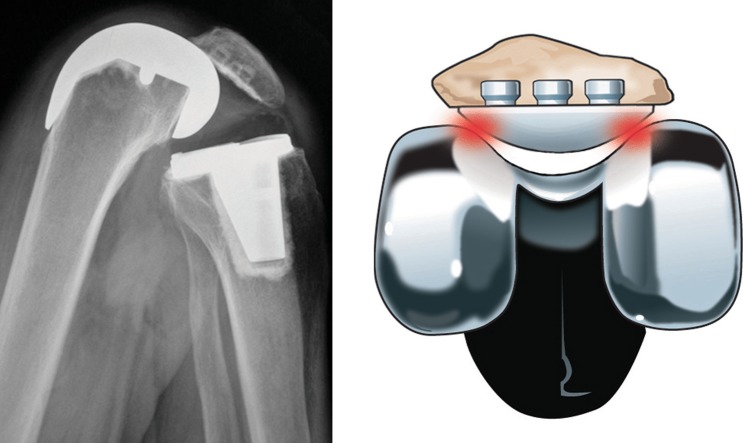
Fig. 1
Fig. 1
High patello-femoral reaction forces occur during knee flexion beyond 90°, when the patellar component leaves the trochlea groove, straddling the intercondylar notch, and contact areas decrease dramatically [124]
Fig. 2
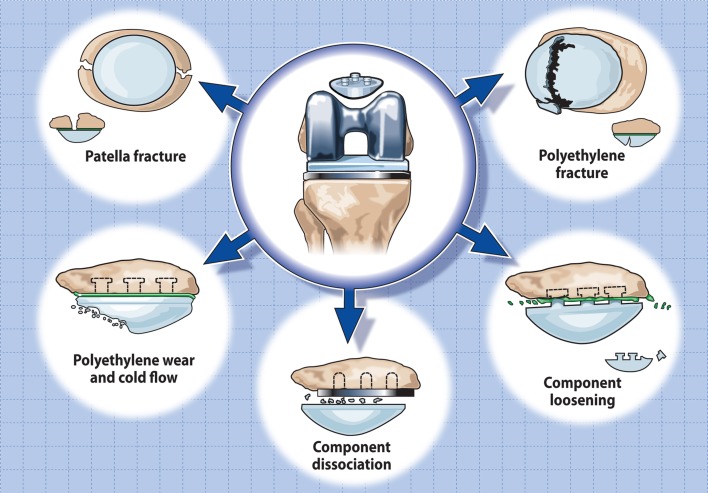
Fig. 2
Common failure modes associated with patellar resurfacing
Fig. 3
Fig. 3
Two femoral components demonstrating design changes to improve patellar function. Unmodified Ortholoc® femoral component with relatively patella unfriendly trochlea configuration (right) and modified Ortholoc® femoral component (left) with asymmetrical, anatomic femoral groove, elevated lateral trochlea flange, and elongated trochlea groove (Arthroplasty components courtesy of Leo Whiteside and associates from the Missouri Bone and Joint Research Foundation, St Louis/MO, USA)
Fig. 4
Fig. 4
Commonly used types of patellar component design configurations [125]
Fig. 5
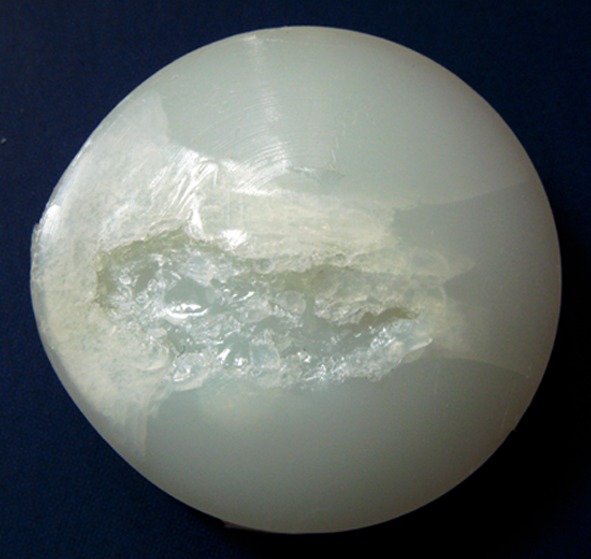
Fig. 5
Retrieved patellar component showing signs of catastrophic wear characterised by a variety of wear mechanisms including cold flow, pitting, abrasion, sub-surface fracture, and delmination
Fig. 6
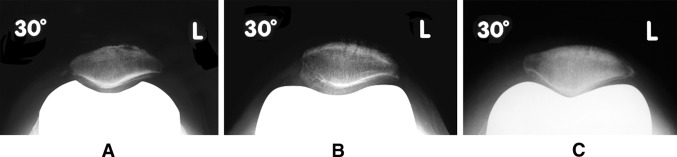
Fig. 6
Post-operative skyline radiographs showing the native patella articulating with three different prosthetic femoral TKA components displaying varying degrees of ‘patella-friendly’ design features. A: Optetrak®, Exactech, USA; B: AGC® Biomet, USA; C: LCS®, DePuy, USA
Fig. 7
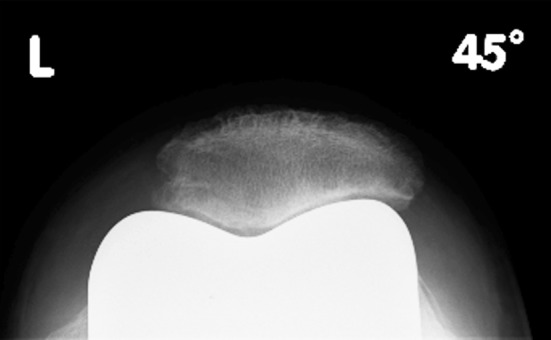
Fig. 7
Skyline radiograph obtained 3 years following TKA demonstrating signs of biological remodelling (‘stress contouring’) of the retro-patellar surface
Fig. 8
Fig. 8
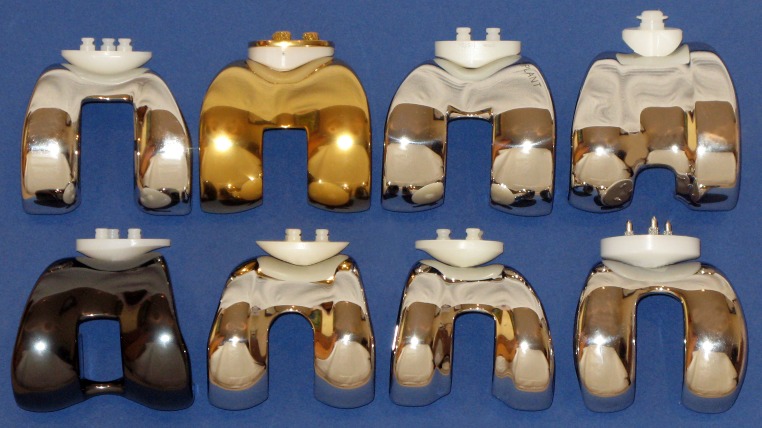
Various femoral arthroplasty components with their respective, designated patellar implant. Top row, left to right: AGC® (dome patella), Biomet, Warsaw, USA; Buechel-Pappas (uncemented anatomic rotating platform patella), Endotec, Orlando, USA; LCS® (anatomical fixed bearing patella), DePuy, Warsaw, USA; Medial rotating knee® (cylindrical patella), Finsbury, England. Bottom row, left to right: Journey® (off-set dome patella), Smith and Nephew, Andover, USA; PFC-Sigma® (modified dome patella), DePuy; Triathlon® (off-set dome patella), Stryker, Kalamazoo, USA; BioPro® Townley Total Knee Original (uncemented metal-backed dome patella), Biopro, Port Huron, USA
Fig. 9
Fig. 9
Illustration extracted from the 2010 annual report of the Swedish Knee Arthroplasty Register showing the yearly distribution concerning the use of patellar components in TKA between 1975 and 2010 (Courtesy of Otto Robertsson and with kind permission of the Swedish Arthroplasty Register)
Fig. 10
Fig. 10
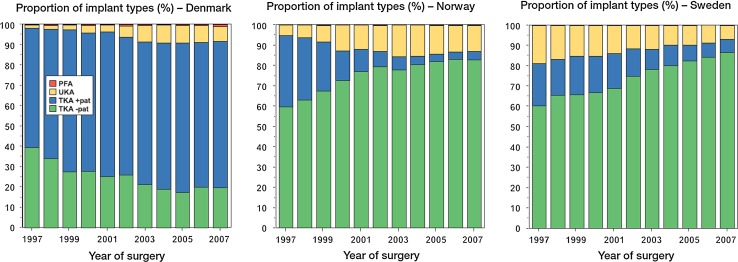
Proportion of implants types used for primary knee arthroplasty in Denmark, Norway and Sweden. Blue column demonstrates the proportion of resurfaced patellae, and green column demonstrates the proportion of patellae which have been left unresurfaced. Please note the significant differences and trends regarding patella resurfacing between the three countries [119]. Courtesy of Otto Robertsson and with kind permission of Acta Orthopaedica)

Comment in

  • The forgotten joint.
    Karlsson J. Karlsson J. Knee Surg Sports Traumatol Arthrosc. 2012 Jul;20(7):1215. doi: 10.1007/s00167-012-2072-9. Knee Surg Sports Traumatol Arthrosc. 2012. PMID: 22660973 No abstract available.

References

    1. Abraham W, Buchanan JR, Daubert H, Greer RB, III, Keefer J. Should the patella be resurfaced in total knee arthroplasty? Efficacy of patellar resurfacing. Clin Orthop Relat Res. 1988;236:128–134. - PubMed
    1. Aglietti P, Insall JN, Walker PS, Trent PS. A new patella prosthesis: design and application. Clin Orthop Relat Res. 1975;107:175–187. doi: 10.1097/00003086-197503000-00023. - DOI - PubMed
    1. Ahmad R, Kumar GS, Katam K, Pozo JL. Significance of ‘hot patella’ in total knee replacement without primary patellar resurfacing. Knee. 2009;16:337–340. doi: 10.1016/j.knee.2009.02.001. - DOI - PubMed
    1. Amstutz HC, Finerman GAM. Knee joint replacement-development and evaluation. Clin Orthop Relat Res. 1973;94:24–41. doi: 10.1097/00003086-197307000-00005. - DOI - PubMed
    1. Anderson JG, Wixson RL, Tsai D, Stuhlberg SD, Chang RW. Functional outcome and patient satisfaction in total knee patients over the age of 75. J Arthroplasty. 1996;11:831–840. doi: 10.1016/S0883-5403(96)80183-5. - DOI - PubMed