Dose-response relationship between selective serotonin re-uptake inhibitors and injurious falls: a study in nursing home residents with dementia
- PMID: 22486601
- PMCID: PMC3403209
- DOI: 10.1111/j.1365-2125.2011.04124.x
Dose-response relationship between selective serotonin re-uptake inhibitors and injurious falls: a study in nursing home residents with dementia
Abstract
Aim: The contribution of selective serotonin re-uptake inhibitors (SSRIs) to injurious fall risk in patients with dementia has not been quantified precisely until now. Our objective was to determine whether a dose-response relationship exists for the use of SSRIs and injurious falls in a population of nursing home residents with dementia.
Methods: Daily drug use and daily falls were recorded in 248 nursing home residents with dementia from 1 January 2006 until 1 January 2008. For each resident and for each day of the study period, data on drug use were abstracted from the prescription database, and information on falls and subsequent injuries was retrieved from a standardized incident report system, resulting in a dataset of 85,074 person-days.
Results: We found a significant dose-response relationship between injurious falls and the use of SSRIs. The risk of an injurious fall increased significantly with 31% at 0.25 of the Defined Daily Dose (DDD) of a SSRI, 73% at 0.50 DDD, and 198% at 1.00 DDD (Hazard ratio = 2.98; 95% confidence interval 1.94, 4.57). The risk increased further in combination with a hypnotic or sedative.
Conclusions: Even at low doses, SSRIs are associated with increased risk of an injurious fall in nursing home residents with dementia. Higher doses increase the risk further with a three-fold risk at 1.00 DDD. New treatment protocols might be needed that take into account the dose-response relationship between SSRIs and injurious falls.
© 2012 The Authors. British Journal of Clinical Pharmacology © 2012 The British Pharmacological Society.
Figures
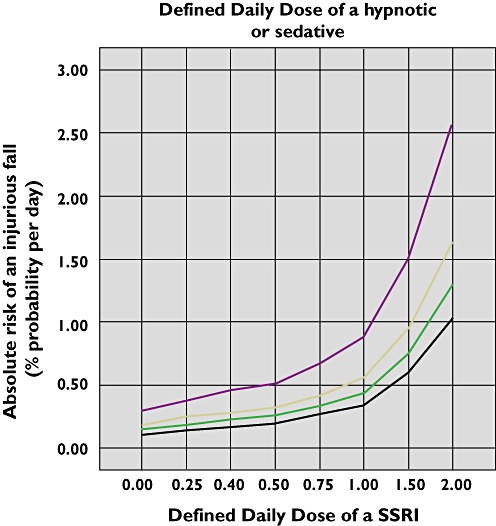
 ); 0.25 (
 ); 0.50 (
 ); 1.00 (
 )
)References
-
- Heinze C, Halfens RJ, Dassen T. Falls in German in-patients and residents over 65 years of age. J Clin Nurs. 2007;16:495–501. - PubMed
-
- Rubenstein LZ, Josephson KR, Robbins AS. Falls in the nursing home. Ann Intern Med. 1994;121:442–51. - PubMed
-
- Nurmi I, Luthje P. Incidence and costs of falls and fall injuries among elderly in institutional care. Scand J Prim Health Care. 2002;20:118–22. - PubMed
-
- Dijcks BP, Neyens JC, Schols JM, van Haastregt JC, de Witte LP. Falls in nursing homes: on average almost two per bed per year, resulting in a fracture in 1.3. Ned Tijdschr Geneeskd. 2005;149:1043–7. - PubMed
-
- Neyens JC, Dijcks BP, Twisk J, Schols JM, van Haastregt JC, van den Heuvel WJ. A multifactorial intervention for the prevention of falls in psychogeriatric nursing home patients, a randomised controlled trial (RCT) Age Ageing. 2009;38:194–9. - PubMed
MeSH terms
Substances
LinkOut - more resources
Full Text Sources
Medical
Research Materials