. 2012 Jun 15;232(1):37-43.
doi: 10.1016/j.bbr.2012.03.037. Epub 2012 Mar 31.

Pharmacological enhancement of calcium-activated potassium channel function reduces the effects of repeated stress on fear memory

Affiliations

Pharmacological enhancement of calcium-activated potassium channel function reduces the effects of repeated stress on fear memory

Derek Atchley et al. Behav Brain Res. .

Abstract

Repeated stress impacts emotion, and can induce mood and anxiety disorders. These disorders are characterized by imbalance of emotional responses. The amygdala is fundamental in expression of emotion, and is hyperactive in many patients with mood or anxiety disorders. Stress also leads to hyperactivity of the amygdala in humans. In rodent studies, repeated stress causes hyperactivity of the amygdala, and increases fear conditioning behavior that is mediated by the basolateral amygdala (BLA). Calcium-activated potassium (K(Ca)) channels regulate BLA neuronal activity, and evidence suggests reduced small conductance K(Ca) (SK) channel function in male rats exposed to repeated stress. Pharmacological enhancement of SK channels reverses the BLA neuronal hyperexcitability caused by repeated stress. However, it is not known if pharmacological targeting of SK channels can repair the effects of repeated stress on amygdala-dependent behaviors. The purpose of this study was to test whether enhancement of SK channel function reverses the effects of repeated restraint on BLA-dependent auditory fear conditioning. We found that repeated restraint stress increased the expression of cued conditioned fear in male rats. However, 1-Ethyl-2-benzimidazolinone (1-EBIO, 1 or 10 mg/kg) or CyPPA (5 mg/kg) administered 30 min prior to testing of fear expression brought conditioned freezing to control levels, with little impact on fear expression in control handled rats. These results demonstrate that enhancement of SK channel function can reduce the abnormalities of BLA-dependent fear memory caused by repeated stress. Furthermore, this indicates that pharmacological targeting of SK channels may provide a novel target for alleviation of psychiatric symptoms associated with amygdala hyperactivity.


Figures

Figure 1
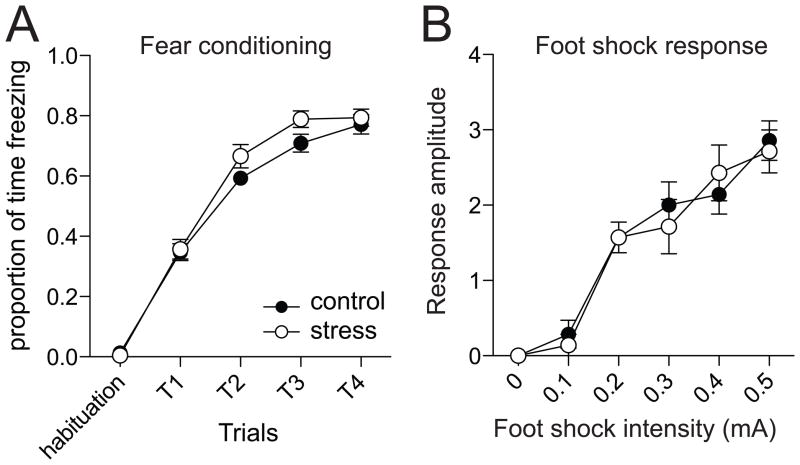
Figure 1. Repeated stress does not significantly increase fear acquisition or response to unconditioned stimulus
A) During the course of fear conditioning, a tone is paired with a footshock. The freezing response to the paired tone increases during the conditioning procedure. However, repeated restraint stress does not increase the freezing response observed during the conditioning procedure. B) The response to increasing amplitude footshock can be measured as an indication of the response to the unconditioned stimulus. Repeated restraint stress does not increase responsiveness to the footshock. Here, and in all plots, data points represent mean ± SEM.
Figure 2
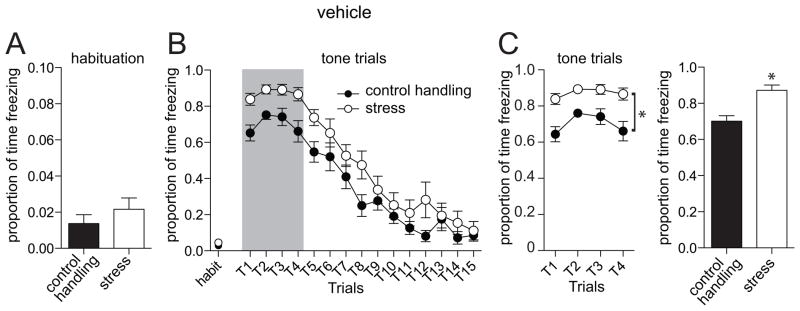
Figure 2. Repeated stress increases the memory of conditioned fear
A) When animals are placed in a novel chamber, there is no observed difference in freezing during habituation. B) When the conditioned tone is repeatedly presented, there is an initial robust freezing response that extinguishes with repeated presentation. There is a greater freezing response to the conditioned tone in animals that were exposed to repeated restraint stress. C) For comparison of fear memory, the first four trials were used (grey box in panel B), before significant extinction is observed. There is a significantly more freezing to the conditioned tone in animals exposed to repeated restraint stress. For this, and remaining figures, the amount of time freezing in the four expression trials (left), as well as the proportion of time spent freezing will be displayed (right). * indicates p<0.05.
Figure 3
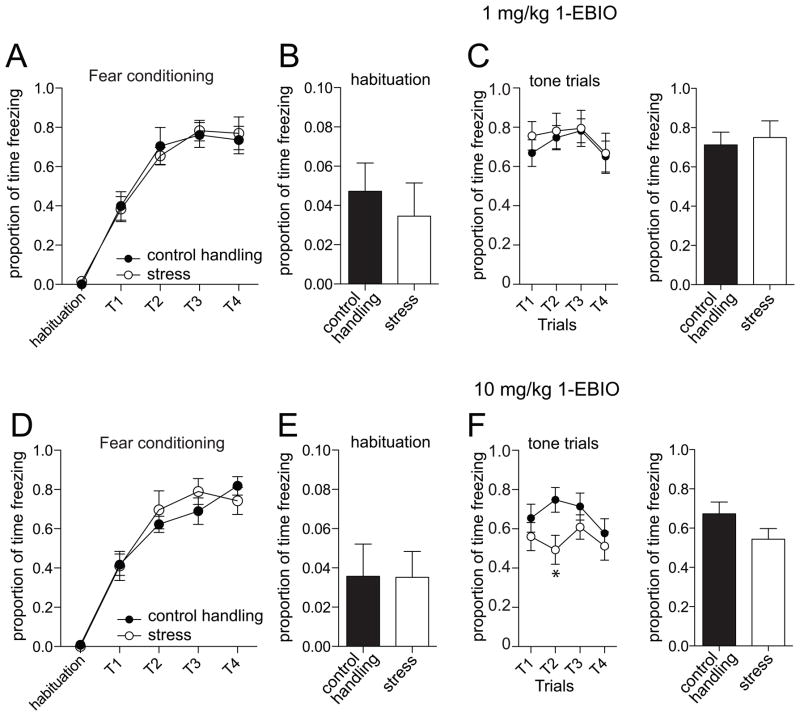
Figure 3. Administration of 1-EBIO normalizes fear memory
A) Freezing during acquisition of fear conditioning on the first day was not significantly different in those rats that were to be tested for the effectiveness of 1-EBIO (1 mg/kg) on fear memory during the second day. B) During habituation on the testing day, there is no significant effect of repeated restraint stress on freezing when 1-EBIO (1 mg/kg) is administered. C) During testing of memory of conditioned fear there is no significant effect of repeated restraint stress on freezing to the conditioned tone if 1-EBIO is administered (1 mg/kg), in contrast to vehicle conditions (Fig 2). D) Freezing during acquisition of fear conditioning on the first day was not significantly different in those rats that were to be tested for the effectiveness of 1-EBIO (10 mg/kg) on fear memory during the second day. E) During habituation on the testing day, there is no significant effect of repeated restraint stress on freezing when 1-EBIO (10 mg/kg) is administered. F) During testing of memory of conditioned fear there is no significant effect of repeated restraint stress on freezing to the conditioned tone if 1-EBIO is administered (10 mg/kg), in contrast to vehicle conditions (Fig 2).
Figure 4
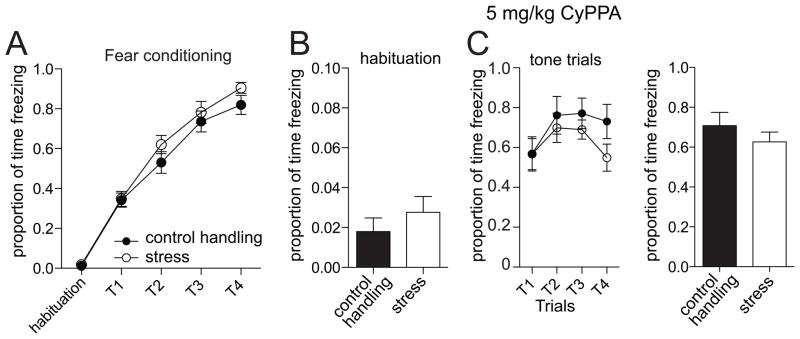
Figure 4. Administration of CyPPA normalizes fear memory
A) Freezing during acquisition of fear conditioning on the first day was not significantly different in those rats that were to be tested for the effectiveness of CyPPA (5 mg/kg) on fear memory during the second day. B) During habituation on the testing day, there is no significant effect of repeated restraint stress on freezing when CyPPA is administered. C) During testing of memory of conditioned fear there is no significant effect of repeated restraint stress on freezing to the conditioned tone if CyPPA is administered (5 mg/kg), in contrast to vehicle conditions (Fig 2).
Figure 5
Figure 5. Pharmacological enhancement of SK channels decreases conditioned freezing in animals exposed to repeated stress
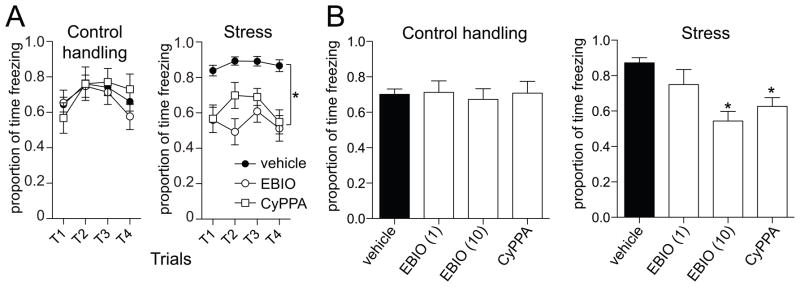
A) When comparing across stress condition, it is observed that 1-EBIO and CyPPA decrease conditioned freezing time in animals exposed to repeated restraint stress, but not in controls. B) The proportion of time freezing in response to a conditioned tone is decreased in a dose-dependent manner by 1-EBIO and decreased by CyPPA compared to vehicle in animals exposed to repeated restraint stress (right), but not control animals (left). EBIO (1) = 1 mg/kg 1-EBIO; EBIO (10) = 10 mg/kg 1-EBIO; * indicates significant difference compared to vehicle.
Figure 6
Figure 6. 1-EBIO does not increase locomotion or response to footshocks
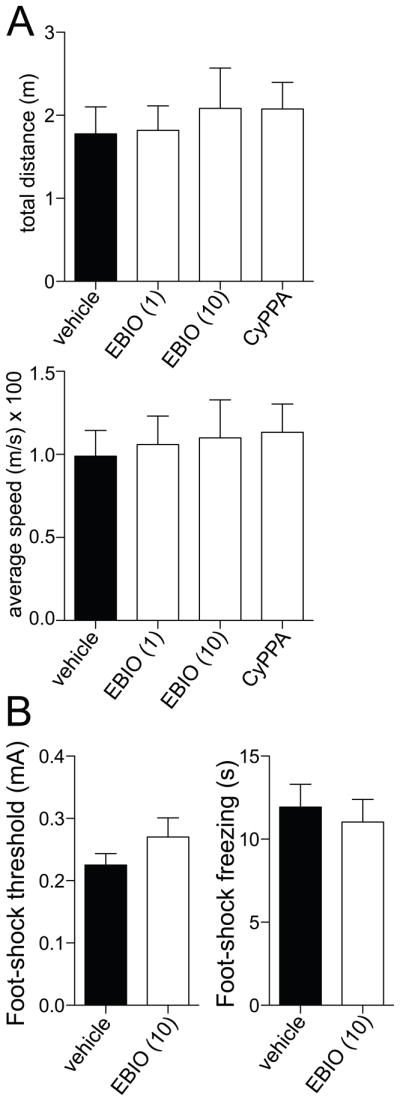
A) Administration of 1-EBIO or CyPPA does not significantly increase locomotion, measured during the pre-test habituation period as the total distance traveled (left) or the average speed (right). B) Administration of 1-EBIO (10 mg/kg) does not significantly decrease the response to aversive stimulation, measured as the threshold stimulation intensity to evoke a withdrawal response to a footshock (left) or the amount of time freezing following suprathreshold footshocks (0.5 mA).

References

    1. McLaughlin KJ, Baran SE, Conrad CD. Chronic stress- and sex-specific neuromorphological and functional changes in limbic structures. Mol Neurobiol. 2009;40:166–82. - PubMed
    1. Heim C, Nemeroff CB. The role of childhood trauma in the neurobiology of mood and anxiety disorders: preclinical and clinical studies. Biol Psychiatry. 2001;49:1023–39. - PubMed
    1. Lupien SJ, McEwen BS, Gunnar MR, Heim C. Effects of stress throughout the lifespan on the brain, behaviour and cognition. Nat Rev Neurosci. 2009;10:434–45. - PubMed
    1. Yehuda R. Post-traumatic stress disorder. N Engl J Med. 2002;346:108–14. - PubMed
    1. Wik G, Fredrikson M, Ericson K, Eriksson L, Stone-Elander S, Greitz T. A functional cerebral response to frightening visual stimulation. Psychiatry Res. 1993;50:15–24. - PubMed

Publication types

MeSH terms

Substances