


Integrin signaling in vascular function
- PMID: 22488305
- PMCID: PMC3652333
- DOI: 10.1097/MOH.0b013e3283523df0
Integrin signaling in vascular function
Abstract
Purpose of review: In the current review, we summarize recent progress on vasculature-specific function and regulation of integrins and integrin-associated proteins, including advances in our understanding of inside-out integrin activation. The studies on regulation of integrin activation received new impulse in 2009 with the identification of kindlin protein family members as crucial mediators of integrin inside-out signaling. In the current review, we outline the recent findings on the role of kindlins in the vascular system, as well as new studies that have begun shaping the mechanistic model of kindlins' function.
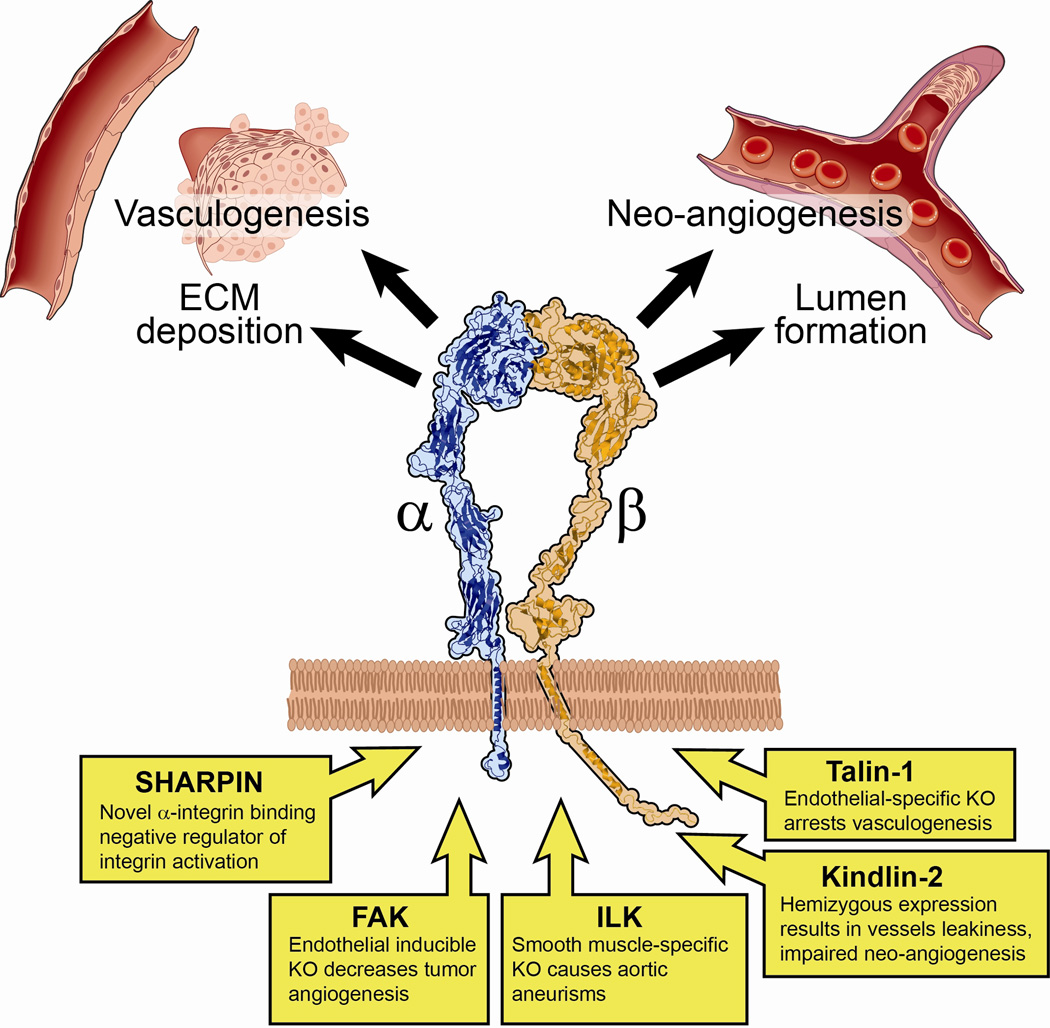
Recent findings: Several tissue-specific knockout models for integrins and genes associated with the integrin functions have been recently presented, including smooth muscle-specific integrin-linked kinase and endothelial-specific focal adhesion kinase and talin-1 ablation. In the heterozygous animal knockout model, kindlin-2 has been demonstrated as a crucial modulator of angiogenesis and vascular permeability. As a number of articles have advanced our understanding of kindlin function, they are reviewed and discussed in further detail. New findings include an additional lipid-binding site within the kindlin molecule and preferential binding of the nonphosphorylated form of β-integrins.
Summary: The role of integrins in angiogenesis has been demonstrated to include, in addition to cell adhesion and mechanotransduction, specific signaling functions. The importance of integrin inside-out pathway in vascular physiology has been unequivocally proven, and endothelial permeability is directly regulated by this process. Inhibition of kindlin-dependent steps in the inside-out pathway as an approach to block platelet aggregation should be paralog-specific, as it may have adverse effects on vascular permeability.
Conflict of interest statement
Authors declare no conflict of interest.
Figures
References
-
- Kiosses WB, Shattil SJ, Pampori N, et al. Rac recruits high-affinity integrin alphavbeta3 to lamellipodia in endothelial cell migration. Nat Cell Biol. 2001 Mar;3(3):316–320. - PubMed
-
- Moser M, Legate KR, Zent R, et al. The tail of integrins, talin, and kindlins. Science. 2009 May 15;324(5929):895–899. - PubMed
Publication types
MeSH terms
Substances
Grants and funding
LinkOut - more resources
Full Text Sources
Other Literature Sources
Research Materials
