


Circadian rhythms in executive function during the transition to adolescence: the effect of synchrony between chronotype and time of day
- PMID: 22490180
- PMCID: PMC4103784
- DOI: 10.1111/j.1467-7687.2012.01137.x
Circadian rhythms in executive function during the transition to adolescence: the effect of synchrony between chronotype and time of day
Abstract
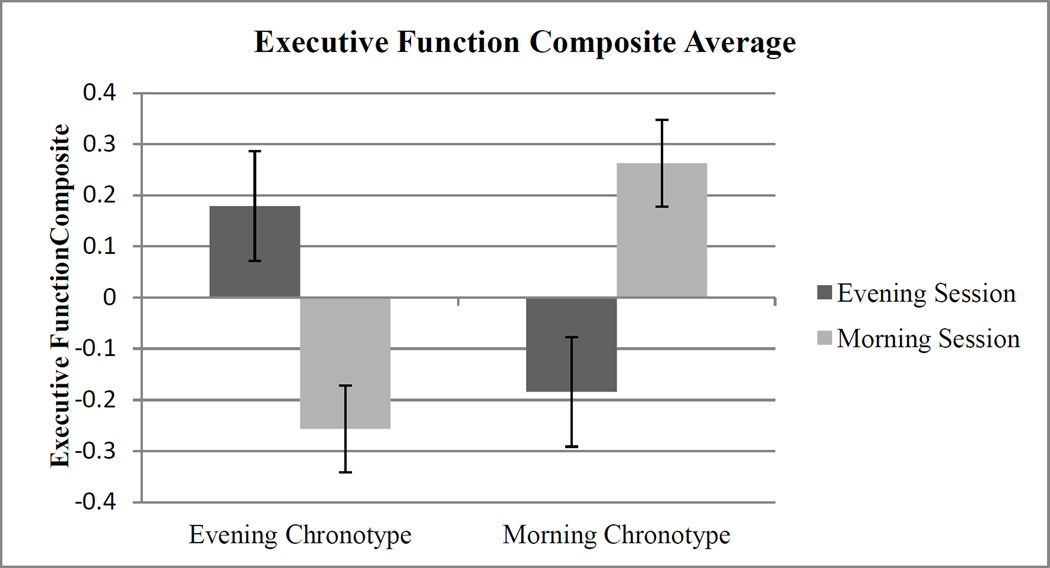
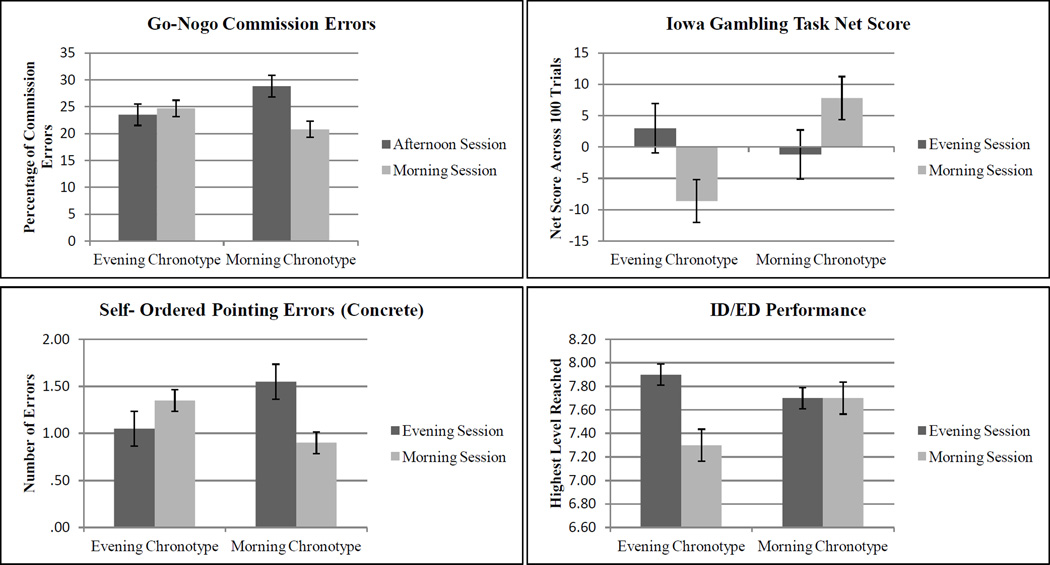
To explore the influence of circadian rhythms on executive function during early adolescence, we administered a battery of executive function measures (including a Go-Nogo task, the Iowa Gambling Task, a Self-ordered Pointing task, and an Intra/Extradimensional Shift task) to Morning-preference and Evening-preference participants (N = 80) between the ages of 11 and 14 years who were tested in the morning or afternoon. Significant Chronotype × Time of Day interactions (controlling for amount of sleep the previous night) revealed that adolescents tested at their optimal times of day performed better than those tested at their nonoptimal times. Implications for our understanding of physiological arousal, sleep, and executive function during adolescence are discussed.
© 2012 Blackwell Publishing Ltd.
Figures
References
-
- Aston-Jones G, Chen S, Zhu Y, Oshinsky ML. A neural circuit for circadian regulation of arousal. Nature Neuroscience. 2001;4:732–738. - PubMed
-
- Baumeister RF, Bratslavsky E, Muraven M, Tice DM. Self-control depletion: Is the active self a limited resource? Journal of Personality and Social Psychology. 1998;74I:1252–1265. - PubMed
-
- Bechara A, Damasio AR, Damasio H, Anderson SW. Insensitivity to future consequences following damage to human prefrontal cortex. Cognition. 1994;50(1–3):7–15. - PubMed
-
- Blair C, Dennis T. An optimal balance: Emotion-cognition integration in context. In: Calkins SD, Bell MA, editors. Child development at the intersection of cognition and emotion. Washington DC: American Psychological Association; 2010. pp. 17–36.
-
- Blair C, Razza RP. Relating effortful control, executive function, and false belief understanding to emerging math and literacy ability in kindergarten. Child Development. 2007;78(2):647–663. - PubMed
Publication types
MeSH terms
Grants and funding
LinkOut - more resources
Full Text Sources
