


High levels of soluble VEGF receptor 1 early after trauma are associated with shock, sympathoadrenal activation, glycocalyx degradation and inflammation in severely injured patients: a prospective study
- PMID: 22490186
- PMCID: PMC3352319
- DOI: 10.1186/1757-7241-20-27
High levels of soluble VEGF receptor 1 early after trauma are associated with shock, sympathoadrenal activation, glycocalyx degradation and inflammation in severely injured patients: a prospective study
Abstract
Background: The level of soluble vascular endothelial growth factor receptor 1 (sVEGFR1) is increased in sepsis and strongly associated with disease severity and mortality. Endothelial activation and damage contribute to both sepsis and trauma pathology. Therefore, this study measured sVEGFR1 levels in trauma patients upon hospital admission hypothesizing that sVEGFR1 would increase with higher injury severity and predict a poor outcome.
Methods: Prospective observational study of 80 trauma patients admitted to a Level I Trauma Centre. Data on demography, biochemistry, Injury Severity Score (ISS), transfusions and 30-day mortality were recorded and plasma/serum (sampled a median of 68 min (IQR 48-88) post-injury) was analyzed for sVEGFR1 and biomarkers reflecting sympathoadrenal activation (adrenaline, noradrenaline), tissue injury (histone-complexed DNA fragments, hcDNA), endothelial activation and damage (von Willebrand Factor Antigen, Angiopoietin-2, soluble endothelial protein C receptor, syndecan-1, soluble thrombomodulin (sTM)), coagulation activation/inhibition and fibrinolysis (prothrombinfragment 1 + 2, protein C, activated Protein C, tissue-type plasminogen activator, plasminogen activator inhibitor-1, D-dimer) and inflammation (interleukin-6). Spearman correlations and regression analyses to identify variables associated with sVEGFR1 and its predictive value.
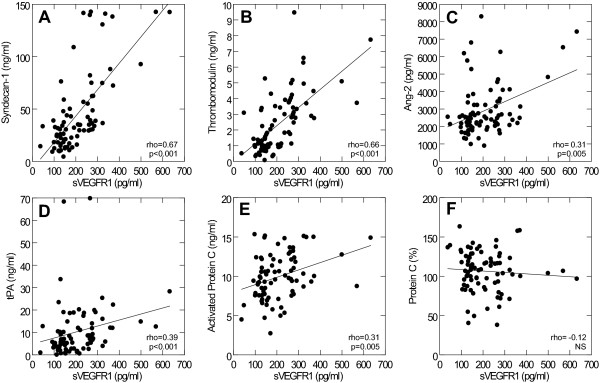
Results: Circulating sVEGFR1 correlated with injury severity (ISS, rho = 0.46), shock (SBE, rho = -0.38; adrenaline, rho = 0.47), tissue injury (hcDNA, rho = 0.44) and inflammation (IL-6, rho = 0.54) (all p < 0.01) but by multivariate linear regression analysis only lower SBE and higher adrenaline and IL-6 were independent predictors of higher sVEGFR1. sVEGFR1 also correlated with biomarkers indicative of endothelial glycocalyx degradation (syndecan-1, rho = 0.67), endothelial cell damage (sTM, rho = 0.66) and activation (Ang-2, rho = 0.31) and hyperfibrinolysis (tPA, rho = 0.39; D-dimer, rho = 0.58) and with activated protein C (rho = 0.31) (all p < 0.01). High circulating sVEGFR1 correlated with high early and late transfusion requirements (number of packed red blood cells (RBC) at 1 h (rho = 0.27, p = 0.016), 6 h (rho = 0.27, p = 0.017) and 24 h (rho = 0.31, p = 0.004) but was not associated with mortality.
Conclusions: sVEGFR1 increased with increasing injury severity, shock and inflammation early after trauma but only sympathoadrenal activation, hypoperfusion, and inflammation were independent predictors of sVEGFR1 levels. sVEGFR1 correlated strongly with other biomarkers of endothelial activation and damage and with RBC transfusion requirements. Sympathoadrenal activation, shock and inflammation may be critical drivers of endothelial activation and damage early after trauma.
Figures
References
-
- Johansson PI, Stensballe J, Rasmussen LS, Ostrowski SR. A high admission syndecan-1 level, a marker of endothelial glycocalyx degradation, is associated with inflammation, protein c depletion, fibrinolysis, and increased mortality in trauma patients. Ann Surg. 2011;254:194–200. doi: 10.1097/SLA.0b013e318226113d. - DOI - PubMed
-
- Haywood-Watson R, Pati S, Kozar R, Faz J, Holcomb JB, Gonzalez E. Human Micro-Vascular Barrier Disruption after Hemorrhagic Shock. J Surg Res. 2010;158:313. (Abstract 37.4)
Publication types
MeSH terms
Substances
LinkOut - more resources
Full Text Sources
Miscellaneous
