. 2012 Jun;21(6):925-33.
doi: 10.1158/1055-9965.EPI-11-1183. Epub 2012 Apr 6.

Increased levels of tetra-antennary N-linked glycan but not core fucosylation are associated with hepatocellular carcinoma tissue

Affiliations

Increased levels of tetra-antennary N-linked glycan but not core fucosylation are associated with hepatocellular carcinoma tissue

Anand Mehta et al. Cancer Epidemiol Biomarkers Prev. 2012 Jun.

Abstract

Background: Alterations in glycosylation have long been associated with the development of cancer. In the case of primary hepatocellular carcinoma (HCC), one alteration that has often been associated is increased amounts of fucose attached to the N-glycans of serum proteins secreted by the liver.

Methods: In an effort to determine the origin of this increased fucosylation, we have conducted N-linked glycan analysis of HCC tissue, the surrounding nontumor tissue, and compared this to tissue from a nondiseased adult liver.

Results: Surprisingly, no difference in the level of fucosylation was observed from the three donor groups, suggesting that the increased levels of fucosylation observed in serum of those with HCC is not the result of increased synthesis of fucosylated proteins in the cancer tissue. On the other hand, increased levels of a tetra-antennary glycan were observed in the HCC tissue as compared with the surrounding tissue or to the nondiseased livers.

Conclusions: This represents, to our knowledge, one of the first reports associating increased levels of branching with the development of HCC.

Impact: The identification of increased levels of tetra-antennary glycan on liver tumor tissue, as opposed to adjacent or nondiseased tissue may lead to improved detection of HCC.


Figures
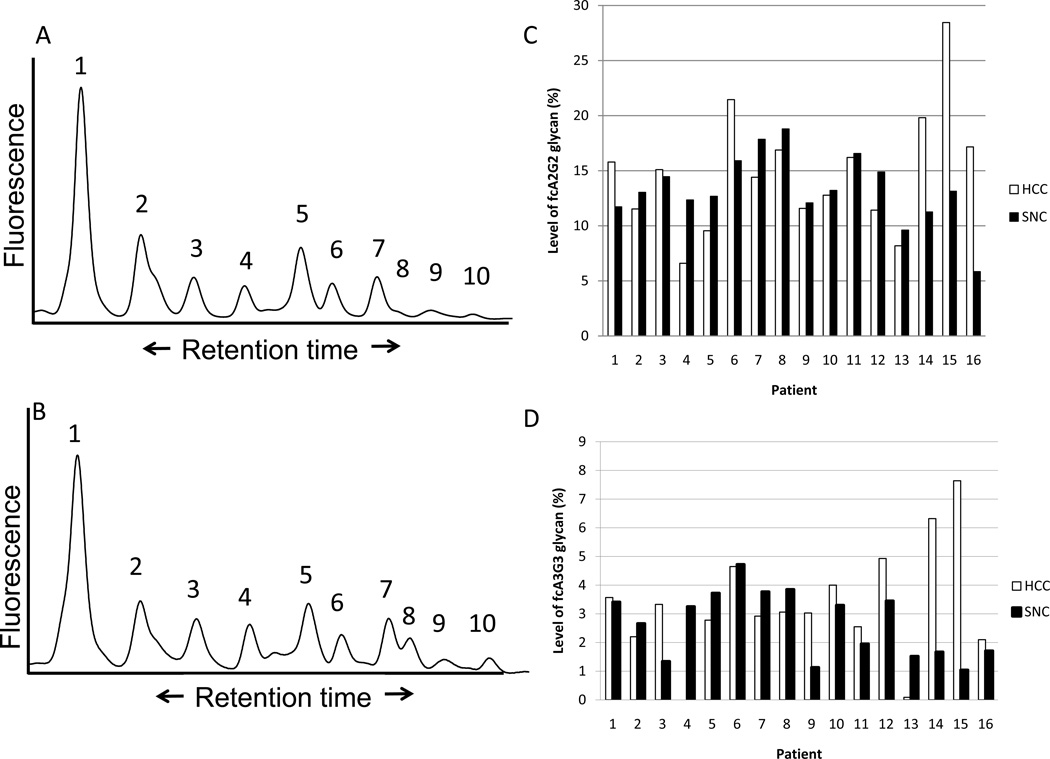
Figure 1
Figure 1
N-linked glycosylation of total protein from representative HCC tissue and adjacent liver tissue. Desialylated N-linked glycan profile of representative adjacent liver tissue (panel A) or HCC tissue (panel B) from one matched pair. Identified species are indicated as follows, using terminology described elsewhere (45): Peak 1, A2G2; Peak 2, F(6)A2G2; Peak 3, M7; Peak 4, A3G3; Peak 5, co-migrating M8 and F(6)A3G3; Peak 7, M9; Peak 8, A4G4; Peak 9, F(6)A4G4. Peaks 6 and 10 are incompletely characterized, although peak 6 contains one or more structures containing outer arm fucose. C) The level of the F(6)A2G2 glycan in the matched pairs of tissue. The % of the F(6)A2G2 glycan as a function of the total glycan profile is shown. D) The level of the F(6)A3G3 glycan in the matched pairs of tissue. As with (C), the % of the F(6)A3G3 glycan is a function of the total glycan profile.
Figure 2
Figure 2
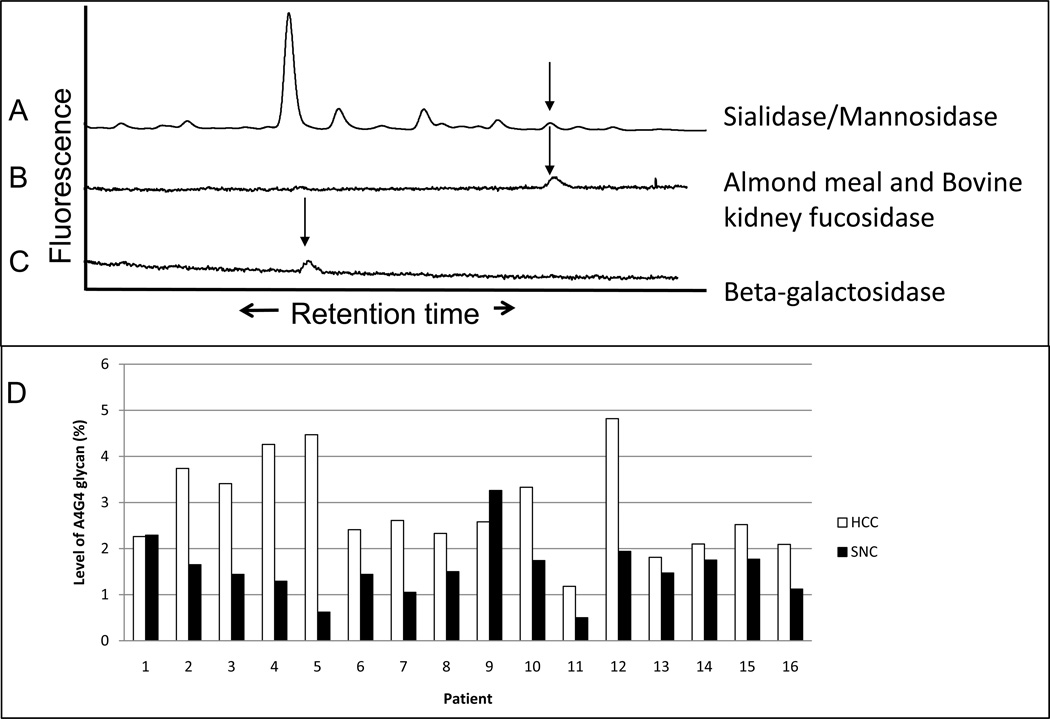
Increased levels of tetra-antennary glycan are associated with HCC tissue. A focus on the tetra-antennary glycan showing (A4G4) the digestion with (A) Sialidase (Arthrobacter ureafaciens) and Jack Bean Mannosidase, (B) a mixture of Bovine Kidney (1,6) and Almond Meal Alpha-(1–3,4) fucosidase and (C) Jack Bean Beta-(1–4,6) galactosidase. The A4G4 peak was collected after treatment with the mannosidase and digested individually. Treatment with Jack Bean Beta-(1–4,6) galactosidase results in the removal of the terminal galactose residues and the creation of an A4G0 glycan as indicated by the arrow. (D) The level of the A4G4 glycan in the matched pairs of tissue. The % of the A4G4 glycan as a function of the total glycan profile is shown.
Figure 3
Figure 3
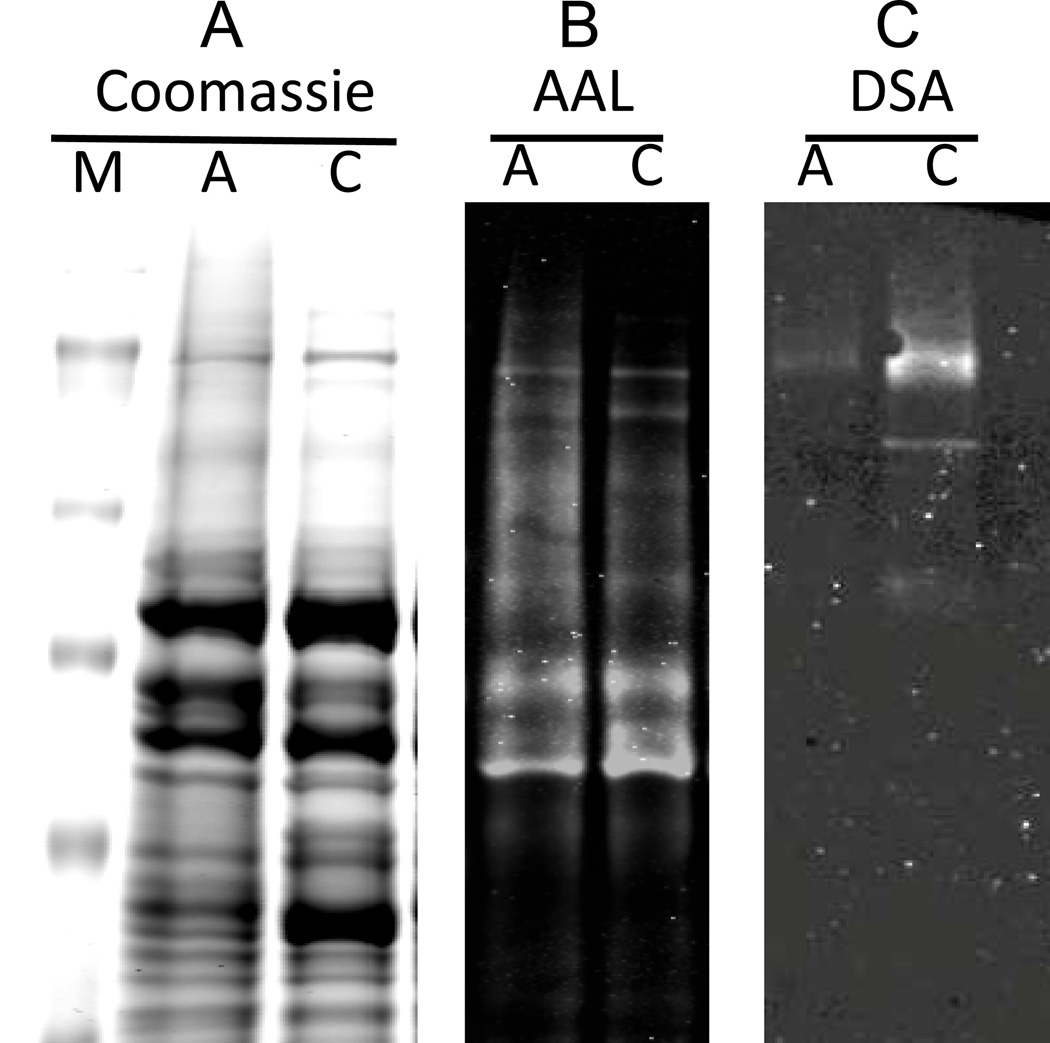
Lectin blotting of HCC and adjacent tissue. Pooled HCC or adjacent tissue was examined by (A) coomassie staining for total protein, (B) via the Aleuria Aurantia lectin (AAL) for fucosylated proteins or (C) the Datura Stramonium Lectin (DSA) for the detection of branched glycan. As this figure shows, consistent with the glycan data, while there is no difference in the level of fucosylation in the HCC and adjacent tissue (B) there is a significant difference in the level of branched glycan in the HCC tissue as compared to the adjacent tissue. For figures: M, Markers; A, Adjacent tissue; C, Cancer tissue.
Figure 4
Figure 4
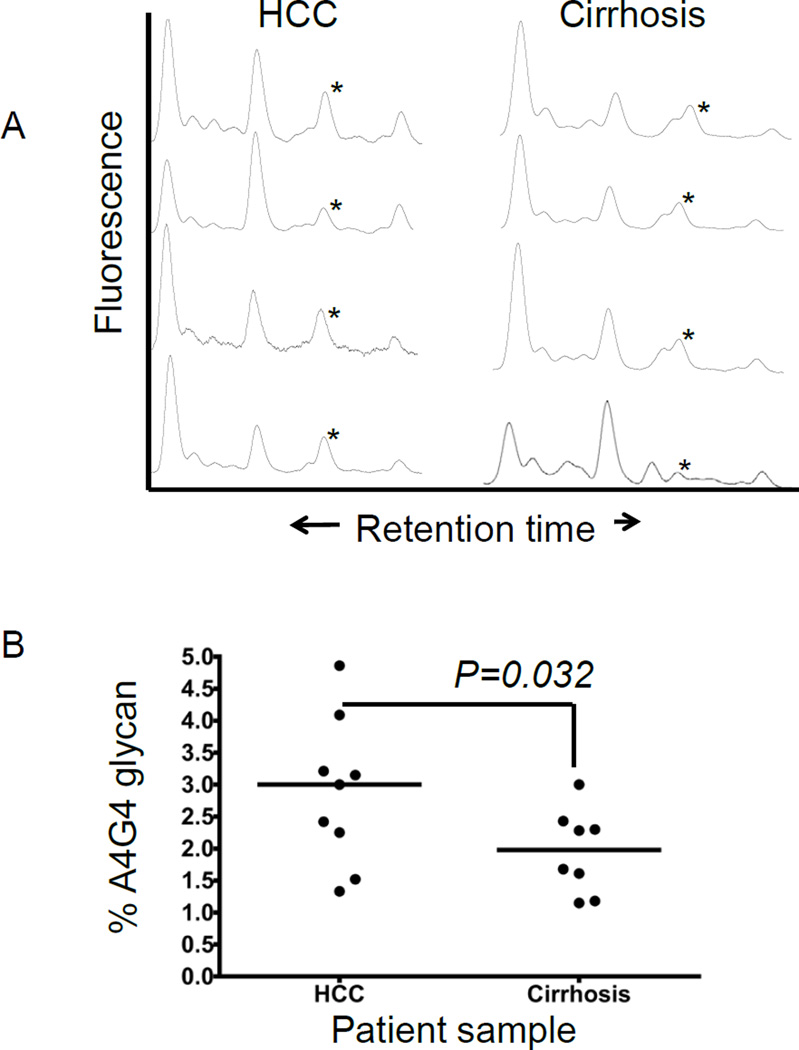
Increased levels of branching on serum glycoproteins from patients with HCC. Top panel: focus on larger branched glycans from 4 representative cirrhotics, and 4 representative HCC samples highlighting specific changes in glycosylation observed in HCC. The A4G4 peak is indicated with an asterisk. As in figure 2, sequential exoglycosidase digestion was used to identify N-linked glycan. Bottom Panel. Scatter plot of the A4G4 glycan from 8 HCC and 8 Cirrhotic patients showing the level of the A4G4 glycan in all patients. The solid line indicates the median level and the p value is indicated.
Figure 5
Figure 5
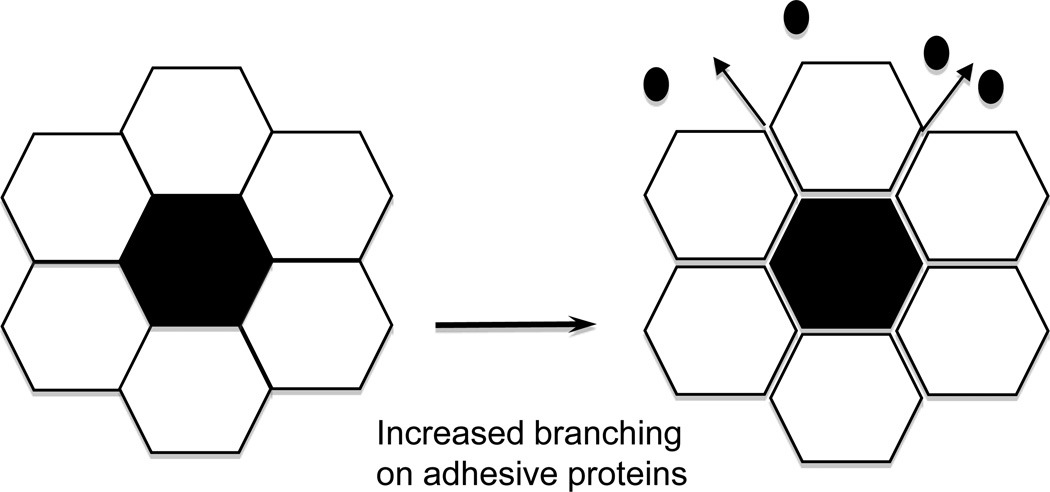
Proposed model. Left, in the normal liver, hepatocytes (white hexagons) surround the biliary space (black hexagons). Tight junctions present near the apical (biliary) surfaces of the hepatocytes isolate bile contents from basolateral contents (blood). Right, as HCC develops, the impermeable barrier weakens, permitting leakage of core fucosylated glycoproteins (black ovals) into the bloodstream.

References

    1. Di Bisceglie AM. Hepatocellular carcinoma: molecular biology of its growth and relationship to hepatitis B virus infection. Med Clin North Am. 1989;73:985–997. - PubMed
    1. Block TM, Mehta AS, Fimmel CJ, Jordan R. Molecular viral oncology of hepatocellular carcinoma. Oncogene. 2003;22:5093–5107. - PubMed
    1. Marrero JA. Hepatocellular carcinoma. Curr Opin Gastroenterol. 2006;22:248–253. - PubMed
    1. Sallie R, Di Bisceglie AM. Viral hepatitis and hepatocellular carcinoma. Gastroenterol Clin North Am. 1994;23:567–579. - PubMed
    1. Lok A, McMahon B. Chronic hepatitis B. Hepatology. 2001;34:1225–1241. - PubMed

Publication types