. 2012 May;5(5):778-87.
doi: 10.1158/1940-6207.CAPR-11-0551. Epub 2012 Apr 3.

Cryptotanshinone activates p38/JNK and inhibits Erk1/2 leading to caspase-independent cell death in tumor cells

Affiliations

Cryptotanshinone activates p38/JNK and inhibits Erk1/2 leading to caspase-independent cell death in tumor cells

Wenxing Chen et al. Cancer Prev Res (Phila). 2012 May.

Abstract

Cryptotanshinone (CPT), a natural compound isolated from the plant Salvia miltiorrhiza Bunge, is a potential anticancer agent. However, the underlying mechanism is not well understood. Here, we show that CPT induced caspase-independent cell death in human tumor cells (Rh30, DU145, and MCF-7). Besides downregulating antiapoptotic protein expression of survivin and Mcl-1, CPT increased phosphorylation of p38 mitogen-activated protein kinase (MAPK) and c-jun N-terminal kinase (JNK), and inhibited phosphorylation of extracellular signal-regulated kinases 1/2 (Erk1/2). Inhibition of p38 with SB202190 or JNK with SP600125 attenuated CPT-induced cell death. Similarly, silencing p38 or c-Jun also in part prevented CPT-induced cell death. In contrast, expression of constitutively active mitogen-activated protein kinase kinase 1 (MKK1) conferred resistance to CPT inhibition of Erk1/2 phosphorylation and induction of cell death. Furthermore, we found that all of these were attributed to CPT induction of reactive oxygen species (ROS). This is evidenced by the findings that CPT induced ROS in a concentration- and time-dependent manner; CPT induction of ROS was inhibited by N-acetyl-L-cysteine (NAC), a ROS scavenger; and NAC attenuated CPT activation of p38/JNK, inhibition of Erk1/2, and induction of cell death. The results suggested that CPT induction of ROS activates p38/JNK and inhibits Erk1/2, leading to caspase-independent cell death in tumor cells.


Conflict of interest statement

Disclosure of Potential Conflicts of Interest

No potential conflicts of interest were disclosed.

Figures
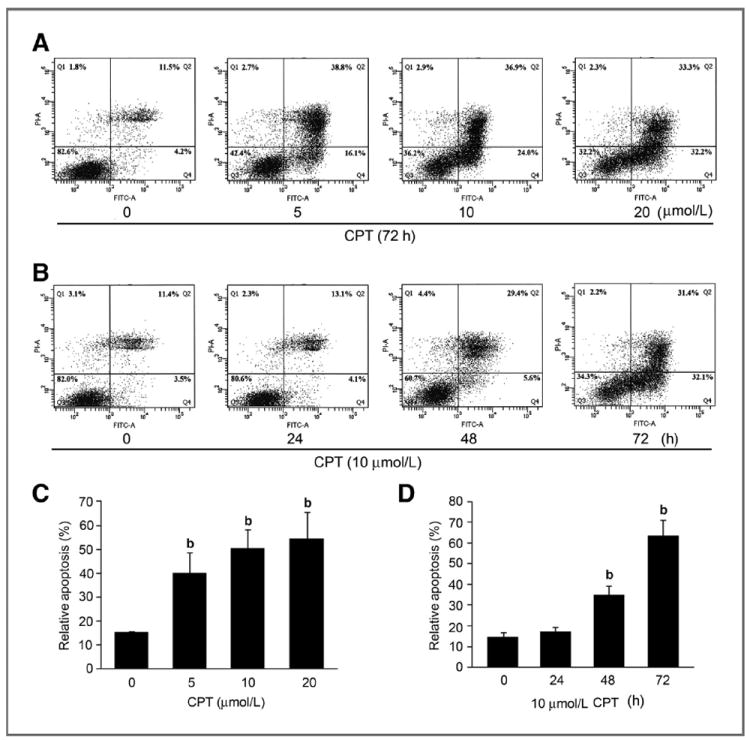
Figure 1
Figure 1
CPT induces apoptotic cell death in tumor cells. Rh30 cells grown in 100-mm dishes (2 × 10⁶ cells per dish) were treated with indicated concentrations of CPT (0–20 μmol/L) for 72 hours (A), or with 10 μmol/L CPT for indicated time (B), and then stained with Annexin V-FITC and PI, followed by flow cytometric analysis. Results (A and B) are presented as mean ± SE (n = 3). b, P < 0.01, difference versus control group.
Figure 2
Figure 2
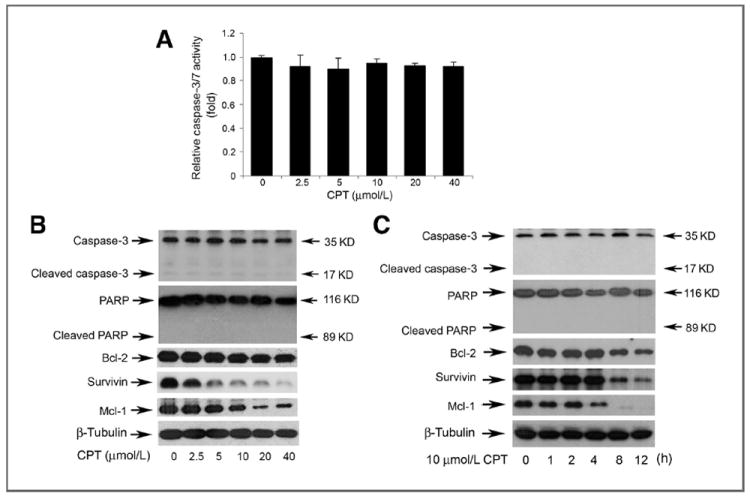
CPT induces caspase-independent cell death in tumor cells. A, DU145 cells grown in a black wall 96-well plate were treated with CPT (0–40 μmol/L) for 24 hours, followed by adding caspase-3/7 substrate solution (50 μL/well). After incubation at room temperature for 1 hour, the fluorescence intensity was recorded by excitation at 354 nm and emission at 442 nm using a Wallac 1420 Multilabel Counter. Results are presented as mean ± SE (n = 6). Note: CPT did not significantly alter the activities of caspase-3/7. DU145 cells were grown in 6-well plates and treated with CPT at indicated concentrations for 8 hours (B), or with CPT (10 μmol/L) for indicated time (C), followed by Western blot analysis with indicated antibodies.
Figure 3
Figure 3
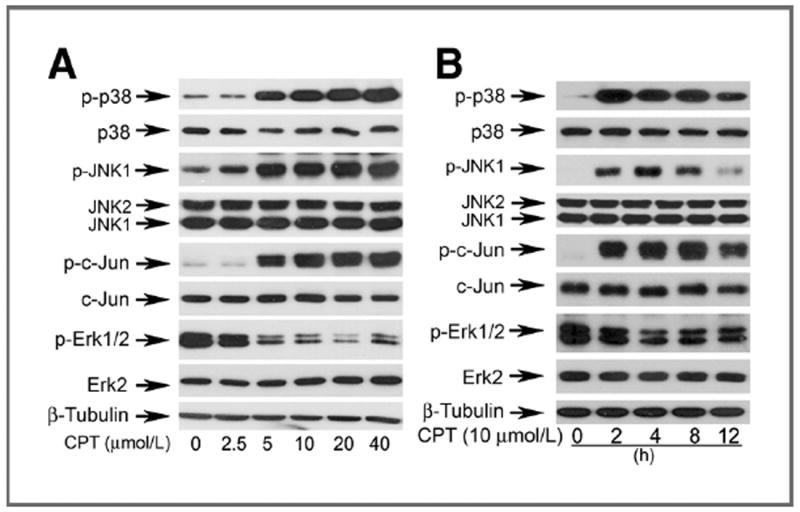
CPT activates p38/JNK and inhibits Erk1/2 in a concentration-and time-dependent manner. DU145 cells grown in 6-well plates were treated with CPT at indicated concentrations for 8 hours (A), or 10 μmol/L CPT for indicated time (B), followed by Western blot analysis with indicated antibodies.
Figure 4
Figure 4
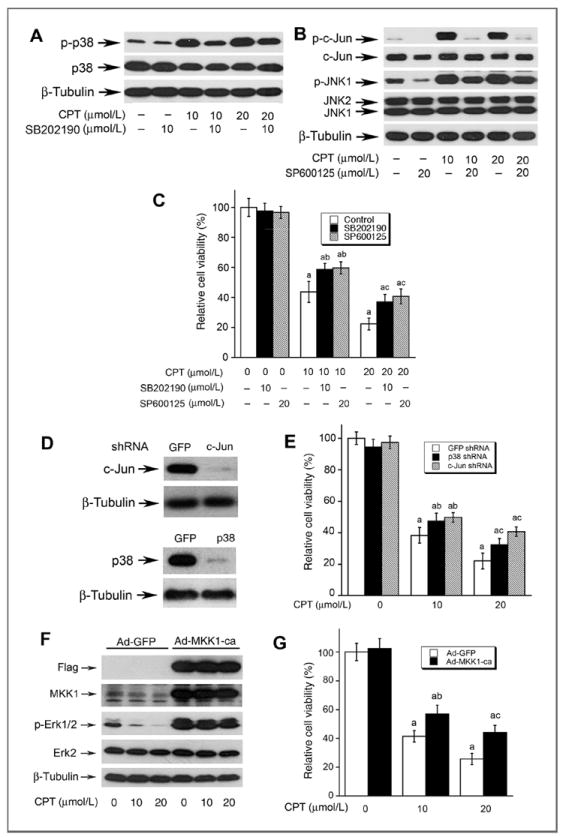
CPT-induced cell death is in part by activation of p38/JNK and inhibition Erk1/2. A–C, DU145 cells, grown in 6-well plates (A and B) or 96-well plates (C), were pretreated with or without SB202190 (10 μmol/L) or SP600125 (20 μmol/L) for 30 minutes, and then exposed to CPT (0, 10, 20 μmol/L) for 8 hours (for Western blotting), or for 48 hours (for cell viability), followed by Western blot analysis using indicated antibodies (A and B), or cell viability assay using one solution reagent (C). D, Rh30 cells grown in 6-well plates were infected with lentiviral shRNAs to p38, c-Jun, and GFP, respectively. In 5 days, whole-cell lysates were subjected to Western blotting using indicated antibodies. Note: Lentiviral shRNA to p38 or c-Jun, but GFP, downregulated cellular protein expression of p38 or c-Jun by approximately 90%. E, Rh30 cells grown 96-well plates, infected with lentiviral shRNA to p38, c-Jun, and GFP, respectively, were exposed to CPT at indicated concentrations for 48 hours, followed by cell viability assay using one solution reagent. Results are presented as mean ± SE (n = 3). a, P < 0.05, difference versus GFP shRNA group; b, P < 0.05, difference versus 10 μmol/L SB202190 group; c, P < 0.05, difference versus 20 μmol/L SP600125 group. F, Rh30 cells grown in 6-well plates were infected with recombinant adenoviruses expressing Flag-tagged constitutively active MKK1 (Ad-MMK1-ca) and GFP (Ad-GFP, control), respectively. In 24 hours, whole-cell lysates were subjected to Western blotting using indicated antibodies. Note: Ad-MKK1-ca, but Ad-GFP, increased expression of MKK1 by 5-fold in Rh30 cells. G, Rh30 cells grown in 96-well plates, infected with Ad-MKK1 and Ad-GFP respectively, were exposed to CPT at indicated concentrations for 48 hours, followed by cell viability assay using one solution reagent. Results are presented as mean ± SE (n = 3). a, P < 0.05, difference versus 0 μmol/L CPT group; b, P < 0.05, difference versus 10 μmol/L CPT group; c, P < 0.05, difference versus 20 μmol/L CPT group.
Figure 5
Figure 5
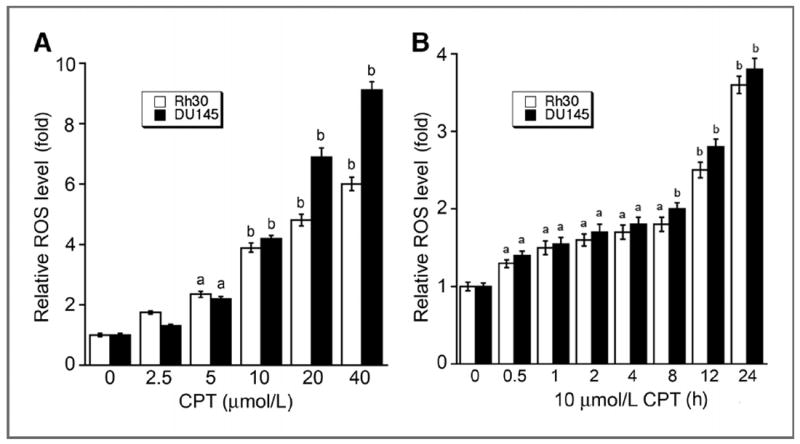
CPT increases ROS levels in tumor cells in a concentration-and time-dependent manner. Rh30 and DU145 cells grown in 96-well plates were treated with CPT at indicated concentrations for 24 hours (A), or with 10 μmol/L CPT for indicated time (B), followed by ROS detection using CM-H2DCFDA. Fluorescent intensity was recorded by excitation at 485 nm and emission at 535 nm using a Wallac 1420 Multilabel Counter. Results are presented as mean ± SE (n = 6). a, P < 0.05; b, P < 0.01, difference versus 0 μmol/L CPT group (A) or 0 hour CPT group (B).
Figure 6
Figure 6
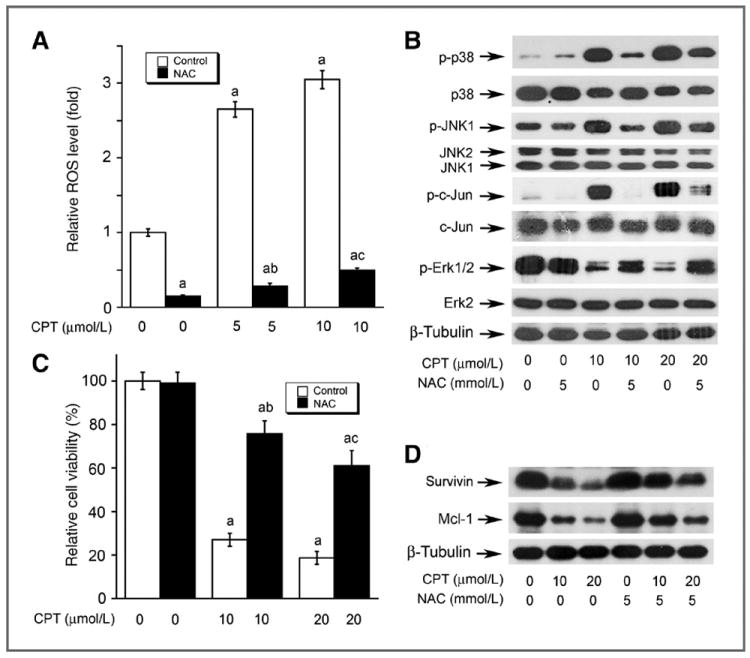
The effects of CPT on MAPKs are attributed to induction of ROS. DU145 cells, grown in 96-well plates (A and C) or 6-well plates (B and D), were pretreated with or without 5 mmol/L NAC for 30 minutes and then exposed to CPT at indicated concentrations for 24 (for ROS detection and Western blotting) or 48 hours (for cell viability assay), followed by ROS detection using CM-H2DCFDA (A), Western blot analysis (B and D) using indicated antibodies, or cell viability assay using one solution reagent (C). Results are presented in (A) and (C) as mean ± SE (n = 6). a, P < 0.05, difference versus 0 μmol/L CPT group; b, P < 0.05, difference versus 5 μmol/L (A) or 10 μmol/L (C) CPT group; c, P < 0.05, difference versus 10 μmol/L (A) or 20 μmol/L (C) CPT group.

References

    1. Cheng TO. Cardiovascular effects of Danshen. Int J Cardiol. 2007;121:9–22. - PubMed
    1. Zhou L, Zuo Z, Chow MS. Danshen: an overview of its chemistry, pharmacology, pharmacokinetics, and clinical use. J Clin Pharmacol. 2005;45:1345–59. - PubMed
    1. Wojcikowski K, Johnson DW, Gobe G. Herbs or natural substances as complementary therapies for chronic kidney disease: ideas for future studies. J Lab Clin Med. 2006;147:160–6. - PubMed
    1. Wang BE. Treatment of chronic liver diseases with traditional Chinese medicine. J Gastroenterol Hepatol. 2000;15(Suppl):E67–70. - PubMed
    1. Yu XY, Lin SG, Chen X, Zhou ZW, Liang J, Duan W, et al. Transport of cryptotanshinone, a major active triterpenoid in Salvia miltiorrhiza Bunge widely used in the treatment of stroke and Alzheimer’s disease, across the blood-brain barrier. Curr Drug Metab. 2007;8:365–78. - PubMed

Publication types

MeSH terms