. 2012 Jul;108(1):83-90.
doi: 10.1152/jn.00074.2012. Epub 2012 Apr 4.

The role of muscle spindles in the development of the monosynaptic stretch reflex

Affiliations

The role of muscle spindles in the development of the monosynaptic stretch reflex

Zhi Wang et al. J Neurophysiol. 2012 Jul.

Abstract

Muscle sensory axons induce the development of specialized intrafusal muscle fibers in muscle spindles during development, but the role that the intrafusal fibers may play in the development of the central projections of these Ia sensory axons is unclear. In the present study, we assessed the influence of intrafusal fibers in muscle spindles on the formation of monosynaptic connections between Ia (muscle spindle) sensory axons and motoneurons (MNs) using two transgenic strains of mice. Deletion of the ErbB2 receptor from developing myotubes disrupts the formation of intrafusal muscle fibers and causes a nearly complete absence of functional synaptic connections between Ia axons and MNs. Monosynaptic connectivity can be fully restored by postnatal administration of neurotrophin-3 (NT-3), and the synaptic connections in NT-3-treated mice are as specific as in wild-type mice. Deletion of the Egr3 transcription factor also impairs the development of intrafusal muscle fibers and disrupts synaptic connectivity between Ia axons and MNs. Postnatal injections of NT-3 restore the normal strengths and specificity of Ia-motoneuronal connections in these mice as well. Severe deficits in intrafusal fiber development, therefore, do not disrupt the establishment of normal, selective patterns of connections between Ia axons and MNs, although these connections require the presence of NT-3, normally supplied by intrafusal fibers, to be functional.


Figures
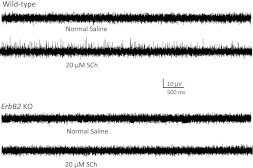
Fig. 1.
Fig. 1.
Loss of spindle responses to application of succinyl choline (SCh) in untreated ErbB2-deficient (ErbB2−/−) postnatal day (P)7–P9 mice. The response from isolated wild-type neonatal quadriceps (Q) muscles in normal solution adapted quickly during maintained stretch but was maintained for several minutes during perfusion with 20 μM SCh (2 top traces). In similar preparations from ErbB2−/− mice [knockout (KO); n = 7], however, there was virtually no response in either solution (2 bottom traces).
Fig. 2.
Fig. 2.
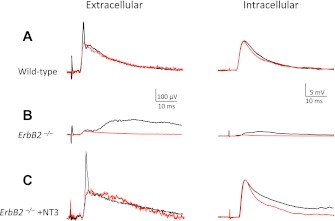
Transmission between Ia afferents and motoneurons (MNs) is abolished in ErbB2−/− mice but is restored by postnatal injections of neurotrophin-3 (NT-3; NT3). Monosynaptic excitatory postsynaptic potentials (EPSPs) were recorded extracellularly in P7–P9 mice from the L3 ventral root (left column) and intracellularly from Q MNs (right column), following stimulation of the Q nerve in wild-type (A), ErbB2−/− (B), and NT-3-treated ErbB2−/− (C) mutant mice. Notice that later, polysynaptic components, visible in the recordings, are not abolished in ErbB2−/− mice. Red traces in each recording in this and subsequent figures are the model traces used to measure monosynaptic EPSP amplitudes (see materials and methods for details).
Fig. 3.
Fig. 3.
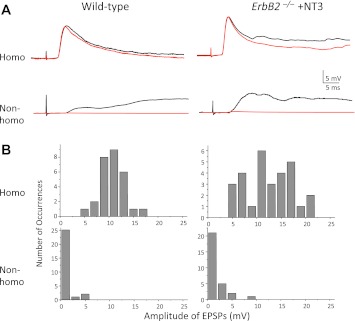
Monosynaptic Ia–MN synaptic connections in NT-3-treated ErbB2−/− mice are specific. A: representative intracellular traces in P7–P9 mice from Q MNs in response to stimulation of Q [homonymous (Homo)] and hip adductors [Add; nonhomonymous (Non-homo)] sensory axons. Note that polysynaptic nonhomonymous inputs are common in both wild-type and NT-3-treated mutant mice. B: amplitude frequency histograms of homonymous and nonhomonymous monosynaptic EPSP amplitudes in wild-type and NT-3-treated ErbB2−/− mice. All homonymous inputs are at least 5 mV in both wild-type and mutant mice, whereas nonhomonymous inputs are nearly all <5 mV. The specificity of homonymous vs. nonhomonymous Ia–MN connections is therefore preserved in NT-3-treated ErbB2−/− mice.
Fig. 4.
Fig. 4.
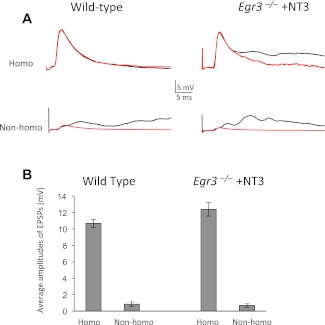
Monosynaptic Ia–MN connections are specific in NT-3-treated Egr3-deficient (Egr3−/−) mice. A: representative intracellularly recorded traces from Q MNs in response to stimulation of Q (homonymous) and Add (nonhomonymous) sensory axons. B: average amplitudes of monosynaptic Ia–MN EPSPs in wild-type and NT-3-treated Egr3−/− mice. In both types of mice, the average homonymous inputs are >10 times larger than nonhomonymous inputs.
Fig. 5.
Fig. 5.
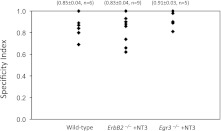
Monosynaptic Ia–MN synaptic connections are specific in individual mice. The specificity of these connections was measured by comparing homonymous and nonhomonymous EPSPs in the same mouse, expressed as a specificity index (SI), where a SI of 1 represents complete specificity (nonhomonymous EPSP amplitudes are 0), and a SI of 0 represents no specificity (homonymous and nonhomonymous EPSP amplitudes are equal). The average SIs for wild-type, NT-3-treated ErbB2−/−, and NT-3-treated Egr3−/− mice are similar, demonstrating that the specificity of these connections is preserved in both strains of mutant mice. The variability in SI values for individual mice is probably a consequence of the small number of Ia–MN connections assayed in each mouse.

References

    1. Andrechek ER, Hardy WR, Girgis-Gabardo AA, Perry RL, Butler R, Graham FL, Kahn RC, Rudnicki MA, Muller WJ. ErbB2 is required for muscle spindle and myoblast cell survival. Mol Cell Biol 22: 4714–4722, 2002 - PMC - PubMed
    1. Arber S, Ladle DR, Lin JH, Frank E, Jessell TM. ETS gene Er81 controls the formation of functional connections between group Ia sensory afferents and motor neurons. Cell 101: 485–498, 2000 - PubMed
    1. Boyd IA. Intrafusal muscle fibres in the cat and their motor control. In: Feedback and Motor Control in Invertebrates and Vertebrates, edited by Barnes WJP, Gladden MH. London: Croom Helm, 1985, p. 123–144
    1. Carr VM, Simpson SB., Jr Proliferative and degenerative events in the early development of chick dorsal root ganglia. I. Normal development. J Comp Neurol 182: 727–739, 1978 - PubMed
    1. Chen HH, Hippenmeyer S, Arber S, Frank E. Development of the monosynaptic stretch reflex circuit. Curr Opin Neurobiol 13: 96–102, 2003 - PubMed

Publication types

MeSH terms