The production of p-cresol sulfate and indoxyl sulfate in vegetarians versus omnivores
- PMID: 22490877
- PMCID: PMC3362314
- DOI: 10.2215/CJN.12491211
The production of p-cresol sulfate and indoxyl sulfate in vegetarians versus omnivores
Abstract
Background and objectives: The uremic solutes p-cresol sulfate (PCS) and indoxyl sulfate (IS) are generated by colon bacteria acting on food components that escape absorption in the small bowel. The production of these potentially toxic compounds may thus be influenced by diet. This study examined whether production of PCS and IS is different in vegetarians and omnivores.
Design, setting, participants, & measurements: The production of PCS and IS was assessed by measuring their urinary excretion rates in participants with normal kidney function. Studies were carried out in 15 vegetarians and 11 individuals consuming an unrestricted diet. Participants recorded food intake over 4 days and collected urine over the final 2 days of each of two study periods, which were 1 month apart.
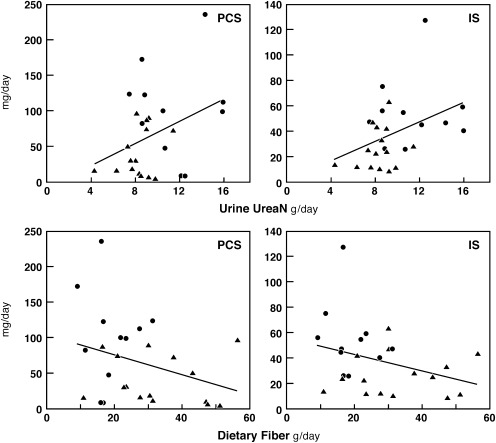
Results: Average PCS excretion was 62% lower (95% confidence interval [95% CI], 15-83) and average IS excretion was 58% lower (95% CI, 39-71) in vegetarians than in participants consuming an unrestricted diet. Food records revealed that lower excretion of PCS and IS in vegetarians was associated with a 69% higher (95% CI, 20-139) fiber intake and a 25% lower (95% CI, 3-42) protein intake. PCS and IS excretion rates varied widely among individual participants and were not closely correlated with each other but tended to remain stable in individual participants over 1 month.
Conclusions: PCS and IS production rates are markedly lower in vegetarians than in individuals consuming an unrestricted diet.
Figures


References
-
- Vanholder R, Baurmeister U, Brunet P, Cohen G, Glorieux G, Jankowski J, European Uremic Toxin Work Group : A bench to bedside view of uremic toxins. J Am Soc Nephrol 19: 863–870, 2008 - PubMed
-
- Evenepoel P, Meijers BK, Bammens BR, Verbeke K: Uremic toxins originating from colonic microbial metabolism. Kidney Int Suppl 114: S12–S19, 2009 - PubMed
-
- Schepers E, Glorieux G, Vanholder R: The gut: The forgotten organ in uremia? Blood Purif 29: 130–136, 2010 - PubMed
-
- Niwa T: Indoxyl sulfate is a nephro-vascular toxin. J Ren Nutr 20[Suppl]: S2–S6, 2010 - PubMed
-
- Vanholder R, Bammens B, de Loor H, Glorieux G, Meijers B, Schepers E, Massy Z, Evenepoel P: Warning: The unfortunate end of p-cresol as a uraemic toxin. Nephrol Dial Transplant 26: 1464–1467, 2011 - PubMed
Publication types
MeSH terms
Substances
Grants and funding
LinkOut - more resources
Full Text Sources
Other Literature Sources
Medical