. 2012 Jul;26(7):2919-29.
doi: 10.1096/fj.11-197384. Epub 2012 Apr 9.

Stroke-induced activation of the α7 nicotinic receptor increases Pseudomonas aeruginosa lung injury

Affiliations

Stroke-induced activation of the α7 nicotinic receptor increases Pseudomonas aeruginosa lung injury

Mathieu Lafargue et al. FASEB J. 2012 Jul.

Abstract

Infectious complications, predominantly pneumonia, are the most common cause of death in the postacute phase of stroke, although the mechanisms underlying the corresponding immunosuppression are not fully understood. We tested the hypothesis that activation of the α7 nicotinic acetylcholine receptor (α7nAChR) pathway is important in the stroke-induced increase in lung injury caused by Pseudomonas aeruginosa pneumonia in mice. Prior stroke increased lung vascular permeability caused by P. aeruginosa pneumonia and was associated with decreased lung neutrophil recruitment and bacterial clearance in mice. Pharmacologic inhibition (methyllycaconitine IC(50): 0.2-0.6 nM) or genetic deletion of the α7nAChR significantly (P<0.05) attenuates the effect of prior stroke on lung injury and mortality caused by P. aeruginosa pneumonia in mice. Finally, pretreatment with PNU-282987, a pharmacologic activator of the α7nAChR (EC(50): 0.2 μM), significantly (P<0.05) increased lung injury caused by P. aeruginosa pneumonia, significantly (P<0.05) decreased the release of KC, a major neutrophil chemokine, and significantly (P<0.05) decreased intracellular bacterial killing by a mouse alveolar macrophage cell line and primary mouse neutrophils. In summary, the α7 nicotinic cholinergic pathway plays an important role in mediating the systemic immunosuppression observed after stroke and directly contributes to more severe lung damage induced by P. aeruginosa.


Figures
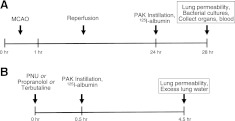
Figure 1.
Figure 1.
Schematics of the in vivo mouse experiments. A) Timeline of stroke and pneumonia. In some experiments, mice were treated with drugs prior to MCAO. In all cases, MCAO was for 1 h duration, followed by 24 h of reperfusion. Airspace instillation of P. aeruginosa (PAK strain, 1×10⁷ CFU) or vehicle was performed and animals sacrificed 4 h later for analysis, as described in Materials and Methods. B) Timeline for effects of α7nAChR or β-adrenergic receptors on P. aeruginosa-induced lung injury. Mice were pretreated with PNU-282987 (0.4 mg/kg i.p.), propranolol (3 mg/kg i.p. + 50 μl 10−4 M i.t.) or terbutaline (1 mg/kg i.p + 50 μl 10−4 M i.t.) or their respective vehicles 30 min before the airspace instillation of P. aeruginosa (PAK strain, 1×10⁷ CFU). Mice were euthanized 4 h later, and lung vascular permeability and excess water were measured, as described in Materials and Methods.
Figure 2.
Figure 2.
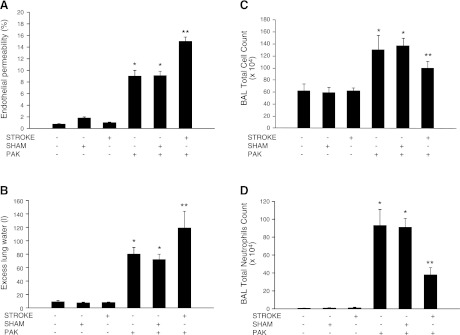
Prior stroke increases lung injury and attenuates neutrophil recruitment in a mouse model of P. aeruginosa pneumonia. C57BL/6 mice underwent transient MCAO or sham surgery, which was followed 24 h later with airspace instillation of P. aeruginosa (PAK strain, 1×10⁷ CFU) or vehicle. Mice were euthanized 4 h later, and BAL was performed, lung vascular permeability (A) and excess lung water (B) were measured, and total cells (C) and neutrophils (D) were counted. Results are shown as means ± sd (n=8 mice/group); *P ≤ 0.05 vs. controls; **P ≤ 0.05 vs. sham-treated mice instilled with P. aeruginosa.
Figure 3.
Figure 3.
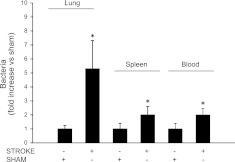
Prior stroke decreases lung bacterial clearance and increases bacterial dissemination in P. aeruginosa pneumonia. C57BL/6 mice underwent transient MCAO or sham surgery, followed 24 h later by airspace instillation of P. aeruginosa (PAK strain, 1×10⁷ CFU) or vehicle. Mice were euthanized 4 h later, and bacteria were counted in lungs, spleen, and blood. Results are shown as means ± sd (n=8 mice/group). *P ≤ 0.05 vs. sham-treated mice instilled with P. aeruginosa.
Figure 4.
Figure 4.
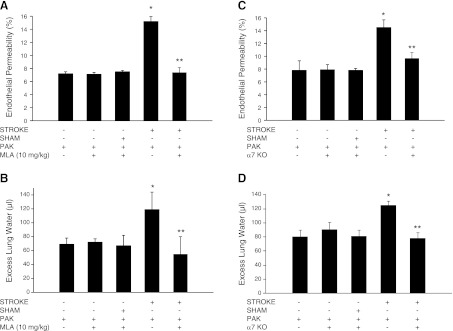
Pharmacologic blockade or genetic deletion of α7nAChR attenuates the effect of prior stroke on lung injury induced by P. aeruginosa. C57BL/6 WT (A, B) or α7-KO (C, D) mice underwent MCAO or sham surgery followed 24 h later by airspace instillation of P. aeruginosa (PAK strain, 1×10⁷ CFU) or vehicle and were studied after 4 h. WT mice were pretreated with MLA (10 mg/kg i.p.), a specific pharmacologic inhibitor of the α7nAChR, or vehicle 1 h before MCAO (A, B). Mice were euthanized 4 h later, and excess lung water (B, D) and lung vascular permeability to protein (A, C) were measured. Results are shown as means ± sd (n=8 mice/group). *P ≤ 0.05 vs. controls; **P ≤ 0.05 vs. WT mice that underwent MCAO and P. aeruginosa instillation.
Figure 5.
Figure 5.
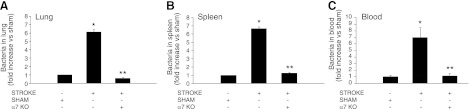
Genetic deletion of the α7nAChR attenuates the effect of stroke on bacterial clearance in P. aeruginosa pneumonia. C57BL/6 WT or α7-KO mice underwent MCAO or sham surgery, followed 24 h later with airspace instillation of P. aeruginosa (PAK strain, 1×10⁷ CFU) or vehicle. Mice were euthanized 4 h later, and bacteria were counted in lungs (A), spleen (B), and blood (C). Results are shown as means ± sd (n=8 mice/group). *P ≤ 0.05 vs. sham mice instilled with P. aeruginosa; **P ≤ 0.05 vs. WT mice that underwent MCAO and P. aeruginosa instillation.
Figure 6.
Figure 6.
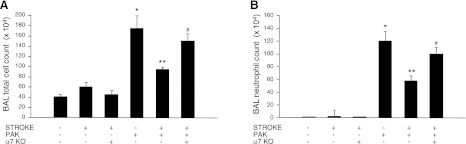
Genetic deletion of the α7nAChR attenuates the effect of stroke on lung neutrophil recruitment in P. aeruginosa pneumonia. C57BL/6 WT or α7-KO mice underwent MCAO or sham surgery, and 24 h later, mice underwent airspace instillation of P. aeruginosa (PAK strain, 1×10⁷ CFU) or vehicle. Mice were euthanized 4 h later; BAL was performed, and total cells (A) and neutrophils (B) were counted. Results are shown as means ± sd (n=6 mice/group). *P ≤ 0.05 vs. sham mice; **P ≤ 0.05 vs. sham mice instilled with P. aeruginosa; #P ≤ 0.05 vs. WT mice that underwent MCAO and P. aeruginosa instillation.
Figure 7.
Figure 7.
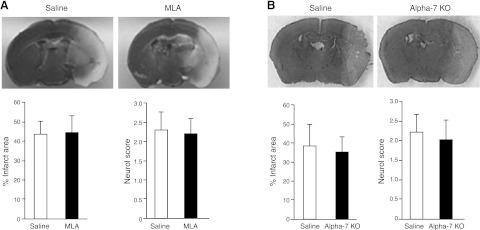
Pharmacologic blockade or genetic deletion of the α7nAChR does not affect stroke outcome. A) Representative TTC-stained brain sections from a saline-treated (top left panel) and an MLA-treated mouse (top right panel) subjected to focal ischemia. Dead or injured tissue is pale, while healthy tissue is dark. Quantitation (bottom panel) shows that percentage of infarct area (as a percentage of the hemisphere after correction for edema) and neurological score did not differ between drug and vehicle treated groups. B) Representative cresyl violet-stained brain sections from WT (top left panel) and α7-KO mouse (top right panel) subjected to stroke. Neither percentage of infarct area nor neuroscore differed between the groups (bottom panel). Results are shown as means ± sd (n=8 mice/group).
Figure 8.
Figure 8.
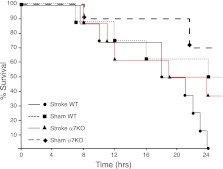
Genetic deletion of the α7nAChR decreases mortality caused by stroke followed 24 h later by P. aeruginosa pneumonia. C57BL/6 WT or α7-KO mice underwent MCAO or sham surgery, followed 24 h later by airspace instillation of P. aeruginosa (PAK strain, 1×10⁷ CFU). Kaplan-Meier survival analysis was performed (n=10 mice/group). WT mice that underwent MCAO died significantly earlier than the WT mice that underwent sham surgery or the α7-KO mice that underwent MCAO followed by airspace instillation of P. aeruginosa.
Figure 9.
Figure 9.
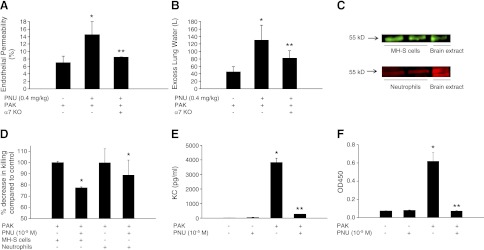
Pharmacologic activation of the α7nAChR increases lung injury induced by P. aeruginosa. A, B) C57BL/6 WT or α7-KO mice were pretreated with PNU-282987 (0.4 mg/kg i.p.), an activator of the α7nAChR, or its vehicle 30 min before airspace instillation of P. aeruginosa (PAK strain, 1×10⁷ CFU). Mice were euthanized 4 h later, and lung vascular permeability to protein (A) and excess lung water (B) were measured as described in Materials and Methods (n=8 mice/group). *P ≤ 0.05 vs. WT mice instilled with P. aeruginosa; **P ≤ 0.05 vs. WT mice pretreated with PNU then instilled with P. aeruginosa. C) α7nAChR is expressed by MH-S cells and mouse neutrophils. Expression of the α7nAChR was demonstrated on MH-S cells and mouse neutrophils by Western blot analysis. D) MH-S cells and mouse neutrophils were exposed to PNU or vehicle for 30 min, then to P. aeruginosa [2×10⁷ CFU/ml; MOI = 10:1] for 1 h, and percentage decrease in killing was determined compared to vehicle control. *P ≤ 0.05 vs. cells (MH-S or neutrophils) pretreated with PNU vehicle. E) MH-S mouse macrophage cells were pretreated with PNU (10−5 M) or its vehicle for 30 min, then exposed to P. aeruginosa [2×10⁷ CFU/ml; MOI = 10:1] for 4 h. ELISA assay for KC was carried out according to the manufacturer's protocol. F) Mouse neutrophils were pretreated with PNU (10−5 M) or its vehicle for 30 min, then exposed to P. aeruginosa [2×10⁷ CFU/ml; MOI = 10:1] for 30 min. NF-κB activation was determined by the phosphorylation of p65 protein measured by ELISA. Experiments D–F were performed in triplicate and repeated 3 times. *P ≤ 0.05 vs. PNU vehicle; **P ≤ 0.05 vs. cells instilled with P. aeruginosa (E, F). Results are shown as means ± sd.
Figure 10.
Figure 10.
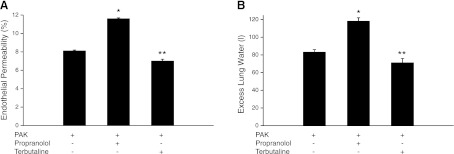
Inhibition of the β-adrenergic receptor increases injury induced by P. aeruginosa in mice. C57BL/6 mice were pretreated with propranolol (3 mg/kg i.p. and 50 μl 10−4 M i.t.), a β-adrenergic receptor inhibitor C57BL/6 or terbutaline (1 mg/kg i.p. and 50 μl 10−4 M i.t.) a β-adrenergic receptor agonist or vehicle 1 h before airspace instillation of P. aeruginosa (PAK strain, 1×10⁷ CFU) or vehicle. Mice were euthanized 4 h later, and lung vascular permeability to protein (A) and excess lung water (B) were measured. Results are shown as means ± sd (n=6 mice/group). *P ≤ 0.05 vs. mice pretreated with vehicle (PBS) then instilled with P. aeruginosa; **P ≤ 0.05 vs. mice pretreated with propranolol then instilled with P. aeruginosa.

References

    1. Rothwell P. M., Algra A., Amarenco P. (2011) Medical treatment in acute and long-term secondary prevention after transient ischaemic attack and ischaemic stroke. Lancet 377, 1681–1692 - PubMed
    1. Henon H., Godefroy O., Leys D., Mounier-Vehier F., Lucas C., Rondepierre P., Duhamel A., Pruvo J. P. (1995) Early predictors of death and disability after acute cerebral ischemic event. Stroke 26, 392–398 - PubMed
    1. Kalra L., Yu G., Wilson K., Roots P. (1995) Medical complications during stroke rehabilitation. Stroke 26, 990–994 - PubMed
    1. Langhorne P., Stott D. J., Robertson L., MacDonald J., Jones L., McAlpine C., Dick F., Taylor G. S., Murray G. (2000) Medical complications after stroke: a multicenter study. Stroke 31, 1223–1229 - PubMed
    1. Hilker R., Poetter C., Findeisen N., Sobesky J., Jacobs A., Neveling M., Heiss W. D. (2003) Nosocomial pneumonia after acute stroke: implications for neurological intensive care medicine. Stroke 34, 975–981 - PubMed

Publication types

MeSH terms

LinkOut - more resources