


How to be proactive about interference: lessons from animal memory
- PMID: 22491142
- PMCID: PMC4670779
- DOI: 10.1177/0956797611430096
How to be proactive about interference: lessons from animal memory
Abstract
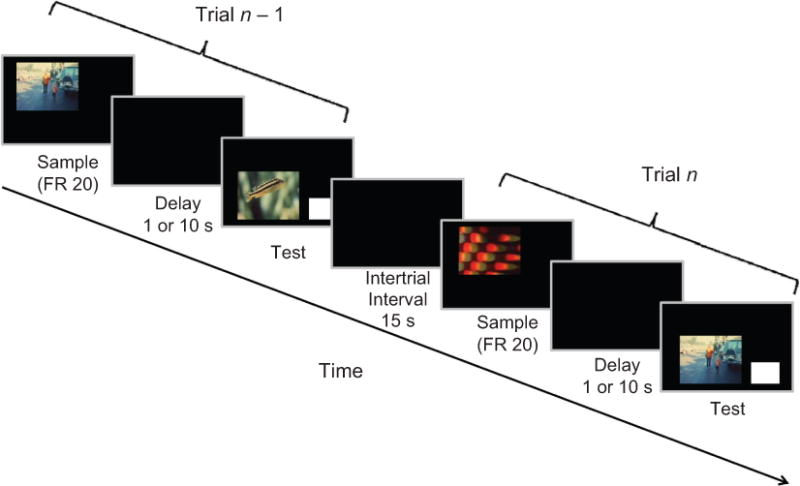
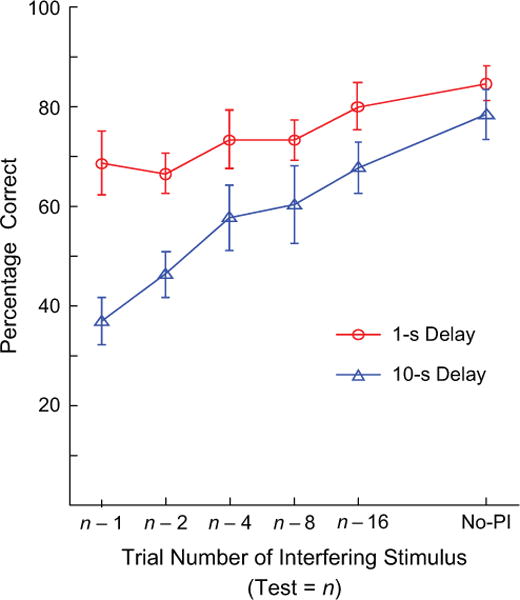
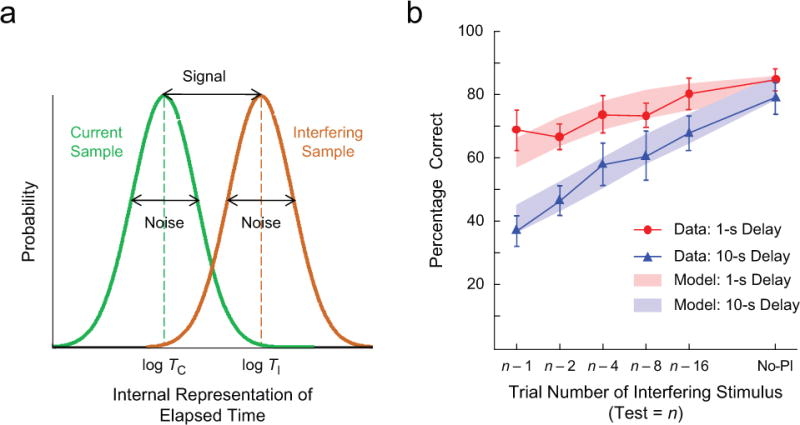
Processes of proactive interference were explored using the pigeon as a model system of memory. This study shows that proactive interference extends back in time at least 16 trials (and as many minutes), revealing a continuum of interference and providing a framework for studying memory. Pigeons were tested in a delayed same/different task containing trial-unique pictures. On interference trials, sample pictures from previous trials reappeared as test pictures on different trials. Proactive-interference functions showed greatest interference from the most recent trial and with the longer of two delays (10 s vs. 1 s). These interference functions are accounted for by a time-estimation model based on signal detection theory. The model predicts that accuracy at test is determined solely by the ratio of the elapsed time since the offset of the current-trial sample to the elapsed time since the offset of the interfering sample. Implications for comparing memory of different species and different types of memory (e.g., familiarity vs. recollection) are discussed.
Conflict of interest statement
The authors declared that they had no conflicts of interest with respect to their authorship or the publication of this article.
Figures
References
-
- Alvarez GA, Cavanagh P. The capacity of visual short-term memory is set both by visual information load and by number of objects. Psychological Science. 2004;15:106–111. - PubMed
-
- Atkinson RC, Shiffrin RM. Human memory: A proposed system and its control processes. In: Spence KW, Spence JT, editors. The psychology of learning and motivation. Vol. 2. New York, NY: Academic Press; 1968. pp. 89–105.
-
- Baddeley AD. Working memory. Science. 1992;255:556–559. - PubMed
-
- Bjork RA. Recency and recovery in human memory. In: Roediger HL III, Nairne JS, Neath I, Surprenant AM, editors. The nature of remembering: Essays in honor of Robert G Crowder. Washington, DC: American Psychological Association; 2001. pp. 211–232.
-
- Brady TF, Konkle T, Alvarez GA. A review of visual memory capacity: Beyond individual items and toward structured representations. Journal of Vision. 2011;11(5) Article 4. Retrieved from http://journalofvision.org/11/5/4. - PMC - PubMed
Publication types
MeSH terms
Grants and funding
LinkOut - more resources
Full Text Sources
