Neurodegenerative differences in the retinas of male and female patients with type 2 diabetes
- PMID: 22491405
- PMCID: PMC3378087
- DOI: 10.1167/iovs.11-8226
Neurodegenerative differences in the retinas of male and female patients with type 2 diabetes
Abstract
Purpose: The purpose of our study is to determine whether neuroretinal function, measured by the multifocal electroretinogram, differs between males and females with type 2 diabetes and no retinopathy.
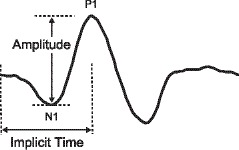
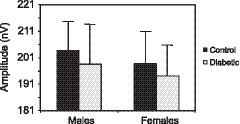
Methods: This study included 70 eyes from 70 adult subjects (14 control males, 22 control females, 16 males with type 2 diabetes, and 18 females with type 2 diabetes). A template-scaling technique was used to obtain first-order P1 implicit times and N1-P1 amplitudes from photopic multifocal electroretinograms within the central 45 degrees.
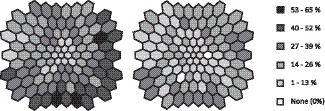
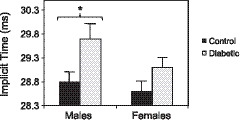
Results: The males with type 2 diabetes were significantly more abnormal than their female counterparts in two separate analyses of local neuroretinal function. First, the total number of retinal locations with an abnormally delayed implicit time (z score ≥ 2) was higher (P < 0.001) in the diabetic males (482 locations = 29.2%) compared to the diabetic females (298 locations = 16.1%). Second, in the response topographies that consisted of 103 means of local implicit times for each group, the diabetic males were significantly delayed (P < 0.025) at 23 corresponding positions (22.3%) compared to the diabetic females. At the same time, no corresponding stimulus locations were significantly delayed in the diabetic females compared to the diabetic males.
Conclusions: Neuroretinal function is more abnormal in males than in females for adults with type 2 diabetes and no retinopathy. These results suggest that, relative to males, females may have some protection from, or resistance to, neurodegenerative changes that precede the development of background retinopathy in type 2 diabetes.
Conflict of interest statement
Disclosure:
Figures
References
-
- Hove MN., Kristensen JK., Lauritzen T., Bek T. The prevalence of retinopathy in an unselected population of type 2 diabetes patients from Arhus County, Denmark. Acta Ophthalmol Scand. 2004;82443–448 . - PubMed
-
- Klein R., Klein BE., Moss SE., Davis MD., DeMets DL. The Wisconsin epidemiologic study of diabetic retinopathy. III. Prevalence and risk of diabetic retinopathy when age at diagnosis is 30 or more years. Arch Ophthalmol. 1984;102527–532 . - PubMed
-
- Tapp RJ., Zimmet PZ., Harper CA, et al. Six year incidence and progression of diabetic retinopathy: results from the Mauritius diabetes complication study. Diabetes Res Clin Pract. 2006;73298–303 . - PubMed
-
- Tung TH., Liu JH., Lee FL., Chen SJ., Li AF., Chou P. Population-based study of nonproliferative diabetic retinopathy among type 2 diabetic patients in Kinmen, Taiwan. Jpn J Ophthalmol. 2006;5044–52 . - PubMed
Publication types
MeSH terms
Substances
Grants and funding
LinkOut - more resources
Full Text Sources
Medical