. 2012 Jun;86(12):6563-74.
doi: 10.1128/JVI.00302-12. Epub 2012 Apr 4.

A lentiviral vector-based, herpes simplex virus 1 (HSV-1) glycoprotein B vaccine affords cross-protection against HSV-1 and HSV-2 genital infections

Affiliations

A lentiviral vector-based, herpes simplex virus 1 (HSV-1) glycoprotein B vaccine affords cross-protection against HSV-1 and HSV-2 genital infections

Flavia Chiuppesi et al. J Virol. 2012 Jun.

Abstract

Genital herpes is caused by herpes simplex virus 1 (HSV-1) and HSV-2, and its incidence is constantly increasing in the human population. Regardless of the clinical manifestation, HSV-1 and HSV-2 infections are highly transmissible to sexual partners and enhance susceptibility to other sexually transmitted infections. An effective vaccine is not yet available. Here, HSV-1 glycoprotein B (gB1) was delivered by a feline immunodeficiency virus (FIV) vector and tested against HSV-1 and HSV-2 vaginal challenges in C57BL/6 mice. The gB1 vaccine elicited cross-neutralizing antibodies and cell-mediated responses that protected 100 and 75% animals from HSV-1- and HSV-2-associated severe disease, respectively. Two of the eight fully protected vaccinees underwent subclinical HSV-2 infection, as demonstrated by deep immunosuppression and other analyses. Finally, vaccination prevented death in 83% of the animals challenged with a HSV-2 dose that killed 78 and 100% naive and mock-vaccinated controls, respectively. Since this FIV vector can accommodate two or more HSV immunogens, this vaccine has ample potential for improvement and may become a candidate for the development of a truly effective vaccine against genital herpes.


Figures
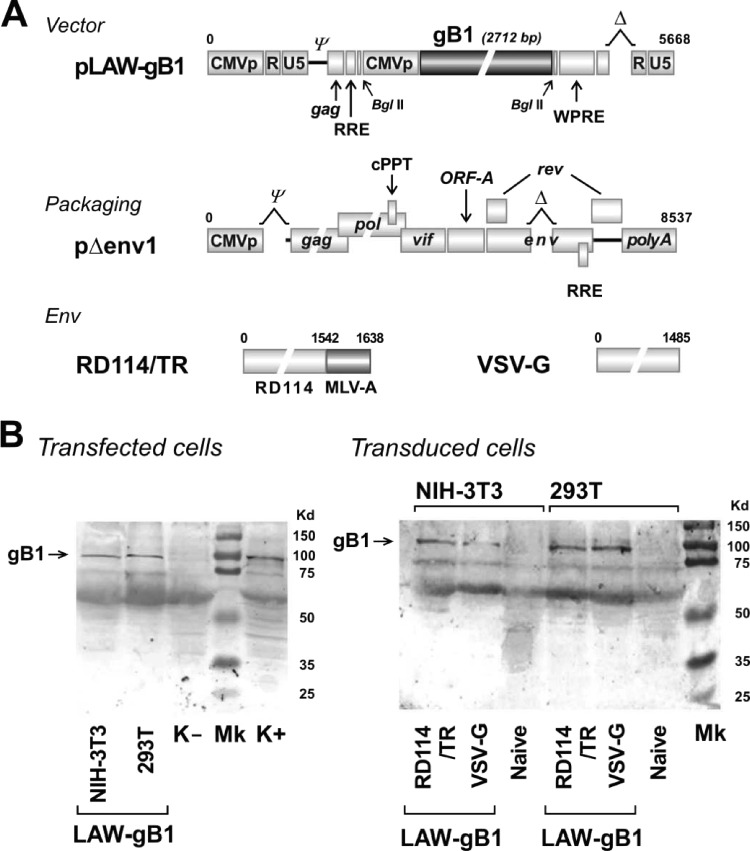
Fig 1
Fig 1
Genomic maps of vector, packaging, and Env plasmids used to generate vLAW-gB1 and analysis of gB1 expression in vitro. (A) Schematic organization of plasmid vector pLAW-gB1, packaging pΔenv1, RD114/TR, a chimeric Env glycoprotein with surface and transmembrane regions of feline endogenous retrovirus RD114 and cytoplasmic tail of murine leukemia virus (50), and VSV-G, the Env glycoprotein G of vesicular stomatitis virus. pLAW-gB1 was produced by cloning full-length HSV-1 glycoprotein B (gB1) into pLAW34. A full description of pLAW34, pΔenv1, and Env constructs is available elsewhere (43). CMVp, CMV promoter; ψ, packaging site; RRE, Rev-responsive element; WPRE, woodchuck hepatitis posttranscriptional regulatory element. (B) WB analysis of gB1 expression as evaluated in transfected (left panel) or transduced (right panel) human 293T and murine NIH 3T3 cell lines. Transfection was performed with pLAW-gB1 alone. Transduction was carried out with vLAW-gB1 pseudotyped with either RD114/TR, or VSV-G. Arrow indicates gB1 protein band. K− and K+, uninfected and HSV-1-infected Vero cells, respectively. Naive, mock-transduced 293T or NIH 3T3 cells. Mk, high-range SDS-PAGE standard (Bio-Rad).
Fig 2
Fig 2
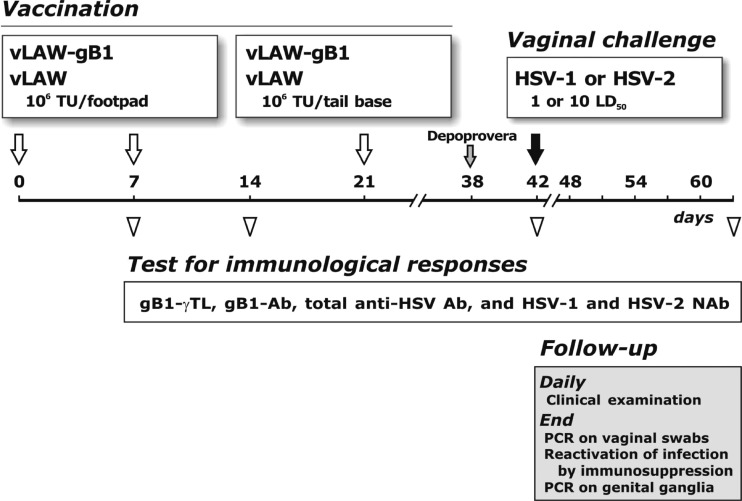
Timeline and details of vaccination, challenge, and immunological and follow-up analyses. Empty arrows indicate inoculations of 106 TU/dose of vaccine vLAW-gB1 and mock-vaccine vLAW. Empty triangles indicate the time at which randomly selected animals were sacrificed and examined for the indicated immunological parameters. At 3 weeks after the last vaccine inoculation, the animals were challenged via vagina with 1 or 10 LD50s of HSV-1 or HSV-2. Challenge, indicated by solid arrow, was preceded by the inoculation of depot medroxyprogesterone acetate (Depoprovera, gray arrow) to synchronize the estrous cycle. Animals were monitored postchallenge for clinical signs of infection for about 3 weeks and, at termination, examined as detailed in the gray box.
Fig 3
Fig 3
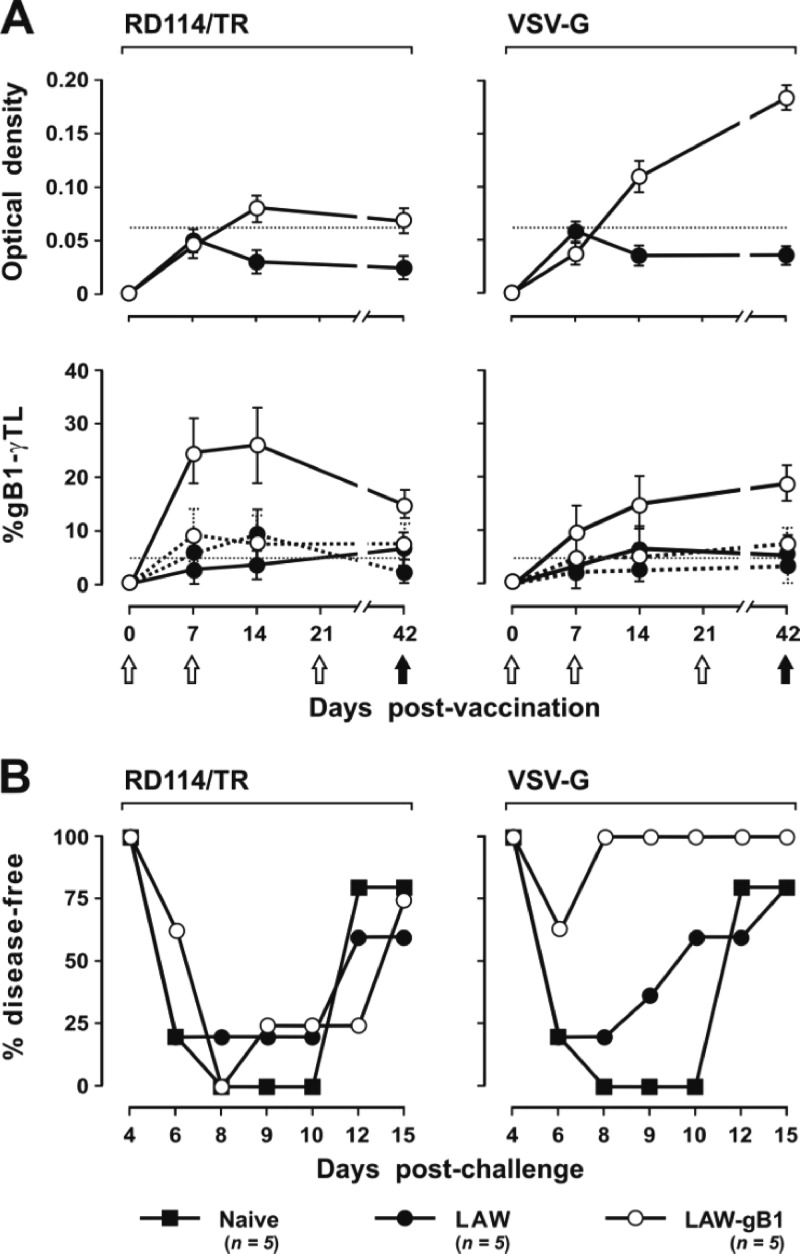
Analysis of elicited immunity and outcome of HSV-1 challenge in animals vaccinated (LAW-gB1) or mock-vaccinated (LAW) with the respective vector pseudotyped with RD114/TR or VSV-G. (A) The top panels show the levels of anti-gB1 antibodies (gB1-Ab), measured with a commercial anti-HSV antibodies ELISA kit; the lower panels show the percentages of IFN-γ-secreting CD8+ T lymphocytes recognizing the gB1 T-lymphocyte epitope 498SSIEFARL505 (gB1-γTL; continuous line) or scrambled peptide ASFLRSEI (dotted line) were determined by intracellular staining of spleen cells stimulated in vitro. IFN-γ-secreting CD4+ T lymphocytes were below cutoff or undetectable. Empty and solid circles indicate LAW-gB1 and LAW animals, respectively. Whiskers indicate the standard deviation. Dotted lines indicate the cutoff, as calculated according to the manufacturer's instructions (gB1-Ab) or experimentally (gB1-γTL). White and black arrows indicate inoculation of above immunogens and challenge with HSV-1, respectively. (B) Percentages of naive, LAW, and LAW-gB1 animals that remained disease-free after challenge with 1 LD50 HSV-1. n, Number of animals/group.
Fig 4
Fig 4
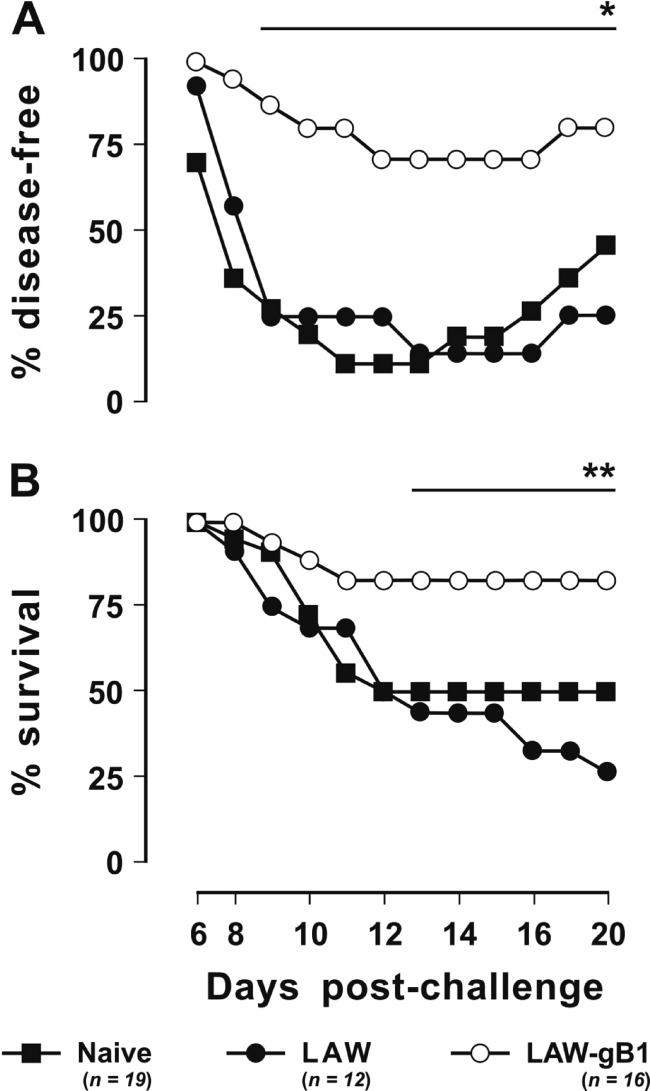
Outcome of challenge performed with 1 LD50 of HSV-2. Animals were vaccinated (LAW-gB1) or mock vaccinated (LAW) with vector particles pseudotyped with VSV-G. (A) Percentages of animals that remained disease-free throughout the observation period. (B) Percentages of surviving animals. The number of dead animals includes those that succumbed to the infection or were euthanized following paralysis or other irreversible lesions. n, Number of animals/group. One and two asterisks indicates significant differences relative to vaccinated animals at P ≤ 0.03 and P ≤ 0.003, respectively.
Fig 5
Fig 5
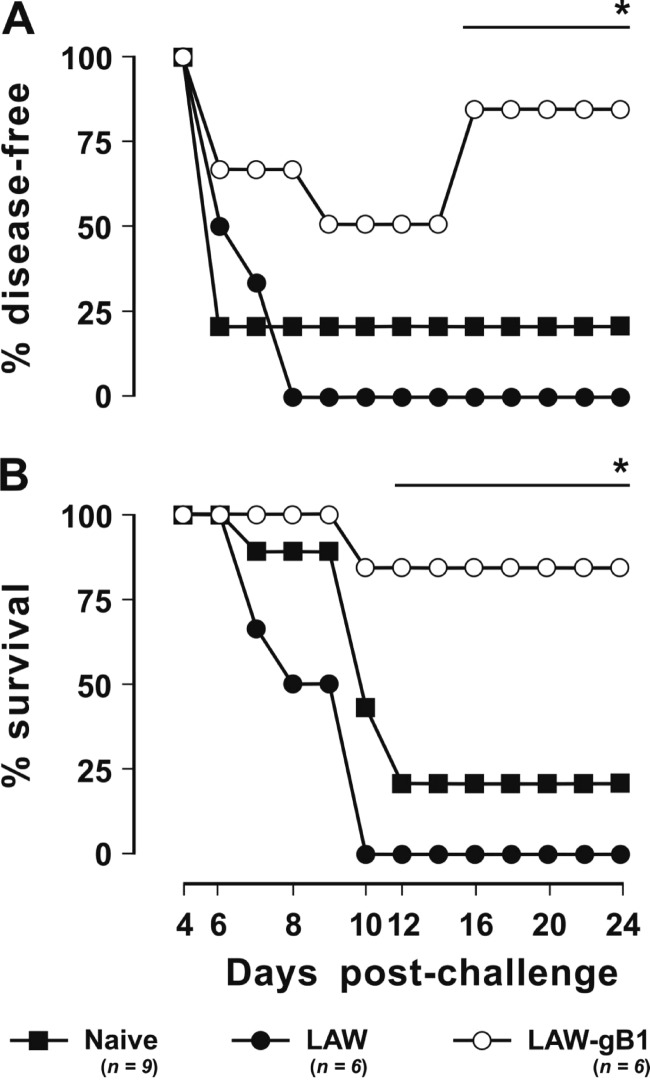
Outcome of challenge performed with 10 LD50s of HSV-2. Animals were vaccinated (LAW-gB1) or mock vaccinated (LAW) with vector particles pseudotyped with VSV-G. (A) Percentages of animals that remained disease-free throughout the observation period. (B) Percentages of surviving animals. The numbers of dead animals were calculated as in Fig. 4. n, Number of animals/group. An asterisk indicates a significant difference relative to vaccinated animals at P ≤ 0.003.
Fig 6
Fig 6
Analysis of anti-HSV immune responses in vaccinated (LAW-gB1) and mock-vaccinated (LAW) animals. The timeline of the vaccination schedule and testing for elicited immune responses is as described in Fig. 2. (A) Percentages of anti-HSV-1 (circles)- and anti-HSV-2 (triangles)-neutralizing activity in sera collected at the indicated times and tested at 1:10 (solid symbols) and 1:20 (empty symbols) dilution. The percent neutralization refers to the number of infected cells incubated with the virus alone. Serum samples from naive animals diluted 1:10 showed a neutralization activity of ≤10%. An asterisk indicates a statistically significant increment at P ≤ 0.005. (B) Percentages of gB1-γTL from spleen (circles), iliac lymph nodes (triangles), or bone marrow (squares) as measured by intracellular staining after stimulation with gB1 T epitope (solid symbols) or scrambled peptide (empty symbols). Analysis was performed in animals euthanized at the indicated times. The dotted line indicates the cutoff. The solid line indicates the average value. IFN-γ-secreting CD4+ T lymphocytes were below cutoff or undetectable. **, Statistically significant increment at P < 0.001.

References

    1. Abu-Raddad LJ, et al. 2008. Genital herpes has played a more important role than any other sexually transmitted infection in driving HIV prevalence in Africa. PLoS One 3:e2230. - PMC - PubMed
    1. Andrei G, et al. 2011. Topical tenofovir, a microbicide effective against HIV, inhibits herpes simplex virus-2 replication. Cell Host Microbe 10:379–389 - PMC - PubMed
    1. Arii J, et al. 2010. Non-muscle myosin IIA is a functional entry receptor for herpes simplex virus-1. Nature 467:859–862 - PubMed
    1. Barraza RA, et al. 2009. Prolonged transgene expression with lentiviral vectors in the aqueous humor outflow pathway of nonhuman primates. Hum. Gene Ther. 20:191–200 - PMC - PubMed
    1. Belshe RB, et al. 2012. Efficacy results of a trial of a herpes simplex vaccine. N. Engl. J. Med. 366:34–43 - PMC - PubMed

Publication types

MeSH terms

Substances