. 2012 Jul;56(7):3568-75.
doi: 10.1128/AAC.06330-11. Epub 2012 Apr 9.

Efficacy of bacteriophage therapy in experimental sepsis and meningitis caused by a clone O25b:H4-ST131 Escherichia coli strain producing CTX-M-15

Affiliations

Efficacy of bacteriophage therapy in experimental sepsis and meningitis caused by a clone O25b:H4-ST131 Escherichia coli strain producing CTX-M-15

Flavie Pouillot et al. Antimicrob Agents Chemother. 2012 Jul.

Abstract

We evaluated phage therapy in experimental infections due to S242, a fatal neonatal meningitis Escherichia coli strain belonging to the worldwide-distributed O25b:H4-ST131 clone that produces extended-spectrum beta-lactamase CTX-M-15. A lytic phage, EC200(PP), active against S242, was isolated from environmental water. After determining in vitro and ex vivo stabilities and pharmacokinetic properties of EC200(PP) in rat pups, we assessed the therapeutic efficacy of a single dose of 10(8) PFU using models of sepsis and meningitis in which fatality was 100%. EC200(PP) was partially neutralized by human serum. In contrast to the high concentration of phage in the spleen and the kidney, low titers in urine and the central nervous system were observed. Nevertheless, in the sepsis model, EC200(PP) administered 7 h or 24 h postinfection resulted in 100% and 50% pup survival, respectively. In the meningitis model, EC200(PP) administered 1 h or 7 h postinfection rescued 100% of the animals. The most delayed treatments were associated with the selection of phage-resistant S242 mutants. However, a representative mutant was highly sensitive to killing serum activity and avirulent in an animal model. EC200(PP) is a potential therapeutic agent for sepsis and meningitis caused by the widespread E. coli O25:H4-ST131 multidrug-resistant clone.


Figures
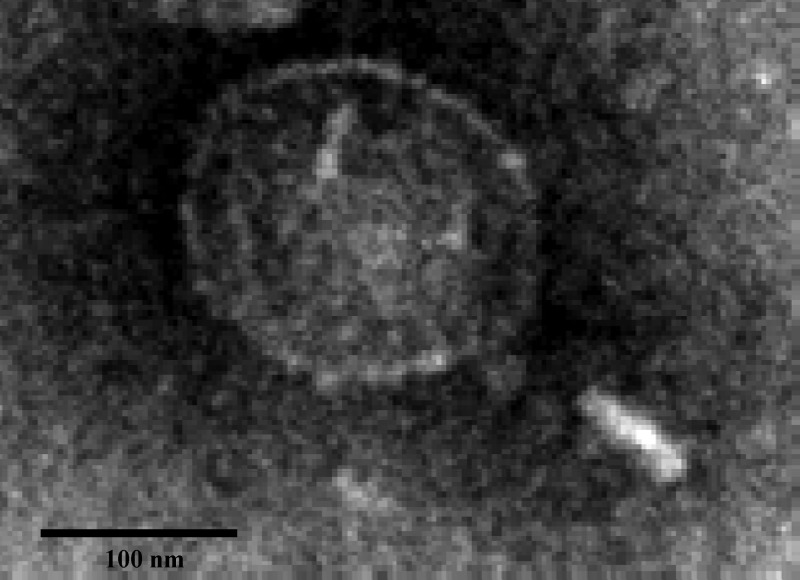
Fig 1
Fig 1
Transmission electron micrograph of a particle (size, 200 nm) of bacteriophage EC200PP, a member of the Podoviridae family. Magnification, ×48,000.
Fig 2
Fig 2
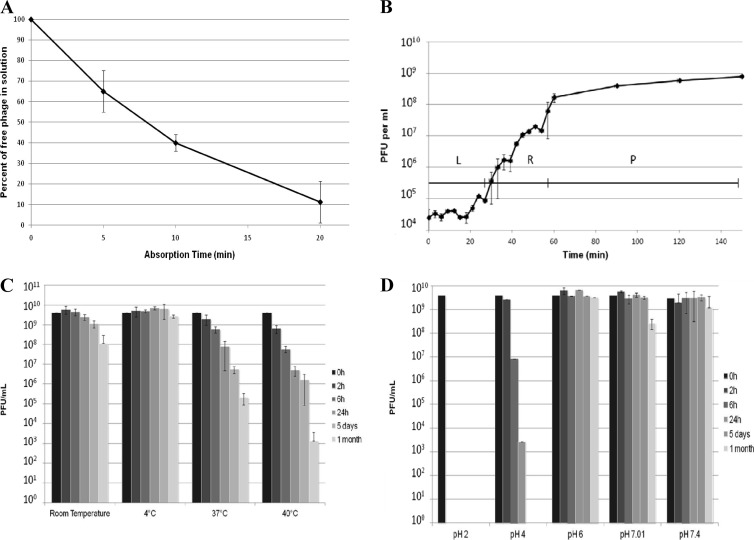
In vitro characterization of phage EC200PP comprising an adsorption rate test (A), single-step growth experiment where latent time and burst size of phage EC200PP were inferred from the curve with a triphasic pattern (L, latent phase; R, rise phase; P, plateau phase) (B), thermal stability test (C), and pH stability (D).
Fig 3
Fig 3
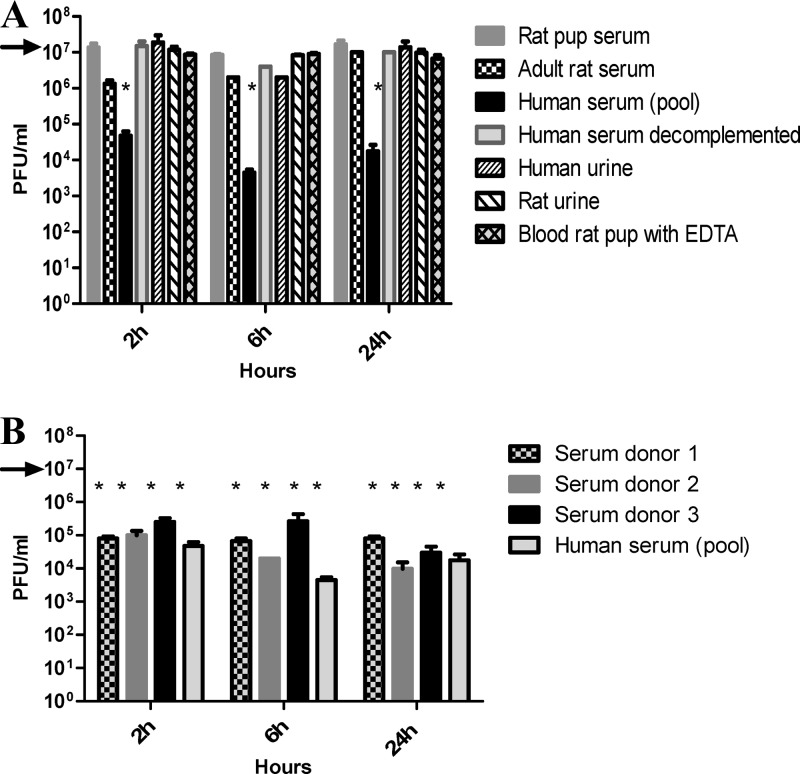
Stability of EC200PP inoculated at 107 PFU (black arrow) in different media (A) and in sera of different donors (B) during 24 h (*, P < 0.001 versus initial inoculum).
Fig 4
Fig 4
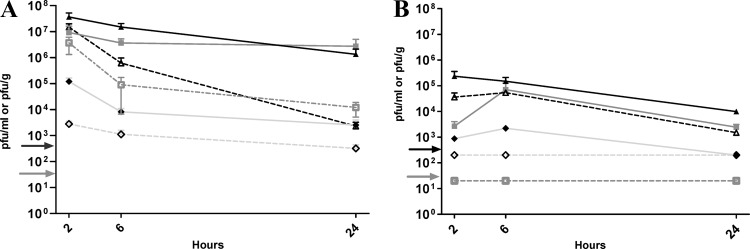
Pharmacokinetic study of EC200PP after intraperitoneal injection (A) or subcutaneous injection (B) of 108 PFU in rat pups. Representation of mean (n = 3 to 5) PFU/ml or PFU/g and standard error of the mean (SEM) in different organs or biologic fluids at 2, 6 and 24 h: ▲, spleen; ♦, brain; ■, kidney; △, blood; ♢, CSF; and □, urine. Detection thresholds: blood and urine (gray arrow) 20 PFU/ml; spleen, kidney, brain, and CSF (black arrow) (200 PFU/ml or/g).
Fig 5
Fig 5
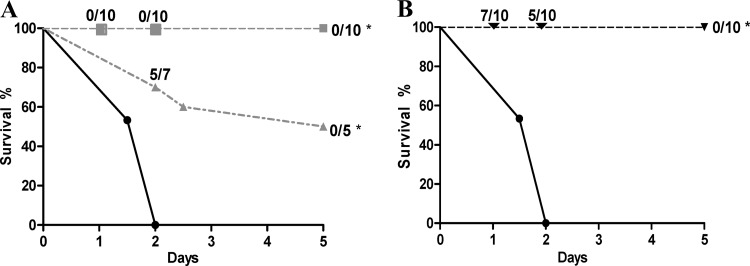
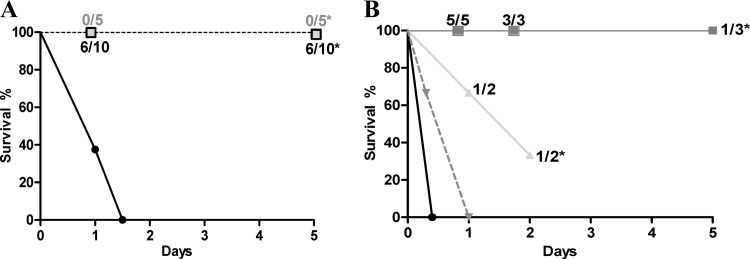
(A) Survival curves after intraperitoneal injection of 2 × 10⁴ CFU of E. coli S242 in rat pups without treatment (●; n = 30) or treated at 7 h (■; n = 10) or 24 h (▲; n = 10) after infection by 108 PFU of EC200PP subcutaneously administered (*, P < 0.001 versus no treatment). Ratios on the figure indicate at different time points the rate of positive blood culture. (B) Survival curves after i.p. injection of 2 × 10⁴ CFU of E. coli S242 (●; n = 30) or 2 × 10⁴ CFU of O4-EC200PPR (▼; n = 10) in rat pups (*, P < 0.001 versus S242). Ratios on the figure indicate at different time points the rate of positive blood culture.
Fig 6
Fig 6
(A) Survival curves after intrathecal injection of 200 CFU of S242 in rat pups without treatment (●; n = 10) or treated at 1 h (■; n = 5) or 7 h (□; n = 10) after infection by 108 PFU of EC200PP by i.p. injection. Ratios on the figure indicate at different time points the rate of positive CSF cultures (*, P < 0.001 versus no treatment). (B) Survival curves after intrathecal injection of 2 × 10⁶ CFU of S242 in rat pups without treatment (●; n = 10) or treated at 1 h (■; n = 5), 2 h (▲; n = 3), or 4 h (▼; n = 3) postinfection by 108 PFU of EC200PP by i.p. injection. Ratios on the figure indicate at different time points the rate of positive CSF cultures (*, P < 0.005 versus no treatment).

References

    1. Barrow P, Lovell M, Berchieri A., Jr 1998. Use of lytic bacteriophage for control of experimental Escherichia coli septicemia and meningitis in chickens and calves. Clin. Diagn. Lab. Immunol. 5:294–298 - PMC - PubMed
    1. Bidet P, et al. 2007. Combined multilocus sequence typing and o serogrouping distinguishes Escherichia coli subtypes associated with infant urosepsis and/or meningitis. J. Infect. Dis. 196:297–303 - PubMed
    1. Birgy A, et al. 2011. Early detection of colonization by VIM-1-producing Klebsiella pneumoniae and NDM-1-producing Escherichia coli in two children returning to France. J. Clin. Microbiol. 49:3085–3087 - PMC - PubMed
    1. Bonacorsi S, et al. 2003. Molecular analysis and experimental virulence of French and North American Escherichia coli neonatal meningitis isolates; identification of new virulent clone. J. Infect. Dis. 187:1895–1906 - PubMed
    1. Boyer-Mariotte S, et al. 2008. CTX-M-15-producing Escherichia coli in fatal neonatal meningitis: failure of empirical chemotherapy. J. Antimicrob. Chemother. 62:1472–1474 - PubMed

Publication types