Role of common and rare APP DNA sequence variants in Alzheimer disease
- PMID: 22491860
- PMCID: PMC3324321
- DOI: 10.1212/WNL.0b013e3182515972
Role of common and rare APP DNA sequence variants in Alzheimer disease
Abstract
Objectives: More than 30 different rare mutations, including copy number variants (CNVs), in the amyloid precursor protein gene (APP) cause early-onset familial Alzheimer disease (EOFAD), whereas the contribution of common APP variants to disease risk remains controversial. In this study we systematically assessed the role of both rare and common APP DNA variants in Alzheimer disease (AD) families.
Methods: Families with EOFAD genetically linked to the APP region were screened for missense mutations and locus duplications of APP. Further, using genome-wide DNA microarray data, we examined the APP locus for CNVs in a total of 797 additional early- and late-onset AD pedigrees. Finally, 423 single nucleotide polymorphisms (SNPs) in the APP locus, including 2 promoter polymorphisms previously associated with AD risk, were tested in up to 4,200 individuals from multiplex AD families.
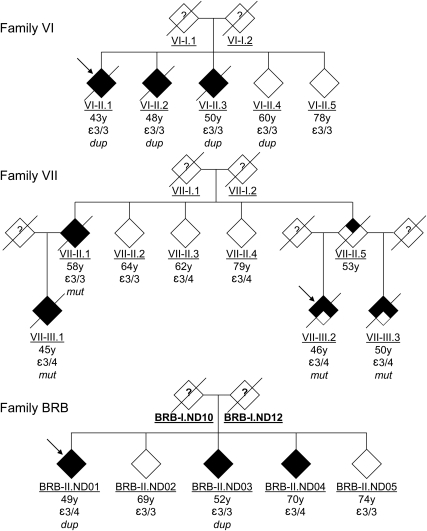
Results: Analyses of 8 21q21-linked families revealed one family carrying a nonsynonymous mutation in exon 17 (Val717Leu) and another family with a partially penetrant 3.5-Mb locus duplication encompassing APP. CNV analysis in the APP locus revealed an additional family carrying a fully penetrant 380-kb duplication, merely spanning APP. Last, contrary to previous reports, association analyses of more than 400 different SNPs in or near APP failed to show significant effects on AD risk.
Conclusion: Our study shows that APP mutations and locus duplications are a very rare cause of EOFAD and that the contribution of common APP variants to AD susceptibility is insignificant. Furthermore, duplications of APP may not be fully penetrant, possibly indicating the existence of hitherto unknown protective genetic factors.
Figures

References
-
- Goate A, Chartier-Harlin MC, Mullan M, et al. Segregation of a missense mutation in the amyloid precursor protein gene with familial Alzheimer's disease. Nature 1991;349:704–706 - PubMed
-
- Cruts M, Van Broeckhoven C. Molecular genetics of Alzheimer's disease. Ann Med 1998;30:560–565 - PubMed
-
- Tanzi RE, Bertram L. Twenty years of the Alzheimer's disease amyloid hypothesis: a genetic perspective. Cell 2005;120:545–555 - PubMed
Publication types
MeSH terms
Substances
Grants and funding
LinkOut - more resources
Full Text Sources
Other Literature Sources
Medical
Miscellaneous