Relationship of Fuchs endothelial corneal dystrophy severity to central corneal thickness
- PMID: 22491913
- PMCID: PMC3859299
- DOI: 10.1001/archophthalmol.2011.1626
Relationship of Fuchs endothelial corneal dystrophy severity to central corneal thickness
Abstract
Objective: To define the relationship between Fuchs endothelial corneal dystrophy (FECD) severity and central corneal thickness (CCT).
Methods: We examined 1610 eyes from a subset of index cases, family members, and unrelated control subjects with normal corneas from the FECD Genetics Multi-Center Study. To estimate the association between FECD severity grade (7-point severity scale based on guttae confluence) and CCT measured by ultrasonographic pachymetry, a multivariable model was used that adjusted for eye, age, race, sex, history of glaucoma or ocular hypertension, diabetes mellitus, contact lens wear, intraocular pressure, and familial relationship to the index case. An interaction between FECD severity grade and edema (stromal or epithelial) on slitlamp examination findings was used to investigate whether the effect of FECD severity grade on CCT differed between those with and without edema.
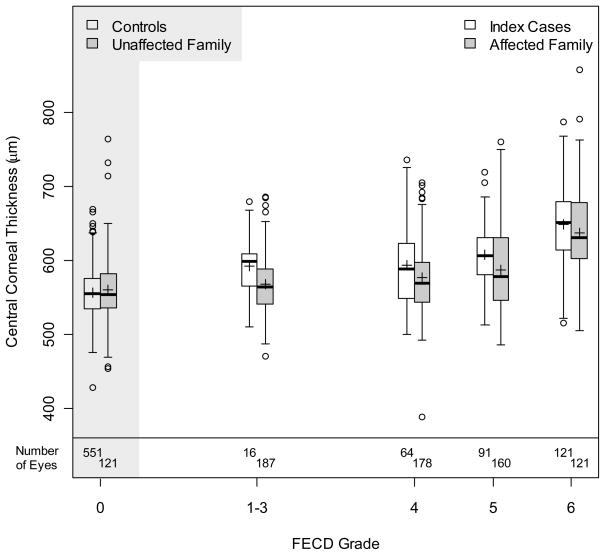
Results: Average CCT was thicker in index cases for all FECD grades compared with unaffected controls (P ≤ .003) and in affected family members with an FECD grade of 4 or greater compared with unaffected family members (P ≤ .04). Similar results were observed for subjects without edema. Average CCT of index cases was greater than that of affected family members with grades 4, 5, and 6 FECD (P ≤ .02). Intraocular pressure was also associated with CCT (P = .01).
Conclusions: An increase in CCT occurs with increasing severity of FECD, including at lower FECD grades in which clinically observable edema is not present. Monitoring CCT changes serially could be a more sensitive measure of disease progression with surgical therapeutic implications.
Figures
References
-
- Burns RR, Bourne WM, Brubaker RF. Endothelial function in patients with cornea guttata. Invest Ophthalmol Vis Sci. 1981;20(1):77–85. - PubMed
-
- Mandell RB, Polse KA, Brand RJ, Vastine D, Demartini D, Flom R. Corneal hydration control in Fuchs’ dystrophy. Invest Ophthalmol Vis Sci. 1989;30(5):845–852. - PubMed
-
- Vitart V, Bencic G, Hayward C, et al. New loci associated with central cornea thickness include COL5A1, AKAP13 and AVGR8. Hum Mol Genet. 2010;19(21):4304–4311. - PubMed
-
- Ehlers N, Bramsen T, Sperling S. Applanation tonometry and central corneal thickness. Acta Ophthalmol (Copenh) 1975;53(1):34–43. - PubMed
Publication types
MeSH terms
Grants and funding
LinkOut - more resources
Full Text Sources
Other Literature Sources