


Role of projections from ventral medial prefrontal cortex to nucleus accumbens shell in context-induced reinstatement of heroin seeking
- PMID: 22492053
- PMCID: PMC3335169
- DOI: 10.1523/JNEUROSCI.0005-12.2012
Role of projections from ventral medial prefrontal cortex to nucleus accumbens shell in context-induced reinstatement of heroin seeking
Abstract
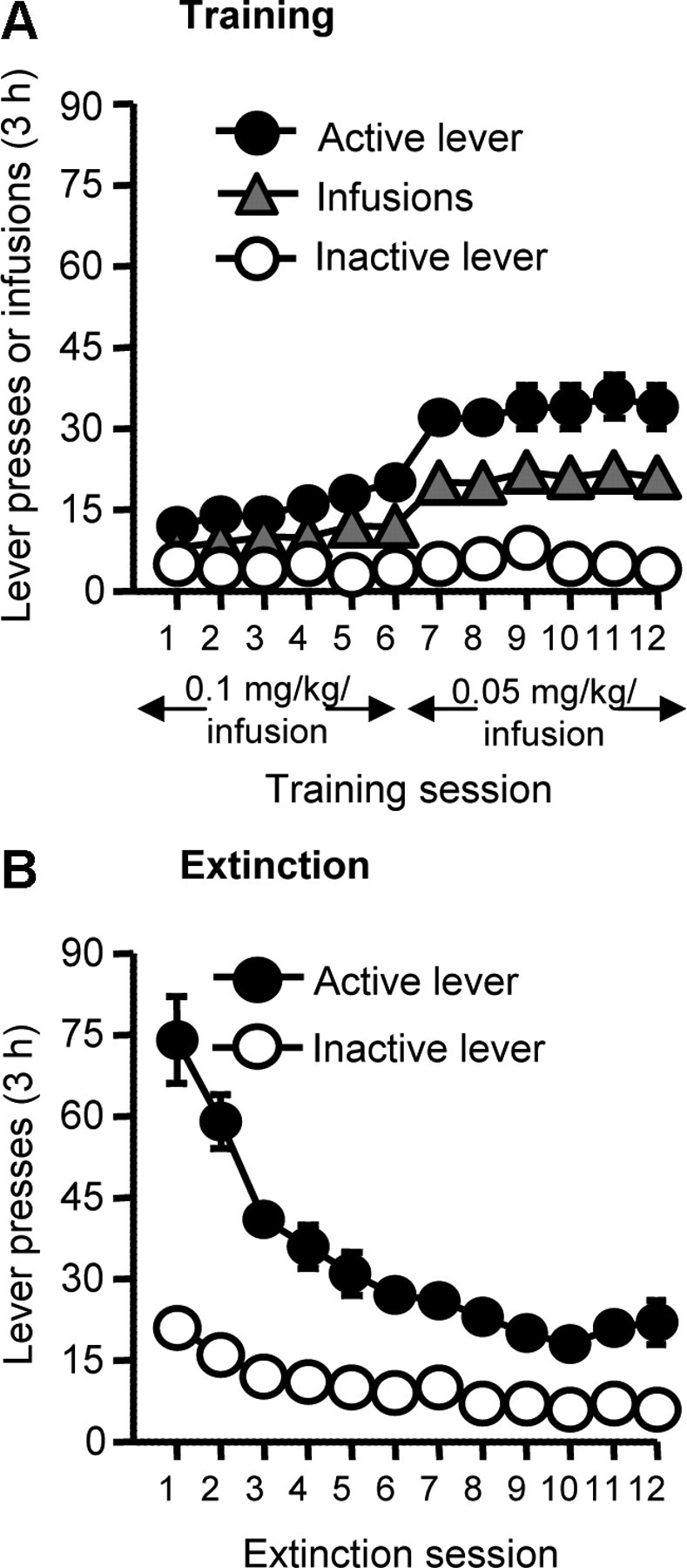
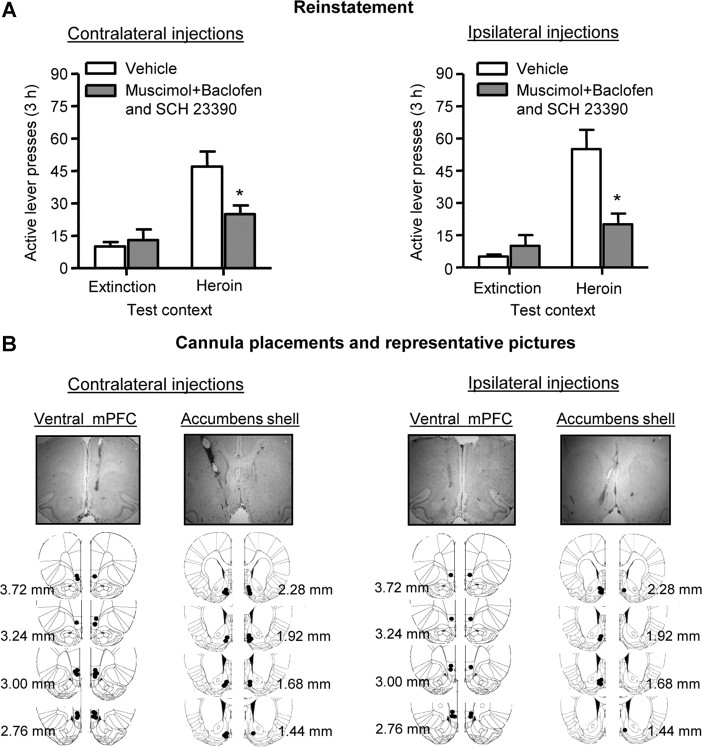
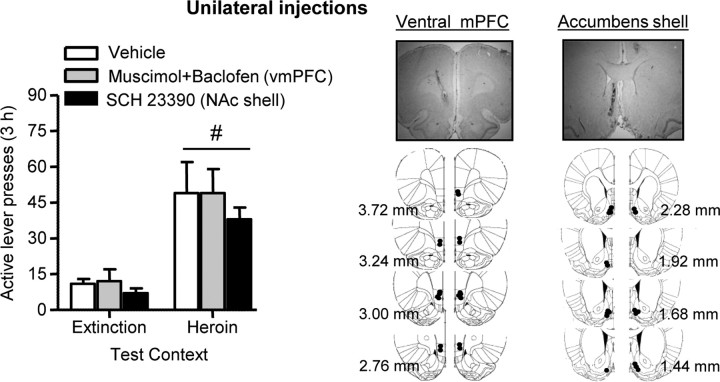
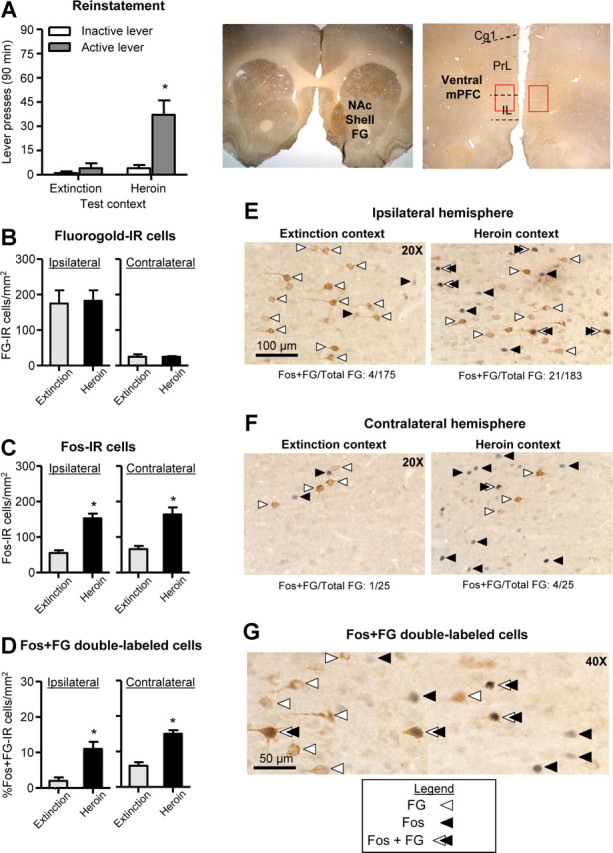
In humans, exposure to contexts previously associated with heroin use can provoke relapse. In rats, exposure to heroin-paired contexts after extinction of drug-reinforced responding in different contexts reinstates heroin seeking. This effect is attenuated by inhibition of glutamate or dopamine transmission in nucleus accumbens shell, or inactivation of ventral medial prefrontal cortex (mPFC). Here, we used an anatomical asymmetrical disconnection procedure to demonstrate that an interaction between glutamatergic projections from ventral mPFC to accumbens shell and local dopamine D(1) postsynaptic receptors contributes to context-induced reinstatement of heroin seeking. We also combined the marker of neuronal activity, Fos, with the retrograde tracer Fluoro-Gold to assess activation in this pathway during context-induced reinstatement. Rats were trained to self-administer heroin for 12 d; drug infusions were paired with a discrete tone-light cue. Lever pressing was subsequently extinguished in a nondrug-associated context in the presence of the discrete cue. Rats were then tested in the heroin- or extinction-associated contexts under extinction conditions. Injections of muscimol + baclofen into ventral mPFC in one hemisphere and D(1)-family receptor antagonist SCH 23390 into the contralateral or ipsilateral accumbens shell decreased context-induced reinstatement. Unilateral injections of muscimol + baclofen into ventral mPFC or SCH 23390 into the accumbens shell had no effect. Context-induced reinstatement was associated with increased Fos expression in ventral mPFC neurons, including those projecting to accumbens shell, with higher double-labeling in the ipsilateral projection than in the contralateral projection. Our results demonstrate that activation of glutamatergic projections from ventral mPFC to accumbens shell, previously implicated in inhibition of cocaine relapse, promotes heroin relapse.
Figures
References
-
- Alvarez-Jaimes L, Polis I, Parsons LH. Attenuation of cue-induced heroin-seeking behavior by cannabinoid CB1 antagonist infusions into the nucleus accumbens core and prefrontal cortex, but not basolateral amygdala. Neuropsychopharmacology. 2008;33:2483–2493. - PubMed
-
- Anderson SM, Bari AA, Pierce RC. Administration of the D1-like dopamine receptor antagonist SCH-23390 into the medial nucleus accumbens shell attenuates cocaine priming-induced reinstatement of drug-seeking behavior in rats. Psychopharmacology. 2003;168:132–138. - PubMed
-
- Anderson SM, Schmidt HD, Pierce RC. Administration of the D2 dopamine receptor antagonist sulpiride into the shell, but not the core, of the nucleus accumbens attenuates cocaine priming-induced reinstatement of drug seeking. Neuropsychopharmacology. 2006;31:1452–1461. - PubMed
-
- Beckstead RM. An autoradiographic examination of corticocortical and subcortical projections of the mediodorsal-projection (prefrontal) cortex in the rat. J Comp Neurol. 1979;184:43–62. - PubMed
Publication types
MeSH terms
Grants and funding
LinkOut - more resources
Full Text Sources
Medical
Miscellaneous
