


Preclinical evidence that activation of mesolimbic alpha 6 subunit containing nicotinic acetylcholine receptors supports nicotine addiction phenotype
- PMID: 22492084
- PMCID: PMC3482009
- DOI: 10.1093/ntr/nts089
Preclinical evidence that activation of mesolimbic alpha 6 subunit containing nicotinic acetylcholine receptors supports nicotine addiction phenotype
Abstract
Introduction: Nicotine is a major psychoactive ingredient in tobacco yet very few individuals quit smoking with the aid of nicotine replacement therapy. Targeted therapies with more selective action at nicotinic acetylcholine receptors (nAChRs) that contain a β2 subunit (β2*nAChRs; *denotes assembly with other subunits) have enjoyed significantly greater success, but exhibit potential for unwanted cardiac, gastrointestinal, and emotive side effects.
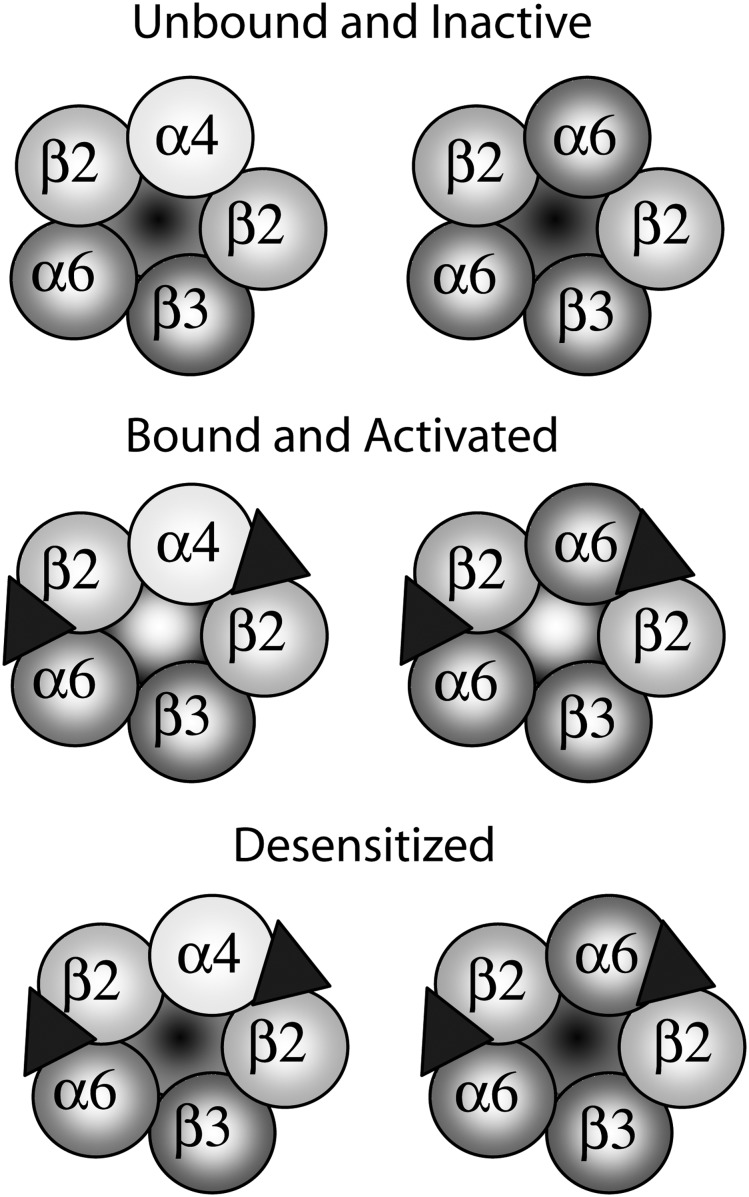
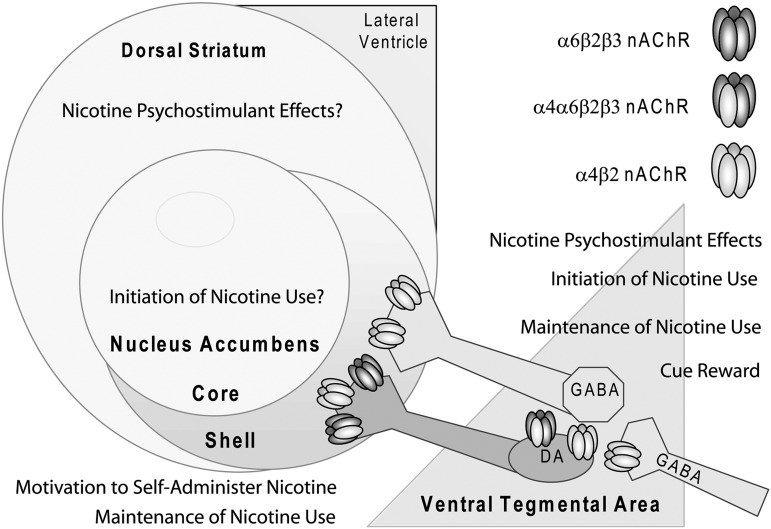
Discussion: This literature review focuses on the preclinical evidence that suggests that subclasses of β2*nAChRs that assemble with the α6 subunit may provide an effective target for tobacco cessation. α6β2*nAChRs have a highly selective pattern of neuroanatomical expression in catecholaminergic nuclei including the ventral tegmental area and its projection regions. α6β2*nAChRs promote dopamine (DA) neuron activity and DA release in the mesolimbic dopamine system, a brain circuitry that is well-studied for its contributions to addiction behavior. A combination of genetic and pharmacological studies indicates that activation of α6β2*nAChRs is necessary and sufficient for nicotine psychostimulant effects and nicotine self-administration. α6β2*nAChRs support maintenance of nicotine use, support the conditioned reinforcing effects of drug-associated cues, and regulate nicotine withdrawal.
Conclusions: These data suggest that α6β2*nAChRs represent a critical pool of high affinity β2*nAChRs that regulates nicotine dependence phenotype and suggest that inhibition of these receptors may provide an effective strategy for tobacco cessation therapy.
Figures
References
-
- Arias HR. Localization of agonist and competitive antagonist binding sites on nicotinic acetylcholine receptors. Neurochemistry International. 2000;36:595–645. doi:10.1016/S0197-0186(99)00154-0. - PubMed
-
- Azam L, McIntosh JM. Effect of novel alpha-conotoxins on nicotine-stimulated [3H]dopamine release from rat striatal synaptosomes. Journal of Pharmacology and Experimental Therapeutics. 2005;312:231–237. doi:10.1124/jpet.104.071456. - PubMed
-
- Barrett SP, Boileau I, Okker J, Pihl RO, Dagher A. The hedonic response to cigarette smoking is proportional to dopamine release in the human striatum as measured by positron emission tomography and [11C]raclopride. Synapse. 2004;54:65–71. doi:10.1002/syn.20066. - PubMed
-
- Benwell ME, Balfour DJ. The effects of acute and repeated nicotine treatment on nucleus accumbens dopamine and locomotor activity. British Journal of Pharmacology. 1992;105:849–856. Retrieved from http://www.ncbi.nlm.nih.gov/pmc/articles/PMC1908718/?tool=pubmed. - PMC - PubMed
Publication types
MeSH terms
Substances
Grants and funding
LinkOut - more resources
Full Text Sources
Other Literature Sources
