Comparative Study
. 2012 Apr;86(4):690-7.
doi: 10.4269/ajtmh.2012.11-0553.

Innate and adaptive immune responses during acute M. tuberculosis infection in adult household contacts in Kampala, Uganda

Affiliations
Comparative Study

Innate and adaptive immune responses during acute M. tuberculosis infection in adult household contacts in Kampala, Uganda

C Scott Mahan et al. Am J Trop Med Hyg. 2012 Apr.

Abstract

Contacts of active pulmonary tuberculosis (TB) patients are at risk for Mycobacterium tuberculosis (MTB) infection. Because most infections are controlled, studies during MTB infection provide insight into protective immunity. We compared immune responses of adult household contacts that did and did not convert the tuberculin skin test (TST). Innate and adaptive immune responses were measured by whole blood assay. Responses of TST converters (TSTC) were compared with persistently TST negative contacts (PTST-) and contacts who were TST+ at baseline (TST+). TLR-2, TLR-4, and IFN-γR responses to IFN-γ did not differ between the groups, nor did γδ T cell responses. T cell responses to MTB antigens differed markedly among TSTC, PTST-, and TST+ contacts. Thus, no differences in innate responses were found among the three household contact groups. However, adaptive T cell responses to MTB antigens did differ before and during MTB infection among PTST-, TSTC, and TST+ contacts.


Figures
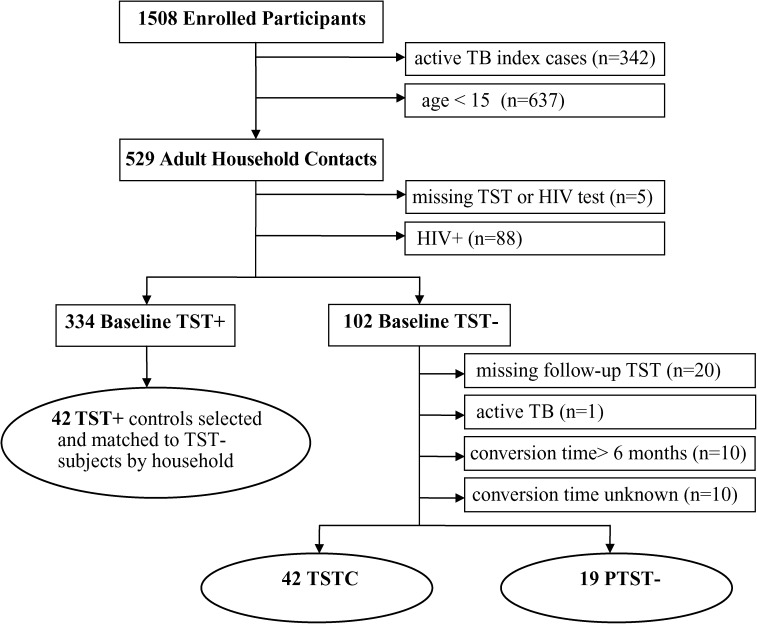
Figure 1.
Figure 1.
Distribution of age, TST, and HIV status of TB index cases and contacts enrolled in a TB household contact study in Kampala, Uganda between 2002–2006. HIV = human immunodeficiency virus; TST = tuberculin skin test; TSTC = tuberculin skin test converter at 3 months; PTST− = persistently TST negative at 12 and 24 months.
Figure 2.
Figure 2.
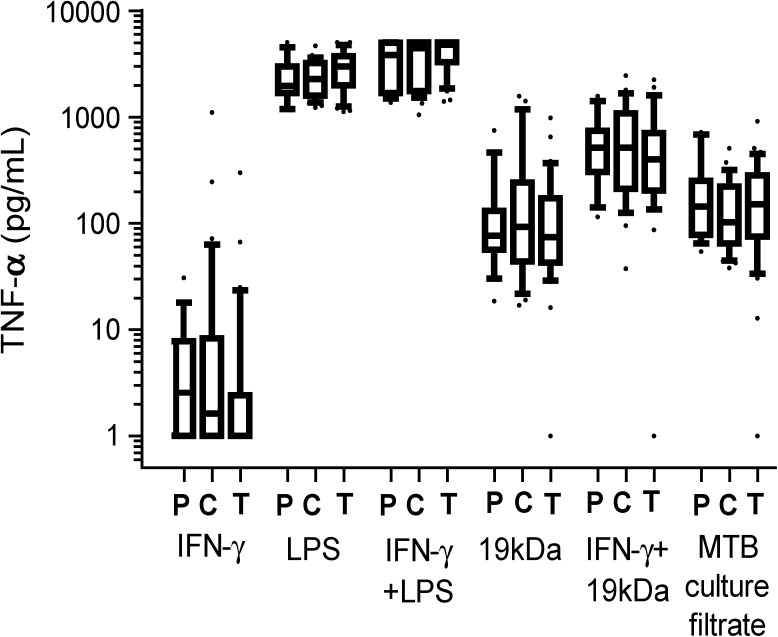
TNF-α responses of PTST− (n = 19), TSTC (n = 42) and TST+ (n = 42) contacts at baseline in response to innate receptor ligands. Whole blood was stimulated overnight with either IFN-γ, LPS, IFN-g pretreatment followed by LPS (IFN-γ + LPS), 19 kDa LpqH (19 kDa), IFN-γ pretreatment followed by 19 kDa LpqH (IFN-γ + 19 kDa) or MTB CF. Supernatants were harvested after 18 h and TNF-α measured by ELISA. Results presented are the mean ± SD of single measurements for each group of contacts. P are PTST− (N = 19), C are TSTC (N = 42) and T are TST+ (N = 42). Box and whisker plots with the whiskers defining the 90th and 10th percentiles. *There were no statistically significant differences among the 3 groups (P > 0.05).
Figure 3.
Figure 3.
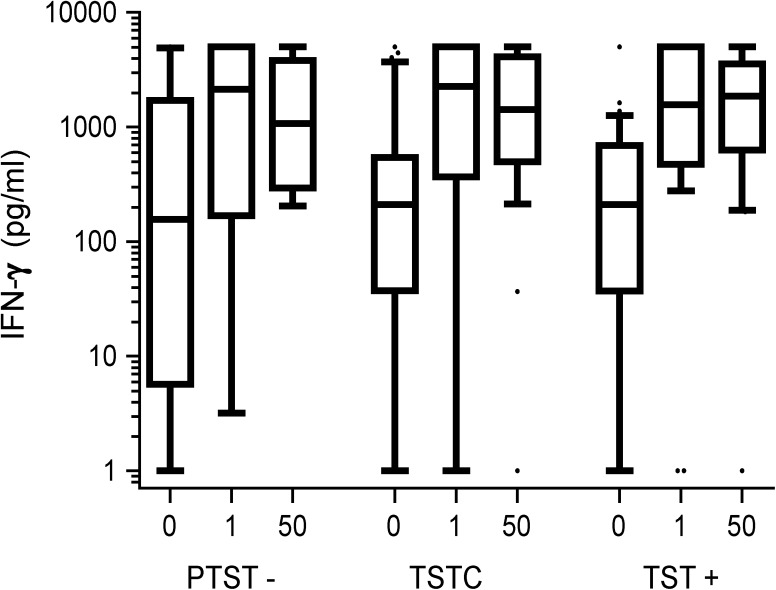
Vδ2 T cell responses of PTST−, TSTC and TST+ contacts at baseline in response to BrHPP and IL-2. Whole blood was stimulated with IL-2 (25 U/mL) with and without BrHPP (1 and 50 μM). Supernatants were harvested after 7 days and IFN-γ measured by ELISA. Results presented are the mean ± SD of single measurements for each group of contacts. 0 = IL2 (25 units/mL) alone; 1 = IL2 + 1 μM BrHPP; 50 = IL2 + 50 μM BrHPP. Box and whisker plots with whiskers defining the 90th and 10th percentiles. *There were no statistically significant differences between the 3 groups (P > 0.05).
Figure 4.
Figure 4.
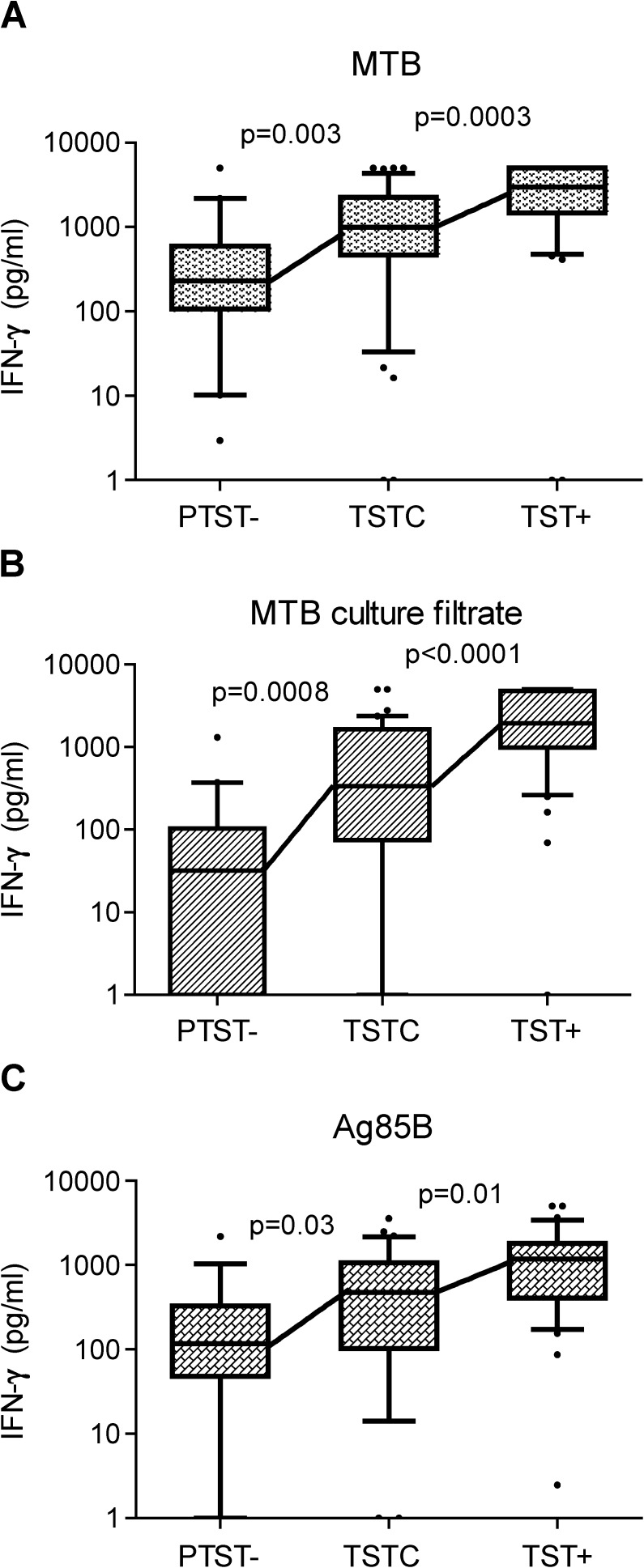
Baseline IFN-γ responses of PTST−, TSTC, and TST+ contacts to MTB bacilli, MTB CF and Ag85B. Whole blood was stimulated with: (A) MTB bacilli (106 CFU/mL). (B) MTB Culture Filtrate (10 μg/mL). (C) Ag85B (10 μg/mL). Supernatants were harvested after 7 days and IFN-γ measured by ELISA. Results presented are the mean ± SD of single measurements for each group of contacts. Box and whisker plots with whiskers defining the 90th and 10th percentiles. P values shown are those for comparisons between adjacent groups.
Figure 5.
Figure 5.
Changes in IFN-γ responses of PTST−, TSTC and TST+ contacts to MTB bacilli, MTB CF and Ag85B during 2 years of follow-up. Adjusted conditional growth model evaluating changes in IFN-γ responses over time to MTB antigens in three groups of contacts. (A) MTB bacilli (106 CFU/well). TSTC and TST+ responses remain significantly different until 10–11 months. (B) MTB Culture Filtrate (10 μg/mL), TSTC and TST remain significantly different (P < 0.05) until 9–10 months when values converge. (C) Ag 85B (10 μg/mL). TSTC and TST+ significant differences are lost after baseline. PTST− responses remain significantly different for all 3 antigens at all time points as compared to the TSTC and TST+ groups (P < 0.05).

References

    1. Means TK, Wang S, Lien E, Yoshimura A, Golenbock DT, Fenton MJ. Human toll-like receptors mediate cellular activation by Mycobacterium tuberculosis. J Immunol. 1999;163:3920–3927. - PubMed
    1. Brightbill HD, Libraty DH, Krutzik SR, Yang RB, Belisle JT, Bleharski JR, Maitland M, Norgard MV, Plevy SE, Smale ST, Brennan PJ, Bloom BR, Godowski PJ, Modlin RL. Host defense mechanisms triggered by microbial lipoproteins through toll-like receptors. Science. 1999;285:732–736. - PubMed
    1. van Crevel R, Ottenhoff TH, van der Meer JW. Innate immunity to Mycobacterium tuberculosis. Clin Microbiol Rev. 2002;15:294–309. - PMC - PubMed
    1. Ulrichs T, Porcelli SA. CD1 proteins: targets of T cell recognition in innate and adaptive immunity. Rev Immunogenet. 2000;2:416–432. - PubMed
    1. Havlir DV, Ellner JJ, Chervenak KA, Boom WH. Selective expansion of human gamma delta T cells by monocytes infected with live Mycobacterium tuberculosis. J Clin Invest. 1991;87:729–733. - PMC - PubMed

Publication types

MeSH terms