


EarlyCDT®-Lung test: improved clinical utility through additional autoantibody assays
- PMID: 22492236
- PMCID: PMC3460172
- DOI: 10.1007/s13277-012-0379-2
EarlyCDT®-Lung test: improved clinical utility through additional autoantibody assays
Abstract
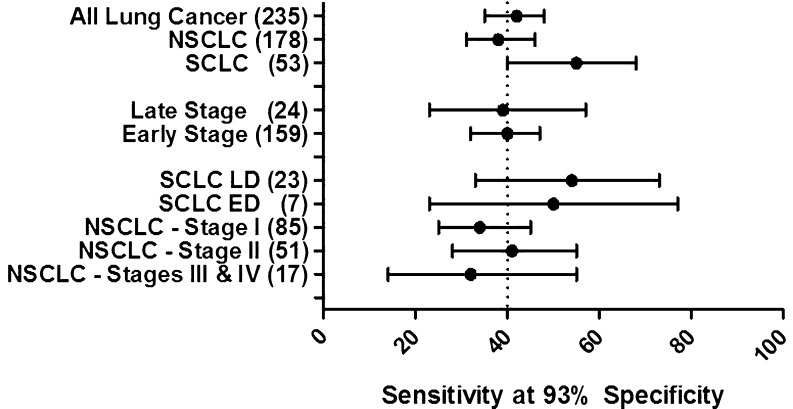
Tumor-associated autoantibodies (AAbs) have been described in patients with lung cancer, and the EarlyCDT®-Lung test that measures such AAbs is available as an aid for the early detection of lung cancer in high-risk populations. Improvements in specificity would improve its cost-effectiveness, as well as reduce anxiety associated with false positive tests. Samples from 235 patients with newly diagnosed lung cancer and matched controls were measured for the presence of AAbs to a panel of six (p53, NY-ESO-1, CAGE, GBU4-5, Annexin I, and SOX2) or seven (p53, NY-ESO-1, CAGE, GBU4-5, SOX2, HuD, and MAGE A4) antigens. Data were assessed in relation to cancer type and stage. The sensitivity and specificity of these two panels were also compared in two prospective consecutive series of 776 and 836 individuals at an increased risk of developing lung cancer. The six-AAb panel gave a sensitivity of 39% with a specificity of 89 %, while the seven-AAb panel gave a sensitivity of 41 % with a specificity of 91 % which, once adjusted for occult cancers in the population, resulted in a specificity of 93 %. Analysis of these AAb assays in the at-risk population confirmed that the seven-AAb panel resulted in a significant increase in the specificity of the test from 82 to 90 %, with no significant change in sensitivity. The change from a six- to a seven-AAb assay can improve the specificity of the test and would result in a PPV of 1 in 8 and an overall accuracy of 92 %.
Figures
References
Publication types
MeSH terms
Substances
LinkOut - more resources
Full Text Sources
Other Literature Sources
Medical
Research Materials
Miscellaneous
