


Effects of essential oils on methane production and fermentation by, and abundance and diversity of, rumen microbial populations
- PMID: 22492451
- PMCID: PMC3370521
- DOI: 10.1128/AEM.00309-12
Effects of essential oils on methane production and fermentation by, and abundance and diversity of, rumen microbial populations
Abstract
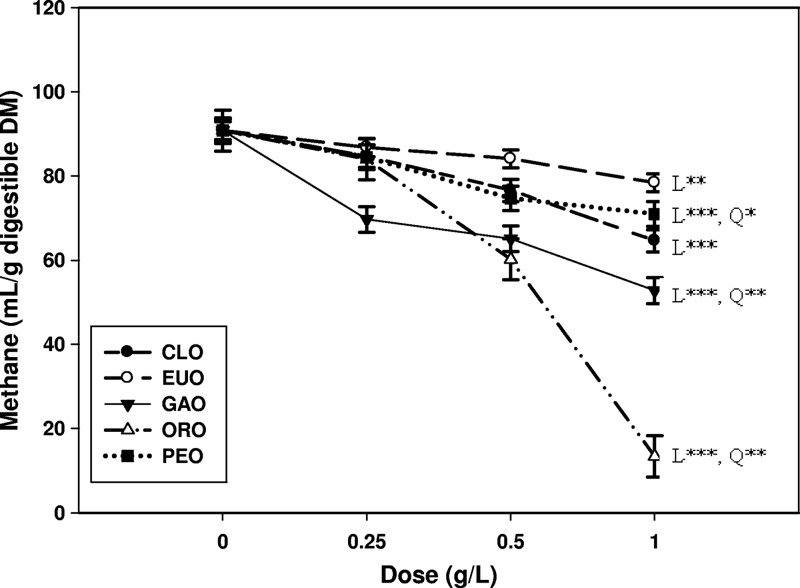
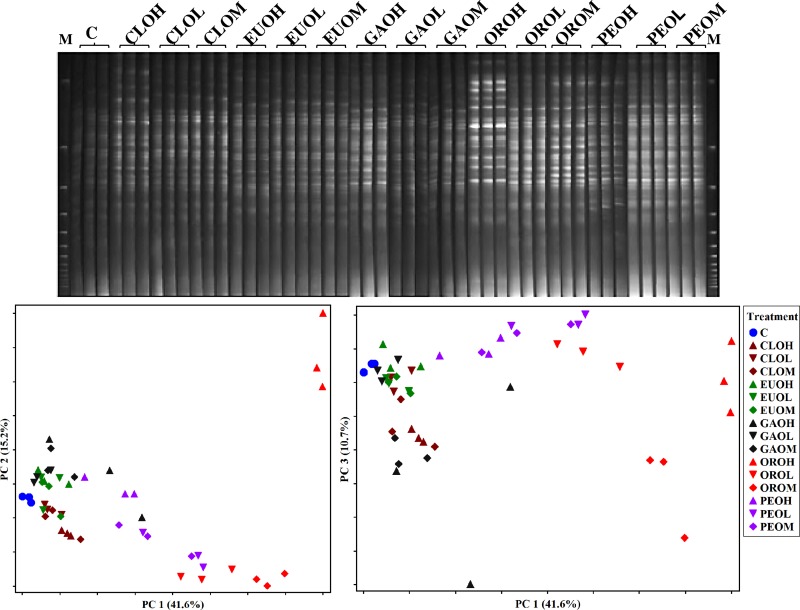
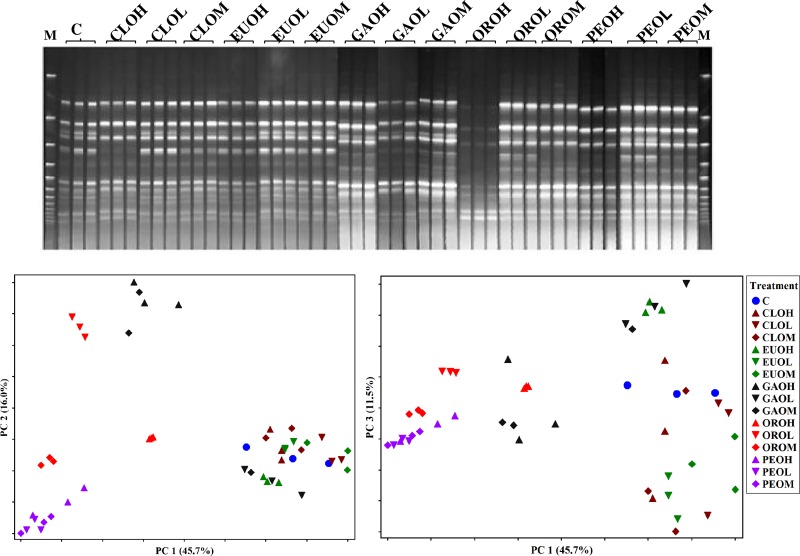
Five essential oils (EOs), namely, clove oil (CLO), eucalyptus oil (EUO), garlic oil (GAO), origanum oil (ORO), and peppermint oil (PEO), were tested in vitro at 3 different doses (0.25, 0.50, and 1.0 g/liter) for their effect on methane production, fermentation, and select groups of ruminal microbes, including total bacteria, cellulolytic bacteria, archaea, and protozoa. All the EOs significantly reduced methane production with increasing doses, with reductions by 34.4%, 17.6%, 42.3%, 87%, and 25.7% for CLO, EUO, GAO, ORO, and PEO, respectively, at 1.0 g/liter compared with the control. However, apparent degradability of dry matter and neutral detergent fiber also decreased linearly with increasing doses by all EOs except GAO. The concentrations of total volatile fatty acids were not affected by GAO, EUO, or PEO but altered linearly and quadratically by CLO and ORO, respectively. All the EOs also differed in altering the molar proportions of acetate, propionate, and butyrate. As determined by quantitative real-time PCR, all the EOs decreased the abundance of archaea, protozoa, and major cellulolytic bacteria (i.e., Fibrobacter succinogenes, Ruminococcus flavefaciens, and R. albus) linearly with increasing EO doses. On the basis of denaturing gradient gel electrophoresis analysis, different EOs changed the composition of both archaeal and bacterial communities to different extents. The Shannon-Wiener diversity index (H') was reduced for archaea by all EOs in a dose-dependent manner but increased for bacteria at low and medium doses (0.25 and 0.50 g/liter) for all EOs except ORO. Due to the adverse effects on feed digestion and fermentation at high doses, a single EO may not effectively and practically mitigate methane emission from ruminants unless used at low doses in combinations with other antimethanogenic compounds.
Figures
References
-
- Agarwal N, Shekhar C, Kumar R, Chaudhary LC, Kamra DN. 2009. Effect of peppermint (Mentha piperita) oil on in vitro methanogenesis and fermentation of feed with buffalo rumen liquor. Anim. Feed Sci. Technol. 148:321–327
-
- Anderson RC, et al. 2010. Effect of nitroethane, dimethyl-2-nitroglutarate and 2-nitro-methyl-propionate on ruminal methane production and hydrogen balance in vitro. Bioresour. Technol. 101:5345–5349 - PubMed
-
- Beauchemin KA, Kreuzer M, O'Mara F, McAllister TA. 2008. Nutritional management for enteric methane abatement: a review. Aust. J. Exp. Agric. 48:21–27
-
- Beauchemin KA, McGinn SM. 2006. Methane emissions from beef cattle: effects of fumaric acid, essential oil, and canola oil. J. Anim. Sci. 84:1489–1496 - PubMed
Publication types
MeSH terms
Substances
LinkOut - more resources
Full Text Sources
Other Literature Sources
Research Materials
