


Habitual levels of high, but not moderate or low, impact activity are positively related to hip BMD and geometry: results from a population-based study of adolescents
- PMID: 22492557
- PMCID: PMC3465797
- DOI: 10.1002/jbmr.1631
Habitual levels of high, but not moderate or low, impact activity are positively related to hip BMD and geometry: results from a population-based study of adolescents
Abstract
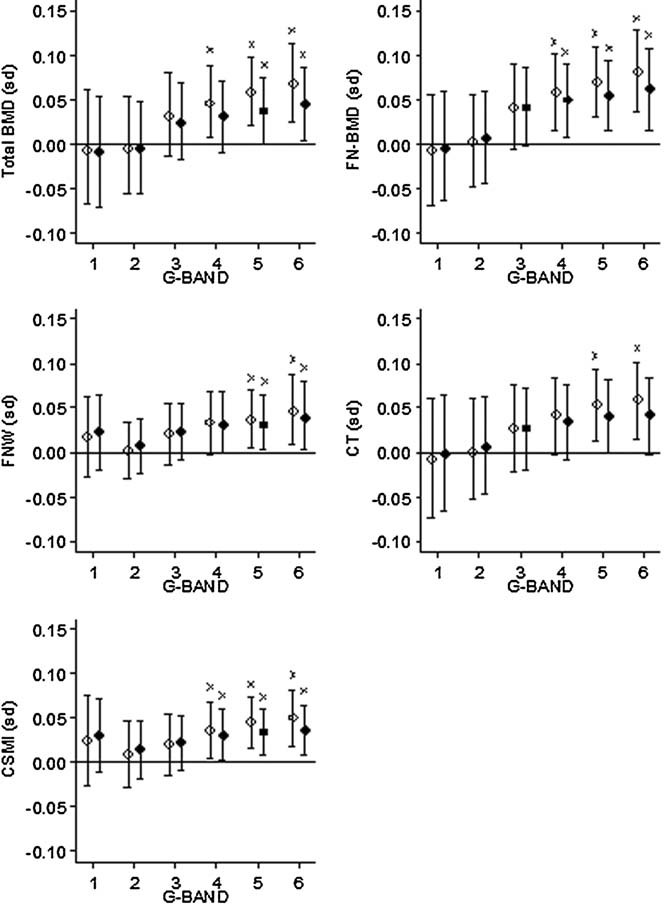
Whether a certain level of impact needs to be exceeded for physical activity (PA) to benefit bone accrual is currently unclear. To examine this question, we performed a cross-sectional analysis between PA and hip BMD in 724 adolescents (292 boys, mean 17.7 years) from the Avon Longitudinal Study of Parents and Children (ALSPAC), partitioning outputs from a Newtest accelerometer into six different impact bands. Counts within 2.1 to 3.1g, 3.1 to 4.2g, 4.2 to 5.1g, and >5.1g bands were positively related to femoral neck (FN) BMD, in boys and girls combined, in our minimally adjusted model including age, height, and sex (0.5-1.1g: beta = -0.007, p = 0.8; 1.1-2.1g: beta = 0.003, p = 0.9; 2.1-3.1g: beta = 0.042, p = 0.08; 3.1-4.2g: beta = 0.058, p = 0.009; 4.2-5.1g: beta = 0.070, p = 0.001; >5.1g: beta = 0.080, p < 0.001) (beta = SD change per doubling in activity). Similar positive relationships were observed between high-impact bands and BMD at other hip sites (ward's triangle, total hip), hip structure indices derived by hip structural analysis of dual-energy X-ray absorptiometry (DXA) scans (FN width, cross-sectional area, cortical thickness), and predicted strength (cross-sectional moment of inertia). In analyses where adjacent bands were combined and then adjusted for other impacts, high impacts (>4.2g) were positively related to FN BMD, whereas, if anything, moderate (2.1-4.2g) and low impacts (0.5-2.1g) were inversely related (low: beta = -0.052, p = 0.2; medium: beta = -0.058, p = 0.2; high: beta = 0.137, p < 0.001). Though slightly attenuated, the positive association between PA and FN BMD, confined to high impacts, was still observed after adjustment for fat mass, lean mass, and socioeconomic position (high: beta = 0.096, p = 0.016). These results suggest that PA associated with impacts >4.2g, such as jumping and running (which further studies suggested requires speeds >10 km/h) is positively related to hip BMD and structure in adolescents, whereas moderate impact activity (eg, jogging) is of little benefit. Hence, PA may only strengthen lower limb bones in adolescents, and possibly adults, if this comprises high-impact activity.
Copyright © 2012 American Society for Bone and Mineral Research.
Figures
Comment in
-
Bone: impact loading-nature's way to strengthen bone.Nat Rev Endocrinol. 2012 May 29;8(7):391-3. doi: 10.1038/nrendo.2012.88. Nat Rev Endocrinol. 2012. PMID: 22640997 No abstract available.
References
-
- Goodship AE, Lanyon LE, McFie H. Functional adaptation of bone in increased stress. J Bone Joint Surg. 1979;61A:539–46. - PubMed
-
- Rubin CT, Lanyon LE. Regulation of bone mass by mechanical strain magnitude. Calcif Tissue Int. 1985;37:411–7. - PubMed
-
- Duda GN, Kirchner H, Wilke HJ, Claes L. A method to determine the 3-D stiffness of fracture fixation devices and its application to predict inter-fragmentary movement. J Biomech. 1998;31(3):247–52. - PubMed
-
- Rittweger J, Beller G, Ehrig J, Jung C, Koch U, Ramolla J, Schmidt F, Newitt D, Majumdar S, Schiessl H, Felsenberg D. Bone-muscle strength indices for the human lower leg. Bone. 2000;27(2):319–26. - PubMed
-
- Hind K, Burrows M. Weight-bearing exercise and bone mineral accrual in children and adolescents: a review of controlled trials. Bone. 2007;40(1):14–27. - PubMed
Publication types
MeSH terms
Grants and funding
LinkOut - more resources
Full Text Sources
Medical
Miscellaneous
