. 2012 Jun 15;205(12):1821-9.
doi: 10.1093/infdis/jis277. Epub 2012 Apr 5.

Impact of fluoroquinolone resistance mutations on gonococcal fitness and in vivo selection for compensatory mutations

Affiliations

Impact of fluoroquinolone resistance mutations on gonococcal fitness and in vivo selection for compensatory mutations

Anjali N Kunz et al. J Infect Dis. .

Abstract

Background: Quinolone-resistant Neisseria gonorrhoeae (QRNG) arise from mutations in gyrA (intermediate resistance) or gyrA and parC (resistance). Here we tested the consequence of commonly isolated gyrA(91/95) and parC86 mutations on gonococcal fitness.

Methods: Mutant gyrA(91/95) and parC86 alleles were introduced into wild-type gonococci or an isogenic mutant that is resistant to macrolides due to an mtrR(-79) mutation. Wild-type and mutant bacteria were compared for growth in vitro and in competitive murine infection.

Results: In vitro growth was reduced with increasing numbers of mutations. Interestingly, the gyrA(91/95) mutation conferred an in vivo fitness benefit to wild-type and mtrR(-79) mutant gonococci. The gyrA(91/95), parC86 mutant, in contrast, showed a slight fitness defect in vivo, and the gyrA(91/95), parC86, mtrR(-79) mutant was markedly less fit relative to the parent strains. A ciprofloxacin-resistant (Cip(R)) mutant was selected during infection with the gyrA(91/95), parC86, mtrR(-79) mutant in which the mtrR(-79) mutation was repaired and the gyrA(91) mutation was altered. This in vivo-selected mutant grew as well as the wild-type strain in vitro.

Conclusions: gyrA(91/95) mutations may contribute to the spread of QRNG. Further acquisition of a parC86 mutation abrogates this fitness advantage; however, compensatory mutations can occur that restore in vivo fitness and maintain Cip(R).


Figures
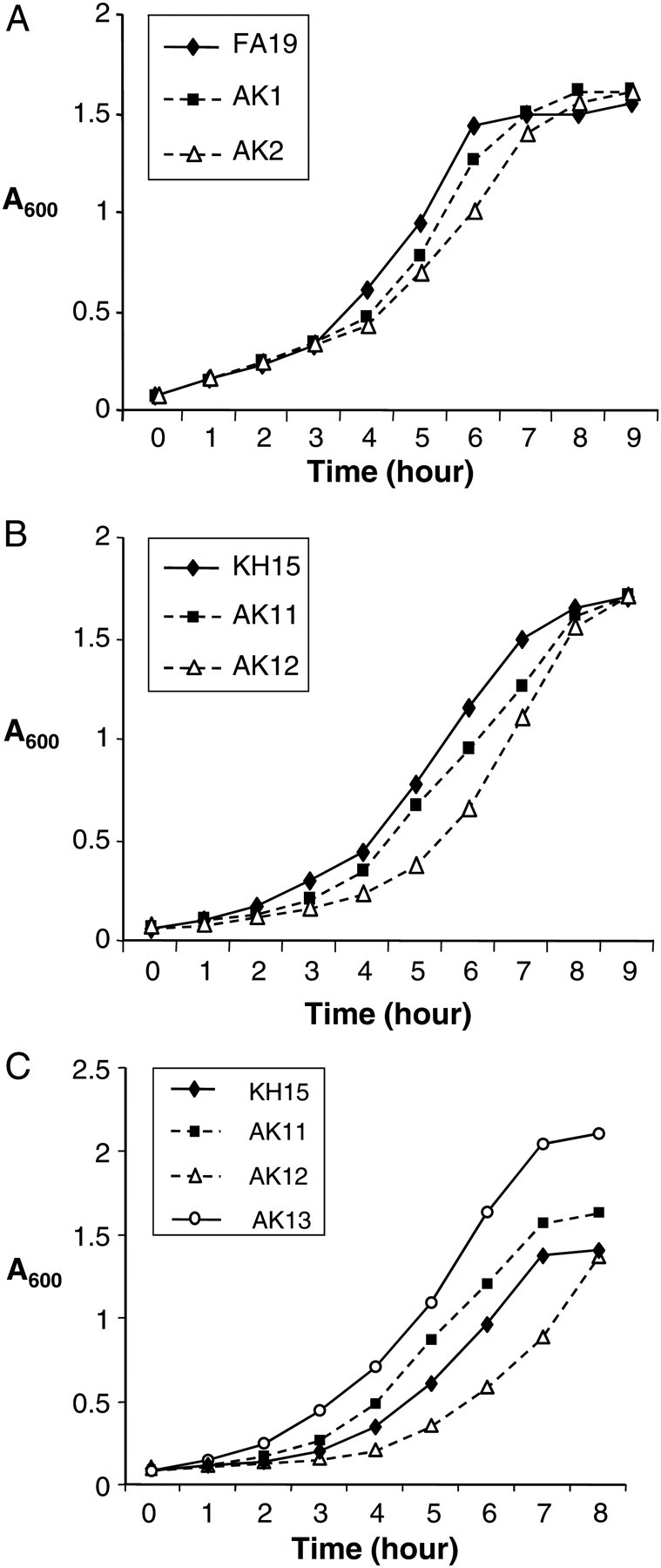
Figure 1.
Figure 1.
In vitro growth kinetics of wild-type and mutant strains. Representative growth curves for FA19SmR, AK1 (gyrA91/95), and AK2 (gyrA91/95, parC86) (A); KH15 (mtr−79), AK11 (mtr−79, gyrASer91Phe/95), and AK12 (mtr−79, gyrASer91Phe/95, parC86) (B); and KH15, AK11, AK12, and AK13 (gyrALeu91Phe/95, parC86) (C) when cultured separately in GC broth. Mutants AK2 and AK12, but not AK1 and AK11 grew more slowly than the respective parent strains. The in vivo–selected mutant AK13 grew significantly faster than mutants KH15, AK11, and AK12. Mutants were cultured separately in GC broth at a starting absorbance reading at 600 nm (A600) A600 = 0.070–0.075 and the A600 reading at each hour plotted. Experiments were performed 3 times per strain set.
Figure 2.
Figure 2.
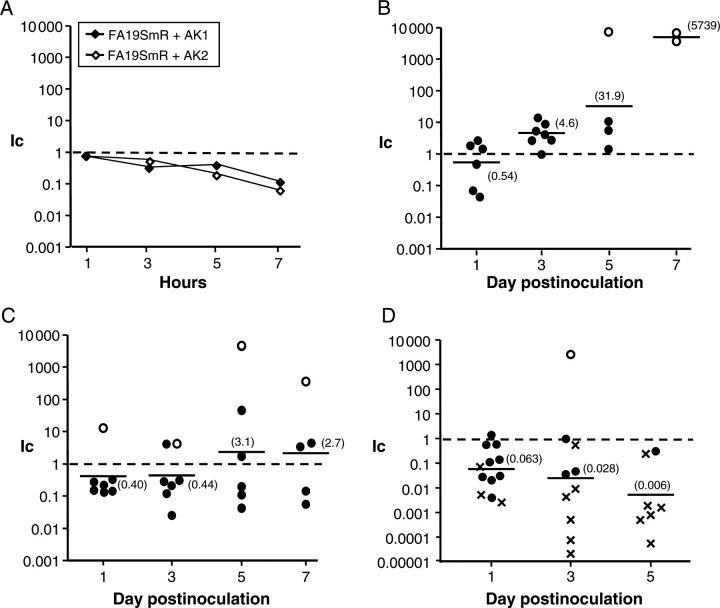
A gyrA91/95 mutant is more fit than the parent wild-type strain in vivo. Strains FA19SmR, AK1 and AK2 were cocultured in vitro and coinoculated into mice. The competitive index (Ic) for in vitro and in vivo competition experiments was calculated as described in the Methods. Ic values = 1.0 indicate no fitness difference; <1 = reduced fitness; and >1 = increased fitness. (A) Ic values for FA19SmR vs AK1 or AK2 when cocultured in GC broth. B–D show results from competitive murine infection experiments with FA19SmR vs AK1 (B), FA19SmR vs AK2 (C), and AK1 vs AK2 (D). Symbols represent the Ic for individual mice at each time point. AK1 but not AK2 bacteria showed a marked in vivo fitness advantage relative to FA19SmR, and consistent with this result, AK2 was highly attenuated compared with AK1 (D). In B and C, open circles correspond to mice from which only AK1 or AK2 bacteria were recovered. In D, cross hatches correspond to mice from which only AK1 was recovered. The open circle in D corresponds to a mouse from which only ciprofloxacin-resistant colonies were recovered. Results are combined data from 2 independent experiments.
Figure 3.
Figure 3.
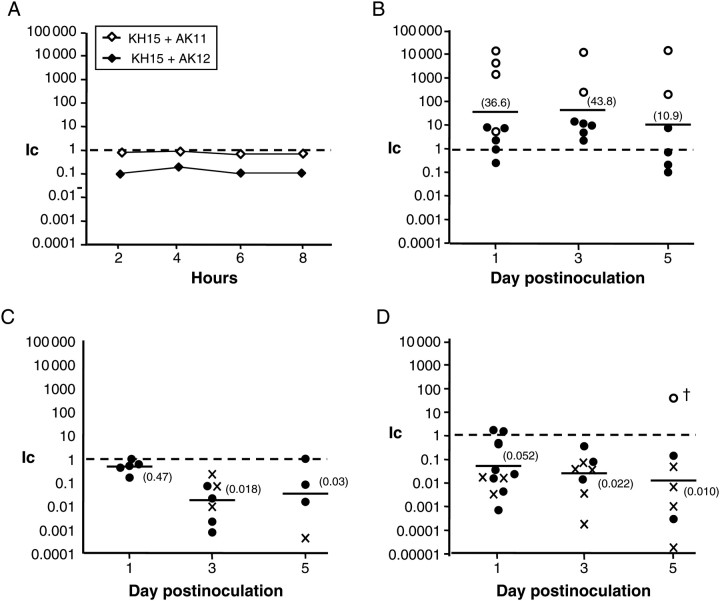
The mutant gyrA91/95 allele increases the in vivo fitness of an mtr mutant. In vitro and in vivo competition experiments were performed between strains KH15, AK11, and AK12 and competitive index (Ic) values were calculated as described in the legend for Figure 2. A, The Ic values for KH15 vs AK11 or AK12 when cocultured in GC broth. B–D, results from competitive murine infections with KH15 vs AK11(B), KH15 vs AK12 (C), and AK11 vs AK12 (D). AK11 bacteria showed a marked in vivo fitness advantage relative to the mtr mutant parent strain KH15 early in infection. In contrast, AK12 was attenuated in vivo. This result is consistent with the increased fitness of AK11 over AK12 shown in D. In B, open circles correspond to mice from which only AK11 bacteria were recovered. In C, cross hatches refer to mice from which only KH15 bacteria were recovered. In D, cross hatches correspond to mice from which only AK11 colony-forming units were recovered. The open circle on day 5 in D corresponds to the mouse from which equal numbers of bacteria were recovered on GC media with streptomycin (Sm) and GC media with Sm and 2.0 ug/mL ciprofloxacin, as occurs with strain AK12. A ciprofloxacin-resistant isolate from this mouse was colony purified and later characterized as mutant AK13. All results are combined data from 2 independent experiments.

Comment in

References

    1. Hook EW, Handsfield HH. Gonococcal infections in the adult. In: Holmes KK, Mardh PA, Sparling PF, et al., editors. Sexually transmitted diseases. 3rd ed. 1999. pp. 451–66. New York: McGraw-Hill.
    1. Workowski KA, Berman S Centers for Disease Control and Prevention. Sexually transmitted diseases treatment guidelines, 2010. MMWR Recomm Rep. 2010;59:1–110. - PubMed
    1. Fleming DT, Wasserheit JN. From epidemiological synergy to public health policy and practice: the contribution of other sexually transmitted diseases to sexual transmission of HIV infection. Sex Transm Infect. 1999;75:3–17. - PMC - PubMed
    1. Ohnishi M, Golparian D, Shimuta K, et al. Is Neisseria gonorrhoeae initiating a future era of untreatable gonorrhea? Detailed characterization of the first strain with high-level resistance to ceftriaxone. Antimicrob Agents Chemother. 2011;55:3538–45. - PMC - PubMed
    1. Workowski KA, Berman SM. Sexually transmitted diseases treatment guidelines, 2006. MMWR Recomm Rep. 2006;55:1–94. - PubMed

Publication types