. 2012 Jun;194(12):3058-68.
doi: 10.1128/JB.06756-11. Epub 2012 Apr 6.

Myxococcus xanthus developmental cell fate production: heterogeneous accumulation of developmental regulatory proteins and reexamination of the role of MazF in developmental lysis

Affiliations

Myxococcus xanthus developmental cell fate production: heterogeneous accumulation of developmental regulatory proteins and reexamination of the role of MazF in developmental lysis

Bongsoo Lee et al. J Bacteriol. 2012 Jun.

Abstract

Myxococcus xanthus undergoes a starvation-induced multicellular developmental program during which cells partition into three known fates: (i) aggregation into fruiting bodies followed by differentiation into spores, (ii) lysis, or (iii) differentiation into nonaggregating persister-like cells, termed peripheral rods. As a first step to characterize cell fate segregation, we enumerated total, aggregating, and nonaggregating cells throughout the developmental program. We demonstrate that both cell lysis and cell aggregation begin with similar timing at approximately 24 h after induction of development. Examination of several known regulatory proteins in the separated aggregated and nonaggregated cell fractions revealed previously unknown heterogeneity in the accumulation patterns of proteins involved in type IV pilus (T4P)-mediated motility (PilC and PilA) and regulation of development (MrpC, FruA, and C-signal). As part of our characterization of the cell lysis fate, we set out to investigate the unorthodox MazF-MrpC toxin-antitoxin system which was previously proposed to induce programmed cell death (PCD). We demonstrate that deletion of mazF in two different wild-type M. xanthus laboratory strains does not significantly reduce developmental cell lysis, suggesting that MazF's role in promoting PCD is an adaption to the mutant background strain used previously.


Figures
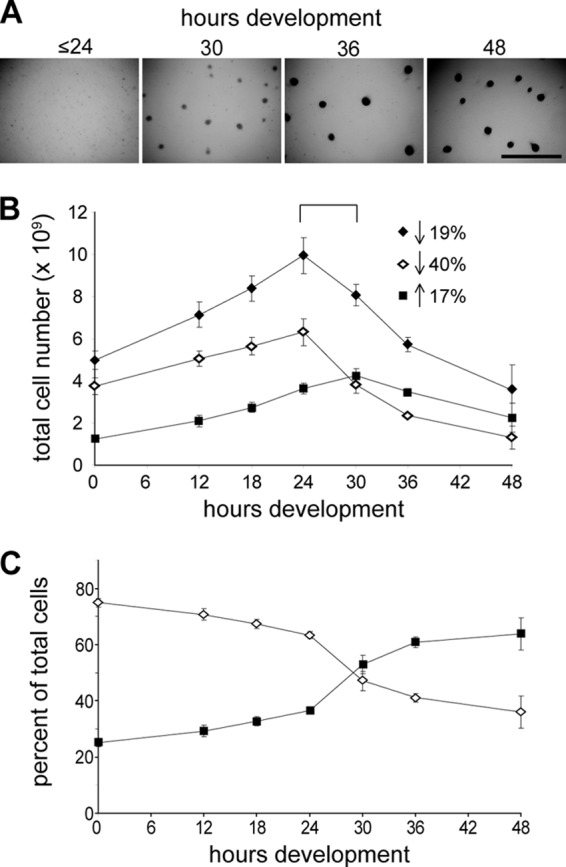
Fig 1
Fig 1
Enumeration of supernatant and sedimented cell fractions during development. (A) Fruiting body formation of wild-type DZ2 developing under submerged culture. Visible aggregation centers can be identified by 30 h of development which enlarge by 36 h and darken with the onset of sporulation (between 36 and 48 h). Scale bar, 2 mm. (B) The number of cells at the indicated hours of development in the sedimented (black squares) or supernatant (white diamonds) cell fractions after centrifugation at 50 × g for 5 min. The total cell number (black diamonds) is the sum of the cells enumerated in the sedimented and supernatant cell fractions. Data are shown as the average and associated standard deviations of three independent biological replicates. Arrows indicate the percent increase (up) or decrease (down) of the number of total, supernatant, or sedimented cells from 24 to 30 h of development. (C) Percentage of the total number of cells enumerated at each time point located in the sedimented (black squares) and supernatant (white diamonds) cell fractions.
Fig 2
Fig 2
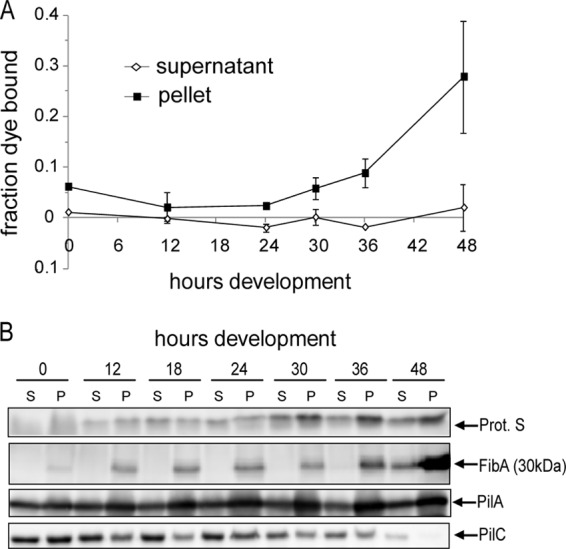
Cells in the pellet and supernatant fractions display distinct characteristics. (A) Assay for production of extracellular polymeric substances (EPS). Approximately 2.8 × 10⁸ cells from the dispersed supernatant (white diamonds) or sedimented (black squares) cell fractions harvested at the indicated hours were incubated with trypan blue. The fraction of dye bound to the cells was calculated by measuring the absorbance of the dye remaining in solution relative to a cell-free control. Data shown are the average and associated standard deviation of two independent biological experiments. (B) Immunoblot analysis of cells from the supernatant (S) and pellet (P; sedimented) fractions using antisera specific for protein S, the 30-kDa fragment of FibA, and the PilA and PilC components of the type IV pilus motility machinery. Each lane contains total cell lysate prepared from 4 × 10⁷ cells.
Fig 3
Fig 3
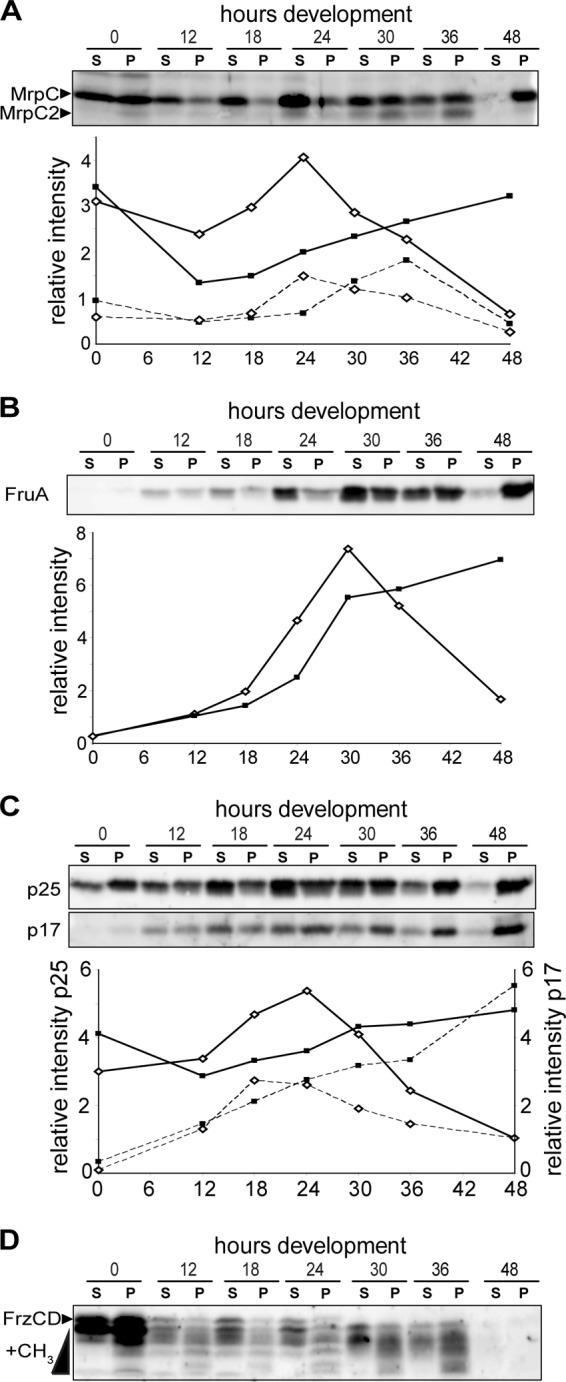
Cells in the pellet and supernatant fractions display distinct patterns of developmental regulator accumulation. Panels show immunoblot analysis of cells from the supernatant (S) and pellet (P; sedimented) fractions using antisera specific for MrpC (A), FruA (B), CsgA (C), and FrzCD (D). Each lane contains cell lysates generated from 4 × 10⁷ cells. For panels A to C, the respective relative intensity measurements for each band from the supernatant (white diamonds) and pellet (black squares) are shown underneath each blot. Representative intensity plots are shown, but similar patterns were observed in at least two biological replicates. Solid lines, MrpC (panel A) and CsgA p25 (panel C); dashed lines, MrpC2 (panel A) and C-signal (p17) (panel C). The relative signal intensities of p25 and p17 were quantified from different exposure times. (D) The methylated forms (+CH3) of FrzCD are the more rapidly migrating bands.
Fig 4
Fig 4
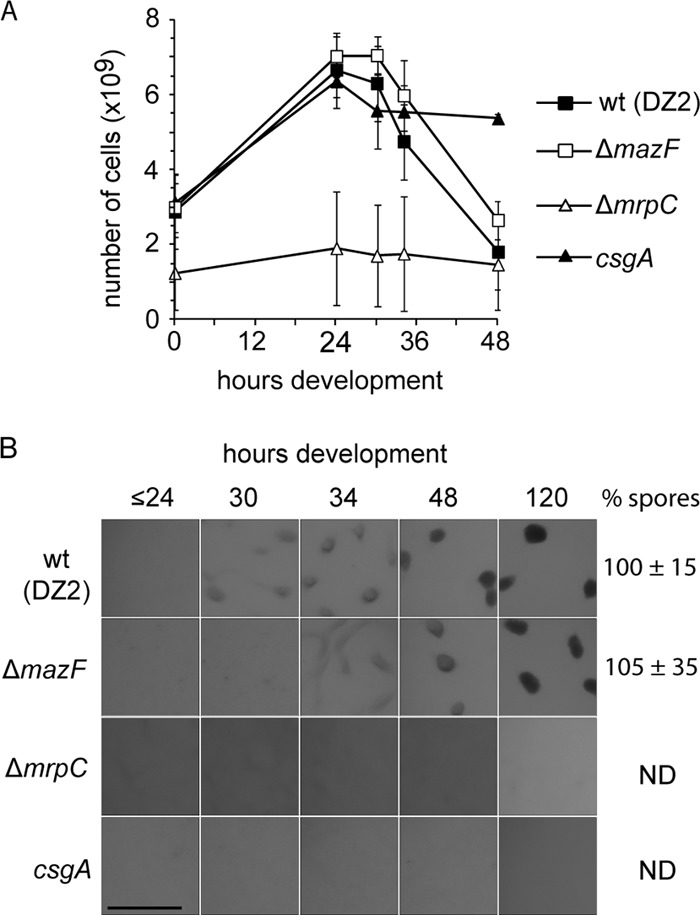
Deletion of mazF does not prevent developmental cell lysis in M. xanthus wild-type DZ2. (A) Developmental phenotype of the DZ2 wild-type (wt) and ΔmazF (PH1021), ΔmrpC (PH1025), csgA (PH1014) strains induced to develop under submerged culture for the indicated hours. The number of heat- and sonication-resistant spores was enumerated from cells harvested at 120 h of development and recorded as the percentage of wild-type spores (% spores). Numbers represent the average and associated standard deviation of three independent biological replicates. ND, not determined. Scale bar, 0.5 mm. (B) Enumeration of the total cell number during development. DZ2 wild-type, ΔmazF, ΔmrpC, and csgA cells from panel A were dispersed and enumerated at the indicated time points using an impedance cell counter. Data are the average and associated standard deviations from three independent biological experiments.
Fig 5
Fig 5
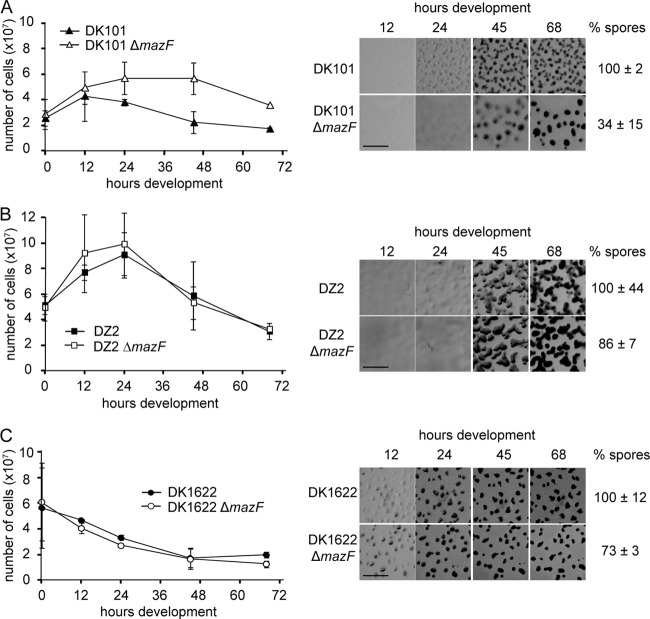
MazF is not necessary for developmental cell lysis in wild-type M. xanthus strains DK1622 and DZ2. (A to C) Total cell enumeration (left panels) and developmental phenotype (right panels) of the DK101 wild-type and DK101 ΔmazF (PH1024) (A), DZ2 wild-type and DZ2 ΔmazF (PH1021) (B), and DK1622 wild-type and DK1622 ΔmazF (PH1023) (C) strains. Left panels show total cell numbers of the developmental time course represented in the right panels. Data are the average and associated standard deviation of two independent biological experiments of duplicate samples. Right panels show developmental phenotypes of the indicated strains induced to develop on nutrient-limited CF agar. Pictures were recorded at the indicated times of development. Scale bar, 0.5 mm. The number of heat- and sonication-resistant spores harvested at 120 h of development was recorded as a percentage of wild-type spores. Numbers represent the average and associated standard deviation from two independent biological replicates of duplicate samples.
Fig 6
Fig 6
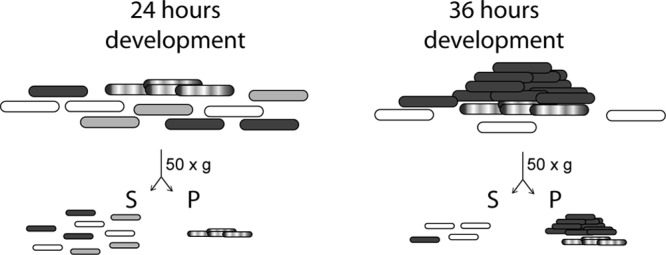
Regulation of developmental heterogeneity—a working model. Cells growing on surfaces in nutrient-rich medium or under starvation conditions can be can be segregated by centrifugation at 50 × g. The supernatant fraction (S) contains single or small groups of cells. The sedimented cell fraction (pellet, P) contains large cell groups. During early stages of development, prior to the formation of visible aggregation centers (e.g., 24 h of development), the sedimented fraction contains cell clusters (hatched cells) which accumulate no or low levels of the developmental regulators MrpC and FruA. The supernatant fraction may contain a mixed population of cells destined to follow different cell fates. Cells which accumulate at least MrpC and FruA (dark gray) are destined to aggregate into fruiting bodies, and cells which do not (white) are destined to become peripheral rods. The remaining cells (light gray) destined to lyse in a process that may involve MrpC but does not require MazF. Later during development (e.g., ≥36 h of development), aggregated cells (dark gray cell mounds) are in the sedimented (P) population. Cell clusters (hatched cells) may remain as a distinct population. Peripheral rods (white cells) remain in the supernatant, and lysed cells are absent.

References

    1. Berleman JE, Chumley T, Cheung P, Kirby JR. 2006. Rippling is a predatory behavior in Myxococcus xanthus. J. Bacteriol. 188:5888–5895 - PMC - PubMed
    1. Berleman JE, et al. 2011. FrzS regulates social motility in Myxococcus xanthus by controlling exopolysaccharide production. PLoS One 6:e23920 doi: - DOI - PMC - PubMed
    1. Bhandari P, Gowrishankar J. 1997. An Escherichia coli host strain useful for efficient overproduction of cloned gene products with NaCl as the inducer. J. Bacteriol. 179:4403–4406 - PMC - PubMed
    1. Black WP, Xu Q, Yang Z. 2006. Type IV pili function upstream of the Dif chemotaxis pathway in Myxococcus xanthus EPS regulation. Mol. Microbiol. 61:447–456 - PubMed
    1. Black WP, Yang Z. 2004. Myxococcus xanthus chemotaxis homologs DifD and DifG negatively regulate fibril polysaccharide production. J. Bacteriol. 186:1001–1008 - PMC - PubMed

Publication types

MeSH terms