


A comparison of facial emotion processing in neurological and psychiatric conditions
- PMID: 22493587
- PMCID: PMC3318183
- DOI: 10.3389/fpsyg.2012.00098
A comparison of facial emotion processing in neurological and psychiatric conditions
Abstract
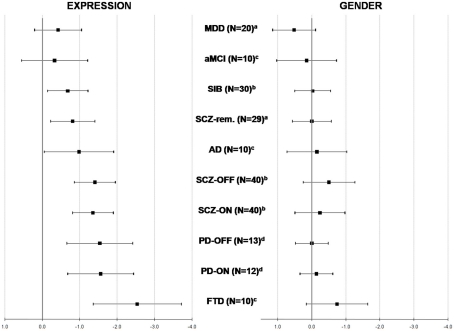
Patients suffering from various neurological and psychiatric disorders show different levels of facial emotion recognition (FER) impairment, sometimes from the early phases of the disease. Investigating the relative severity of deficits in FER across different clinical and high-risk populations has potential implications for the diagnosis and treatment of these diseases, and could also allow us to understand the neurobiological mechanisms of emotion perception itself. To investigate the role of the dopaminergic system and of the frontotemporal network in FER, we reanalyzed and compared data from four of our previous studies investigating FER performance in patients with frontotemporal dysfunctions and/or dopaminergic system abnormalities at different stages. The performance of patients was compared to the performance obtained by a specific group of matched healthy controls using Cohen's d effect size. We thus compared emotion and gender recognition in patients with frontotemporal dementia (FTD), amnestic mild cognitive impairment (aMCI), Alzheimer's disease (AD) at the mild dementia stage, major depressive disorder, Parkinson's disease treated by l-DOPA (PD-ON) or not (PD-OFF), remitted schizophrenia (SCZ-rem), first-episode schizophrenia treated by antipsychotic medication (SCZ-ON), and drug-naïve first-episode schizophrenia (SCZ-OFF), as well as in unaffected siblings of patients with schizophrenia (SIB). The analyses revealed a pattern of differential impairment of emotion (but not gender) recognition across pathological conditions. On the one hand, dopaminergic medication seems not to modify the moderate deficits observed in SCZ and PD groups (ON vs. OFF), suggesting that the deficit is independent from the dopaminergic system. On the other hand, the observed increase in effect size of the deficit among the aMCI, AD, and FTD groups (and also among the SIB and SCZ-rem groups) suggests that the deficit is dependent on neurodegeneration of the frontotemporal neural networks. Our transnosographic approach combining clinical and high-risk populations with the impact of medication provides new information on the trajectory of impaired emotion perception in neuropsychiatric conditions, and on the role of the dopaminergic system and the frontotemporal network in emotion perception.
Keywords: facial expression recognition; neurology; psychiatry; social cognition; transnosographic approach.
Figures
References
-
- Aleman A., Kahn R. S. (2005). Strange feelings: do amygdala abnormalities dysregulate the emotional brain in schizophrenia? Prog. Neurobiol. 77, 283–298 - PubMed
-
- American Psychiatric Association. (1994). Diagnostic and Statistical Manual of Mental Disorders, 4th Edn Washington, DC: American Psychiatric Association
LinkOut - more resources
Full Text Sources
Miscellaneous
